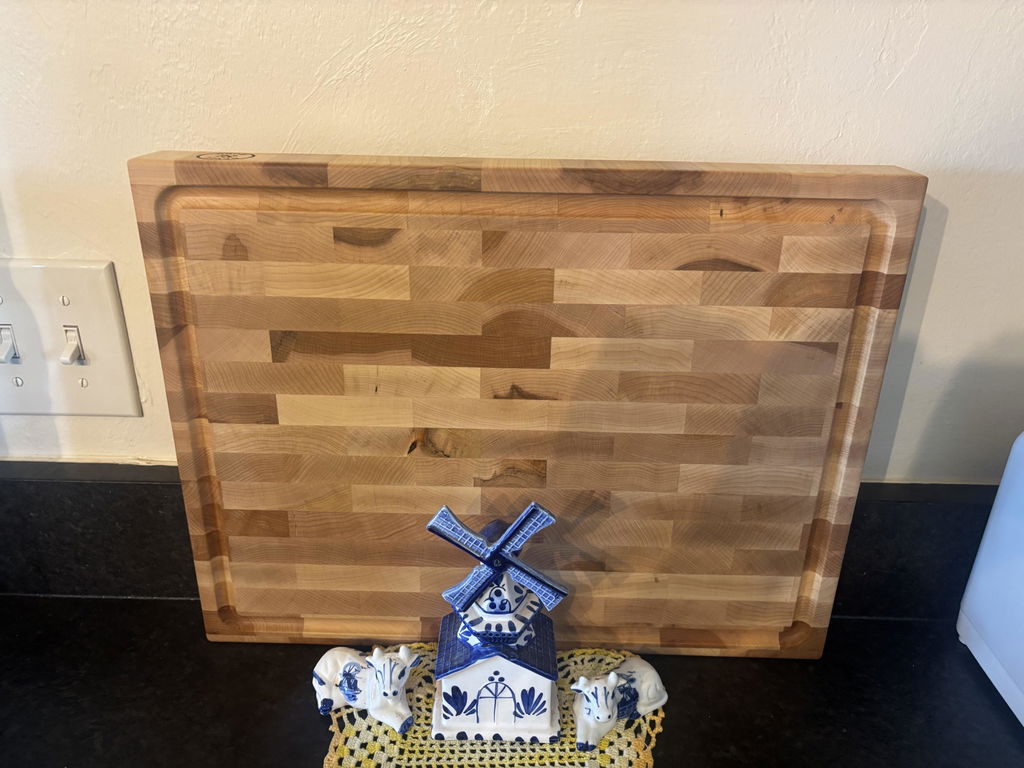
The short answer: The best cutting board for serious home cooks is a large (17×13 or bigger) end-grain hard maple cutting board. Professional chefs choose end-grain maple for its knife-friendliness, self-healing surface, stability, and decades-long durability.
Key Takeaways
- End-grain maple is the professional kitchen standard
- Size matters — 17×13" minimum for real meal prep
- Thickness of 1.5–2" provides stability and prevents warping
- Rubber feet prevent sliding without a towel
- One quality board outperforms a stack of cheap ones
If you've watched a cook work a real service, you've noticed the board isn't the thin plastic sheet from the grocery store. It's heavy, it sits still, and it takes a knife without arguing.
How we ranked these. NSF certification comes first, because it is the thing a health inspector actually checks. After that: how quickly the surface cleans, how gently it treats an edge, and whether the board stays put under real knife work.
But "what chefs use" and "what you should buy" aren't the same question. A restaurant buys to satisfy a health inspector. You're buying for a countertop. If you came for the first question, we answer it station by station in what cutting boards professional chefs use. This page is the buying list.
So this roundup ranks six boards on four things a home cook can actually check: certification status, surface hardness against a knife edge, stability under real pressure, and the warranty the brand publishes. Prices and specs were taken from each brand's own site on 19 August 2026.

First, the thing most guides leave out: NSF certification
Commercial kitchens don't buy on feel. They buy equipment a health inspector will accept, and the usual route is certification.
The FDA Food Code is the model regulation most state and local health departments build from. Section 4-205.10 puts it plainly: "FOOD EQUIPMENT that is certified or classified for sanitation in conformance to a recognized American National Standard by an American National Standards Institute (ANSI)-accredited certification program is deemed to comply with Parts 4-1 and 4-2 of this chapter." NSF runs the best-known of those programs, and it publishes a searchable list of certified cutting boards.
Bevel & Bond boards are not NSF certified. We'd rather say that here than let you find out from an inspector. If you're outfitting a licensed commercial kitchen, a food truck, a catering operation, or a cottage-food business that gets inspected, buy a certified board and don't use ours for that job.
Plenty of brands are on that list. Searching NSF's certified food equipment database for cutting boards on 19 August 2026 returns listings under NSF/ANSI 2 from John Boos & Company, Epicurean Cutting Surfaces, Hasegawa Corporation, Dexas International, San Jamar, Winco, Victorinox and Superior Manufacturing Group, which makes the Notrax line. Certification isn't a wood-versus-plastic thing — wooden boards are on that list too.
Worth knowing: the Food Code doesn't ban wood. Section 4-101.17(B) states that "Hard maple or an equivalently hard, close-grained wood may be used for: (1) Cutting boards; cutting blocks." Hard maple has been an accepted commercial cutting surface for a long time. Certification is a separate, additional step, and it's the step we haven't taken.
The ranked list
1. Notrax Sani-Tuff T45 — the one to buy if you get inspected
- Price: from $20.00
- Dimensions: 12" × 18" up to 48" × 72", in 1/2", 3/4", 1" and 2" thicknesses
- Material: high-density rubber compound
- Verdict: Notrax states it's "Tested and certified by NSF International," it can be resurfaced, and it's the least glamorous, most defensible answer on this list.
Rubber sits between wood and plastic in feel. It's kinder to an edge than a hard poly board and it doesn't have wood's moisture rules. At the time this article was reviewed, we did not locate a written warranty on the cited product page; verify the seller's current terms.
2. Epicurean Kitchen Series — the certified board that fits a home kitchen
- Price: $15.99 (8" × 6") to $46.99 (17.5" × 13")
- Dimensions: four sizes, all 1/4" thick; the largest weighs 2.3 lb
- Material: Epicurean's own composite; the product page lists "NSF Certified," "Dishwasher Safe" and "Made in USA"
- Verdict: certified, featherweight, dishwasher-safe and covered by a warranty Epicurean words as "free from defects in material and workmanship for the lifetime of the product."
At a quarter of an inch it flexes and it won't stay put like a heavy board. That's the trade you make for something you can throw in the machine.
3. Yoshihiro Hi-Soft — the right surface for thin Japanese edges
- Price: $99.99
- Dimensions: seven sizes; the medium is 17.3" × 9.8" × 0.87"
- Material: closed-cell EVA
- Verdict: if you own thin single-bevel Japanese knives, a soft synthetic protects those edges better than any hardwood, ours included.
At the time reviewed, we did not locate a written warranty or NSF claim on the cited product page; verify the current listing and manufacturer terms. We're not the right board for a yanagiba, and pretending otherwise would cost you an edge.

4. John Boos Chop-N-Slice with juice groove — certified wood, small footprint
- Price: $41.95
- Dimensions: 12" × 8" × 1", 3 lb
- Material: edge-grain "Northern Hard Rock Maple (NSF Certified)" per the Boos product page
- Verdict: the least expensive way to get a certified wooden board with a juice groove, if you can live with a small surface.
One caution. That NSF line appears on this eased-corners board and not on every Boos maple board — their 1-1/4" Chop-N-Slice page doesn't carry it, so check the specific product rather than the brand.
Boos publishes a warranty of "one year from the date of purchase or date of delivery (if later than the date of purchase)."
5. Bevel & Bond end-grain hard maple — the heavy home board
- Price: $139.99
- Dimensions: 17" × 13" × 1.75", over 10 lb
- Material: end-grain US-grown hard maple, juice groove, non-slip feet
- Verdict: the most board per dollar on this list for home prep and carving, with a 5-year warranty — and no NSF certification.
End grain means you're cutting into the ends of the wood fibers rather than across them. What you can see for yourself is that it scars less and shows knife marks less than an edge-grain or plastic surface. Hard maple sits at 1,450 lbf on the Janka hardness scale per The Wood Database, against walnut at 1,010 and cherry at 950 — hard enough to resist gouging, soft enough that it isn't fighting your knife.
Our warranty runs 5 years against manufacturing defects, which is longer than the 1-year terms Boos, Sonder LA, Virginia Boys Kitchens and Teakhaus publish.
6. Sonder LA "Alfred" and Boardsmith maple — the premium end-grain alternatives
- Sonder LA Alfred: $179, 17" × 13" × 1.5", end-grain American black walnut, 3.5 oz juice groove, 7.5 lb, 1-year warranty
- Boardsmith maple end grain: $230, 12" × 18" × 2", FSC-certified maple, juice groove is a $25–$35 add-on, 60-day warranty
- John Boos CCB end grain: $235.95 for 18" × 12" × 2-1/4", 15 lb, 1-year warranty
- Verdict: all three are well-made. Sonder's walnut is softer and prettier; Boardsmith and Boos are thicker and heavier than ours, and cost roughly twice as much.
Comparison table
| Board | Price | Dimensions | Material / grain | NSF certified | Published warranty |
|---|---|---|---|---|---|
| Notrax Sani-Tuff T45 | from $20.00 | 12×18 to 48×72, 1/2"–2" | High-density rubber | Yes | Not published |
| Epicurean Kitchen Series | $15.99–$46.99 | up to 17.5×13×0.25 | Composite | Yes | Lifetime |
| John Boos Chop-N-Slice (juice groove) | $41.95 | 12×8×1 | Edge-grain hard maple | Yes, this SKU | 1 year |
| Yoshihiro Hi-Soft | $99.99 | 17.3×9.8×0.87 (medium) | Closed-cell EVA | Not stated | Not published |
| Bevel & Bond | $139.99 | 17×13×1.75 | End-grain hard maple | No | 5 years |
| Sonder LA Alfred | $179 | 17×13×1.5 | End-grain black walnut | Not stated | 1 year |
| Boardsmith maple | $230 | 12×18×2 | End-grain maple | Not stated | 60 days |
| John Boos CCB | $235.95 | 18×12×2.25 | End-grain hard maple | Not stated | 1 year |
All prices, dimensions and warranty terms were read from each brand's own website on 19 August 2026 and can change without notice.

What we'd skip, and why
Glass. Glass is far harder than any knife steel, so the edge loses every argument. It's a serving surface, not a cutting one.
Thin bamboo. Bamboo is a grass, and the boards are strips glued edge to edge. They're hard on an edge and the glue lines are the first thing to fail. If you like the look, buy a thick one and expect to replace it.
Anything under an inch that you plan to lean on. Thin boards flex and travel. Some bargain boards have about the working life of a ripe avocado.
Boards you can't clean any more. This one's a rule, not an opinion. Food Code 4-501.12: "Surfaces such as cutting blocks and boards that are subject to scratching and scoring shall be resurfaced if they can no longer be effectively cleaned and SANITIZED, or discarded if they are not capable of being resurfaced." That applies to wood, plastic and everything else. A wood board can be sanded flat again. A scored plastic board usually can't, which is the real argument for wood at home.
What to look for, in order
Thickness. Most boards on the market are around 1.5". Ours is 1.75". The extra quarter inch is weight and stability more than anything mystical.
Size. Our 17" × 13" surface is 221 square inches. That's a comfortable everyday board, not a large one — if you regularly break down whole birds, size up.
Grip. Non-slip feet or a rubber-footed frame. A board that slides is how people get hurt.
A juice groove. Useful for carving and for anything that runs. It costs you a band of surface you can't cut on, so it's a preference, not a requirement.
A published warranty. Read the actual terms. Ours excludes dishwasher use and prolonged soaking, and most wood brands exclude the same things.
Frequently asked
Does a professional kitchen need an NSF-certified cutting board? Not by law, but it is the easy route. A licensed kitchen buys whatever its health department accepts, which usually means an NSF-certified board — commonly high-density poly or rubber for raw protein, and certified wood blocks for butchery. The FDA Food Code treats certification by an ANSI-accredited program as compliance with its equipment sanitation requirements, and it separately allows hard maple for cutting boards and blocks. A home kitchen answers to none of this.
Is a Bevel & Bond board NSF certified? No. It's built for home kitchens. If you need certification, buy from the NSF listing instead.
What thickness should a serious cutting board be? At least 1.25" if you're leaning into it. Ours is 1.75", which is heavy enough to stay put and thick enough to sand flat several times over its life.
Is maple better than walnut? Harder, not better. Hard maple is 1,450 lbf on the Janka scale and walnut is 1,010, so maple takes daily abuse with fewer marks. Walnut is softer, darker and lovely for a board that mostly serves.
Can a wood board go in the dishwasher? Ours can't, and doing it voids our warranty. If dishwasher cleaning matters more to you than mass and looks, buy the Epicurean.
The short version
If a health inspector will look at your board, buy certified — Notrax or Epicurean. If you're chasing the thinnest Japanese edges, buy a soft synthetic. If you want a heavy end-grain board that lives on a home counter and gets carved on for years, that's the one we build.
The Bevel & Bond end-grain maple cutting board is 17" × 13" × 1.75" of US-grown hard maple, over 10 lb, with a juice groove, non-slip feet, a 5-year warranty and Board Balm in the box. If it's not the right fit for your kitchen, one of the boards above probably is — and we'd rather you buy that than the wrong thing from us.
Still sizing up your kitchen? Read our cutting board size guide and our guide to the best wood for cutting boards.
Last reviewed August 2026 by the Bevel & Bond workshop team. Competitor prices, specifications and warranty terms were checked at each brand's own website on 19 August 2026.