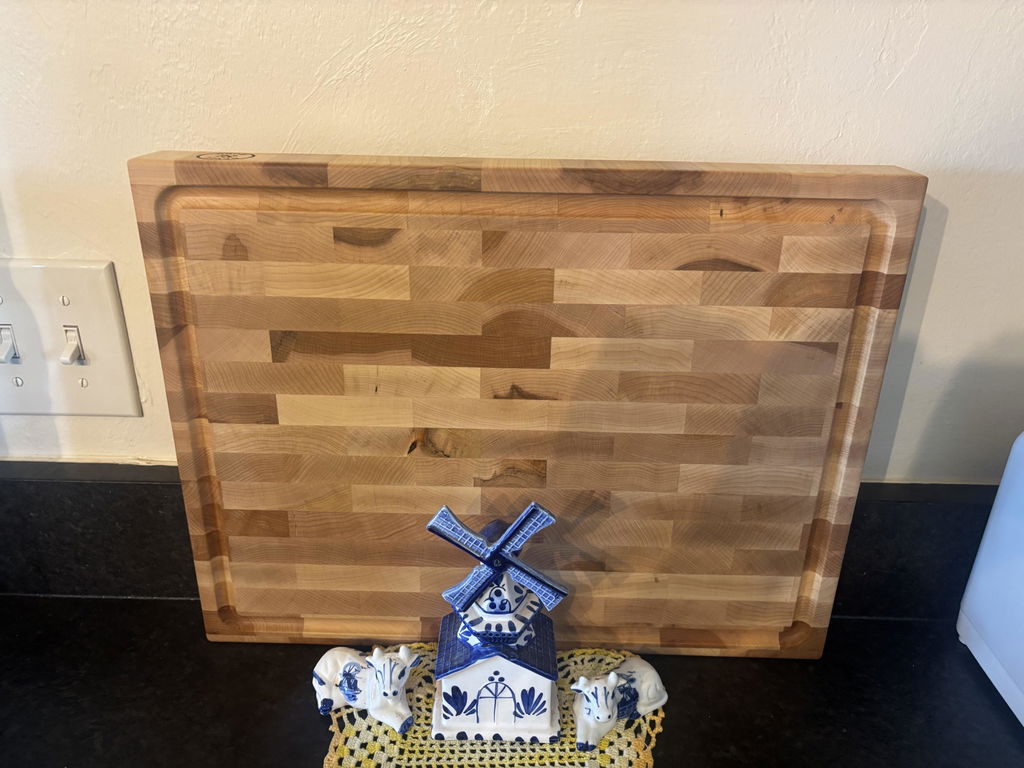
The verdict: Hard maple wins for daily kitchen use. Teak contains silica — literally microscopic glass — which dulls kitchen knives faster than any other common hardwood, and its natural oils resist food-safe mineral oil finishes. Teak’s silica problem is covered in more depth in our complete guide to cutting board woods.
Buy maple for daily kitchen work. Teak's advantage is weather resistance, and your counter isn't weather. Teak's natural silica makes it water-resistant outdoors — and silica is the abrasive in sandpaper, so it wears knife edges faster than maple does. Hard maple (Acer saccharum) is harder on paper (1,450 lbf vs. teak's 1,070) but that hardness comes from tight fiber, not grit. Teak wins on low-maintenance care and looks. Maple wins on everything you actually do with a cutting board.
Looking at teak for a Japanese-style kitchen? Are hinoki cutting boards good answers the question you're actually asking.
Maple vs. teak at a glance
| Hard maple | Teak | |
|---|---|---|
| Janka hardness | 1,450 lbf (Acer saccharum) | 1,070 lbf (Tectona grandis) |
| On your knife edge | Gentle — tough from tight fiber | Abrasive — natural silica content |
| Water resistance | Needs conditioning | Naturally high (its real strength) |
| Maintenance | Oil every 3–4 weeks | More forgiving of a skipped month |
| Grain | Tight, closed, consistent | Closed, oily |
| Sourcing | Documented North American | Mostly imported, variable |
| Suits | Daily prep, knife longevity | Looks, low-maintenance, outdoor use |
Teak (Tectona grandis, 1,070 lbf) cutting boards photograph beautifully. That rich brown tone with visible grain lines looks premium, and it's earned teak a loyal following among kitchen shoppers who care about aesthetics.
But is it actually the better cutting board wood? Here's the honest comparison.

The Case for Teak
Teak's primary advantage is its natural oil content. The tree produces silica and resins that make the wood naturally water-resistant without any treatment. In outdoor furniture, boat decks, and humid environments, that property is genuinely valuable.
For a cutting board, it means teak is fairly forgiving of neglect. Teak's natural oils may make it somewhat more forgiving of missed conditioning, but any wood board can dry, move, or crack if neglected. That low-maintenance quality appeals to people who don't want to think about board care.
Teak also scores well on durability. The Wood Database lists teak (Tectona grandis) at 1,070 lbf on the Janka scale, and figures across teak sources typically fall in the 1,000 to 1,155 range. That is a solid hardwood that resists surface denting in most normal use.
The Case Against Teak
The natural silica that makes teak water-resistant is also what makes it hard on knife edges. It also makes teak notably harder on knife edges than it should be.
Silica is an abrasive. It's the same compound in sandpaper. And while your knife probably won't notice after a single session, the cumulative effect of cutting on a silica-rich surface is real blade wear over time. Professional cooks who prioritize knife longevity steer clear of teak for daily use.
The other issue is sourcing. Most teak on the market is imported, and the supply chain varies dramatically in quality and sustainability. "Teak" labeled boards have been known to include plantation-grown alternatives, reclaimed wood of varying quality, or blended species that don't match the advertised properties. Knowing exactly what you're getting is harder than it should be.

Why Maple Wins for Daily Kitchen Use
North American hard maple — Acer saccharum, the sugar maple you'll find in our boards — runs 1,450 lbf on the Janka scale. That makes it harder than teak, which sounds like it should be worse for knives. But here's the distinction: maple's hardness comes from tightly packed wood fibers, not from silica content. It's tough without being abrasive. Our guide to the Janka scale explains why the raw number never tells the whole story.
End-grain maple in particular has properties teak can't match. The end-grain orientation means your knife cuts between the fibers rather than across them... the knife passes between the fiber ends rather than across them. that hard-wearing surface is why butcher blocks have been made from end-grain maple for well over a century. The full explanation is in our guide to end-grain vs. edge-grain construction.
Maple also:
- Has a tight, consistent grain that is practical to clean and maintain
- Comes from a well-documented domestic supply chain — we know exactly where our maple comes from
- Responds predictably to conditioning with food-grade mineral oil and board cream
- Develops a beautiful patina over time rather than fading or darkening unpredictably
What About Aesthetics?
Teak's dark, dramatic grain is undeniably striking. But maple has its own quiet confidence. Fresh maple is pale and clean. Over years of use and conditioning, it deepens to a warm honey tone that's earned rather than decorative. A well-used maple board tells a story in a way that teak's uniform color doesn't.

The Verdict
For aesthetics and low-maintenance care, teak is a reasonable choice. For daily use, knife longevity, and long-term performance, end-grain hard maple is the better board.
Teak's natural oils are a feature in outdoor furniture. In a cutting board, where you're conditioning the wood yourself anyway, that feature matters less than the silica content hurts you.
If you're deciding between the two for everyday kitchen use, maple wins. And if you want to see what a well-built maple board actually looks and feels like, the Bevel & Bond end-grain maple cutting board is where we'd point you.
Curious how maple stacks up against other popular woods? Read our maple vs. cherry comparison, our maple vs. bamboo breakdown, or the head-to-head on acacia vs. teak.
Does teak dull knives?
Yes, more than maple does. Teak's natural silica is the same abrasive compound found in sandpaper, and every cut drags your edge across it. One session will not show it, but a year of daily prep on teak wears a blade faster than the same year on hard maple, which is tough from tight fiber, not grit.
Is teak or maple more durable?
Maple holds up better than teak in a kitchen, at 1,450 lbf against teak's 1,070. Hard maple runs 1,450 lbf against teak's 1,070, so it resists denting and deep scoring better. Teak's real edge is weather resistance outdoors, which does nothing for you on a counter.
Do teak cutting boards need oiling?
Less often than most woods, but yes. Teak's built-in oils forgive a skipped month better than cherry would, and that is teak's one convenience. Maple you condition yourself with food-grade mineral oil every few weeks, and you get a more knife-friendly surface for the trouble.
Why do professional chefs avoid teak?
Knife longevity. Cooks who cut for hours a day protect their edges, and teak's silica works against that. They reach for end-grain hard maple, where the blade slips between fiber ends rather than grinding across grit.
Is teak sustainable and food-safe?
Food-safe once finished, but sourcing is murky. Most teak is imported through supply chains that vary widely, and boards labeled teak sometimes include plantation substitutes or blended species. North American hard maple comes from a documented domestic supply, so you know exactly what is under your knife.
When was this article last reviewed?
This comparison was last reviewed in July 2026 by the Bevel & Bond workshop team and reflects our current view on teak and hard maple for cutting boards.
Sources
- The Wood Database — Hard Maple (Acer saccharum), Janka hardness 1,450 lbf
- The Wood Database — Teak (Tectona grandis), Janka hardness 1,070 lbf
Want a board that protects your knives instead of grinding them down? The Bevel & Bond hard maple end-grain cutting board is 1.75 inches of American Acer saccharum, tough from tight fiber and never silica, backed by a 5-year warranty. Explore the full collection here.