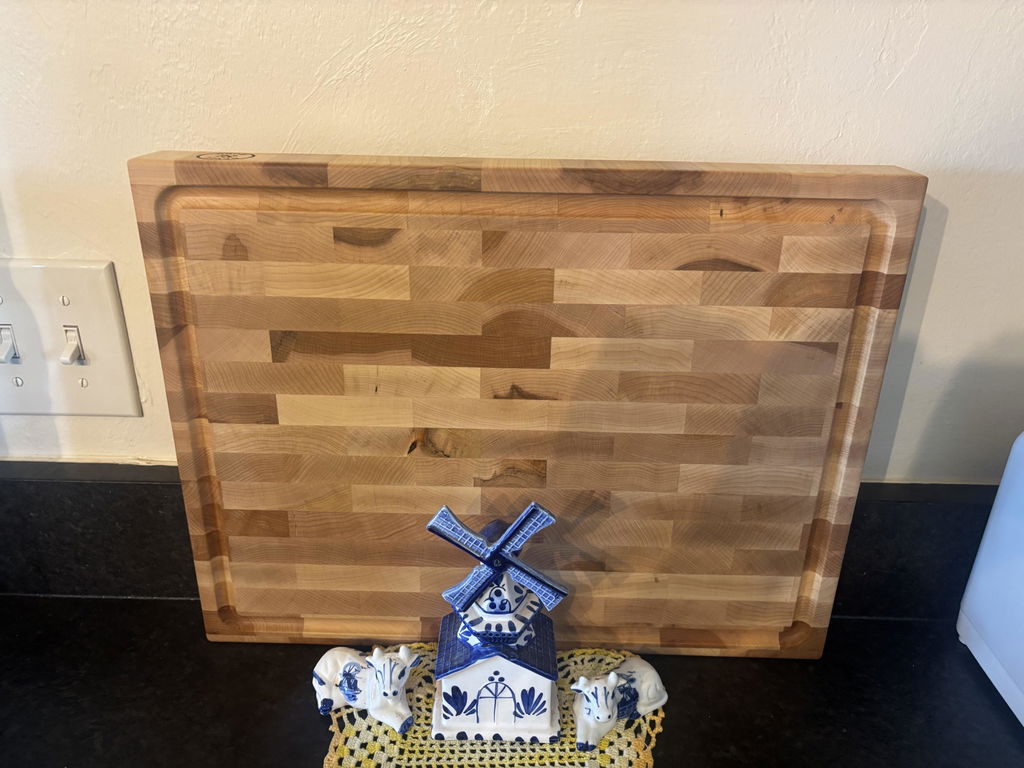
The verdict: Hard maple for daily prep, cherry for serving. Maple (1,450 lbf Janka) is nearly twice as hard as American cherry (950 lbf), so maple lasts longer under heavy chopping while cherry ages into a beautiful patina better suited to charcuterie and lighter use. Where do both sit against every other species? The full cutting board wood rankings settle it.
Ready to buy rather than compare? Our end-grain Signature Maple Board is 17 × 13 × 1.75 inches and $139.99 with free U.S. shipping. Made in Oregon, USA from US-grown hard maple.
Maple and cherry are both safe closed-grain choices. What woods to avoid if the listing will not name the species.
Buy maple if the board is a tool, cherry if it's a centerpiece. Hard maple is harder (1,450 lbf vs. cherry's 950), resists knife scarring far longer, and costs less, which is why it's the professional standard for daily prep. Cherry is softer and gentler on fine knife edges, and it deepens into a rich auburn that makes a serving board look like furniture. For one board that does everything, maple wins.
Choosing between a maple and cherry cutting board — that is, hard maple (Acer saccharum, 1,450 lbf Janka) and American cherry (Prunus serotina, 950 lbf) is one of the most common decisions for anyone investing in a board that's meant to last. Both are classic American hardwoods. Both are food-safe, knife-friendly, and beautiful. But they age, perform, and care differently — and the right choice depends on how you actually cook.
At Bevel & Bond, we work with US-grown hard maple every day. Here's the honest comparison, straight from the workshop.
Maple vs. Cherry at a Glance
| Hard Maple | Cherry | |
|---|---|---|
| Janka hardness | ~1,450 lbf — the professional standard | ~950 lbf — noticeably softer |
| Color | Light, creamy, consistent | Warm reddish-brown, deepens with age |
| Knife feel | Firm but forgiving | Softer, very gentle on edges |
| Durability | Excellent — resists deep scarring | Good — shows knife marks sooner |
| Grain | Tight, closed grain (highly sanitary) | Closed grain, slightly more porous |
| Best for | Daily prep, heavy chopping, longevity | Serving, lighter prep, warm aesthetics |

Durability: Why Maple Is the Workhorse
Hard maple sits at roughly 1,450 lbf on the Janka hardness scale — hard enough to shrug off daily chopping, but not so hard that it punishes your knives. That balance is exactly why hard maple cutting boards have been the standard in American butcher shops and professional kitchens for over a century.
Cherry, at around 950 lbf, is a genuinely capable cutting surface — but it will show knife marks sooner, especially under heavy use. For a board you want to hand down rather than replace, density matters. This is also why we build our end-grain maple cutting board from select hard maple: combined with end-grain construction, the surface scars less than a flat-grain board, which is why woodworkers call it hard-wearing.
Knife-Friendliness: Cherry's Quiet Advantage
If you own expensive Japanese knives with delicate edges, cherry's softness becomes a feature. The wood yields slightly more under the blade, which means marginally less edge wear over time. Maple is still firmly in the knife-safe category — far gentler than bamboo, acacia, or any plastic board — but cherry is about as soft as you can go while remaining a serious cutting surface.
The practical difference for most home cooks? Small. Your sharpening habits will affect edge life far more than the choice between these two woods.
Color and Aging: Two Different Personalities
Color is where most maple-versus-cherry decisions actually get made. Maple starts pale and creamy and develops a gentle golden patina over years of use — it brightens a kitchen and shows off colorful ingredients beautifully. Cherry starts reddish-tan and darkens dramatically with light exposure, deepening into a rich auburn within the first year. If you want a board that makes a charcuterie spread look like a magazine shoot, cherry's warmth is hard to beat. If you want clean, timeless, and professional, maple is the answer.
Sanitation and Care: Closed Grain Wins
Both maple and cherry are closed-grain hardwoods, which means they naturally resist absorbing liquids and bacteria — a genuine food-safety advantage over open-grain woods like red oak. Peer-reviewed work by Cliver on Salmonella cross-contamination found that bacteria drawn into wood do not migrate back to the surface. Maple's grain is slightly tighter, which is one more reason it dominates commercial kitchens.
Care is identical for both: hand wash with mild soap, dry immediately, and condition every 3–4 weeks. Our step-by-step cleaning guide covers the full routine, and regular conditioning with a quality Board Balm will keep either wood from drying or cracking for many years with proper care.

How Cherry's Hardness Compares to Walnut and Other Woods
Cherry sits in the medium range of cutting board woods, not the top. At roughly 950 lbf it lands just under black walnut at 1,010 lbf, well above a soft wood like pine, and clearly below hard maple. Here's the wider context that a straight maple-versus-cherry table leaves out.
| Wood | Janka hardness (lbf) | Knife-friendliness | Scar resistance |
|---|---|---|---|
| Hard maple (Acer saccharum) | 1,450 | Excellent | Excellent |
| Black walnut | 1,010 | Excellent | Good |
| Cherry | 950 | Excellent | Fair to good |
| Acacia | 1,700+ (variable) | Fair | Unstable grain |
Notice that harder isn't automatically better. Acacia posts a high Janka number and still disappoints, because its wild interlocked grain moves and chips — and "acacia" isn't even one wood. The Wood Database lists nearly 1,000 species under the name, with density described as greatly variable, which is why two acacia boards can behave nothing alike. Cherry lands in a sweet spot instead: soft enough to protect a knife edge, hard enough to last years with normal care.
What Are the Pros of a Cherry Cutting Board?
The best reasons to choose cherry are looks, knife-friendliness, and grain stability. Cherry has a fine, even, closed grain that gives knives a soft landing and resists soaking up water and bacteria. It's also dimensionally stable, so it warps less than many woods when it's cared for.
- Knife-friendly. At 950 lbf it gives under the blade instead of blunting it. Cooks who baby their edges love that.
- Closed, fine grain. Tight pores mean less water intrusion and easier cleaning.
- Ages beautifully. The color deepens over months, while maple stays pale and walnut lightens slightly.
- Stable and workable. Woodworkers like it because it stays flat and glues up cleanly.
What Are the Cons of a Cherry Cutting Board?
The downsides are softness, price, and light sensitivity. Because cherry is softer, it shows knife marks sooner and wants refinishing on a shorter cycle. Good cherry also costs more than maple, since the lumber runs higher and the yield is lower.
Then there's the sun. Cherry darkens unevenly if part of the board sits under strong light while the rest stays covered, so a fruit bowl parked in one spot can leave a pale ghost. None of that is a dealbreaker for the right buyer — it's simply why cherry works better as a specialist board than as the default daily workhorse.
How Do You Care for a Cherry Cutting Board?
Hand wash, dry it standing on edge, and keep it oiled on the same schedule as maple: weekly for the first month to break it in, then about once a month, moving to every 2 to 3 weeks through the dry winter heating season, plus a deep wax conditioning a few times a year. Because cherry is softer and a little more porous, it's worth sitting at the busier end of that range.
Never run it through the dishwasher, never let it soak, and skip olive or vegetable oil, which turn rancid inside the wood. To even out the color as it ages, rotate the board so both faces get similar light. If a pale spot shows up under a bowl, a few days of indirect sun usually blends it back in.
So Which Should You Choose?
Choose maple if: you want maximum durability for daily prep, a surface that stays sanitary under heavy use, and the same wood the pros have trusted for many years with proper care. It's the better pure cutting board.
Choose cherry if: your board will double as a serving piece, you prize warm color over maximum toughness, or you're protecting very fine knife edges on lighter prep.
Can't decide? Many of our customers love combination boards — and if you're weighing maple against walnut instead, we've broken that comparison down in our maple vs walnut vs cherry guide.
Browse our full maple cutting boards collection to find the right fit.
The Bevel & Bond Take
We build our boards from select US-grown hard maple because, after everything is weighed, it offers the best combination of durability, knife-friendliness, sanitation, and timeless looks of any American hardwood. Every Bevel & Bond end-grain maple cutting board is produced in the USA, backed by a five-year limited warranty covering qualifying manufacturing defects under normal household use, and built for years of everyday use with proper care.
Questions about wood choice? We answer every inquiry ourselves — get in touch.
Is maple or cherry better for a cutting board?
Maple for a daily workhorse, cherry for a warm serving board. Hard maple at 1,450 lbf resists heavy chopping and stays sanitary under abuse, which is why it is the professional standard. Cherry at 950 lbf is softer and gentler on knife edges, better suited to lighter prep and boards that double as serving pieces.
Is cherry wood too soft for a cutting board?
No, cherry is plenty firm for a real cutting surface at around 950 lbf on the Janka scale. It handles everyday prep and stays gentle on knives. It is softer than maple, so it shows knife marks sooner under heavy daily chopping, which is why it shines as a lighter-duty or serving board.
Does a cherry cutting board darken over time?
Yes, and dramatically. Cherry starts reddish-tan and deepens into a rich auburn within the first year, mostly from light exposure. Maple does the opposite, staying pale and developing only a gentle golden patina. If you want a board whose color visibly matures, cherry rewards you the most.
Are maple and cherry cutting boards knife-friendly?
Maple and cherry are both knife-friendly, and far more so than bamboo, acacia, glass, or plastic. Both are closed-grain hardwoods that cushion the edge instead of grinding it. Cherry is marginally gentler because it is softer, but maple in end-grain form is nearly as kind while lasting much longer.
Is cherry better than walnut for a cutting board?
Cherry and walnut are close: walnut is slightly harder at 1,010 lbf and darker in tone, cherry slightly softer at 950 lbf and warmer. Both are knife-friendly, and both sit a step below maple on durability. Choose walnut if you want a deep chocolate board, cherry if you want a warm auburn one.
Is cherry wood good for a charcuterie or serving board?
Cherry is one of the best woods for a serving board. Its warm auburn color makes cheeses, cured meats, and fruit look great, and its fine closed grain wipes clean easily after a spread. Serving is light-duty work, so cherry's lower hardness stops being a drawback here.
How long does a cherry cutting board last?
A well-made cherry board lasts many years with proper care, though it'll want refinishing more often than maple along the way. Thickness and maintenance decide the outcome. A thick board that gets oiled on schedule and sanded when it scars outlasts a thin one by years. Softness affects how often you refinish, not whether the board survives.
Does a cherry cutting board stain easily?
Not easily, thanks to its tight closed grain, but a well-oiled seal is what keeps stains out. Beets, turmeric, and red wine can mark a dry, unsealed board. Keep it conditioned and any surface staining stays shallow and sands out, and cherry's natural darkening helps hide minor discoloration over time.
When was this article last reviewed?
This comparison was last reviewed in July 2026 by the Bevel & Bond workshop team and reflects our current view on hard maple and cherry cutting boards.
Sources
- The Wood Database — Hard Maple (Acer saccharum), Janka hardness 1,450 lbf
- The Wood Database — Black Cherry (Prunus serotina), Janka hardness 950 lbf
- The Wood Database — Black Walnut (Juglans nigra), Janka hardness 1,010 lbf
- The Wood Database — Acacia, a genus of nearly 1,000 species with greatly variable density
- Cliver D.O., "Cutting boards in Salmonella cross-contamination," Journal of AOAC International, 2006
Want the workhorse the pros have trusted for many years with proper care? The Bevel & Bond hard maple end-grain cutting board is 1.75 inches of select American hard maple, backed by a five-year limited warranty covering qualifying manufacturing defects under normal household use. Explore the full collection here.
Keep reading
- Maple vs. Acacia Cutting Boards: Don't Buy Before You Read This
- Maple vs. Bamboo Cutting Boards: The Knife-Edge Truth
- Maple vs Walnut vs Cherry: The Complete Hardwood Cutting Board Guide
Ready to choose your board? Browse all our cutting boards.