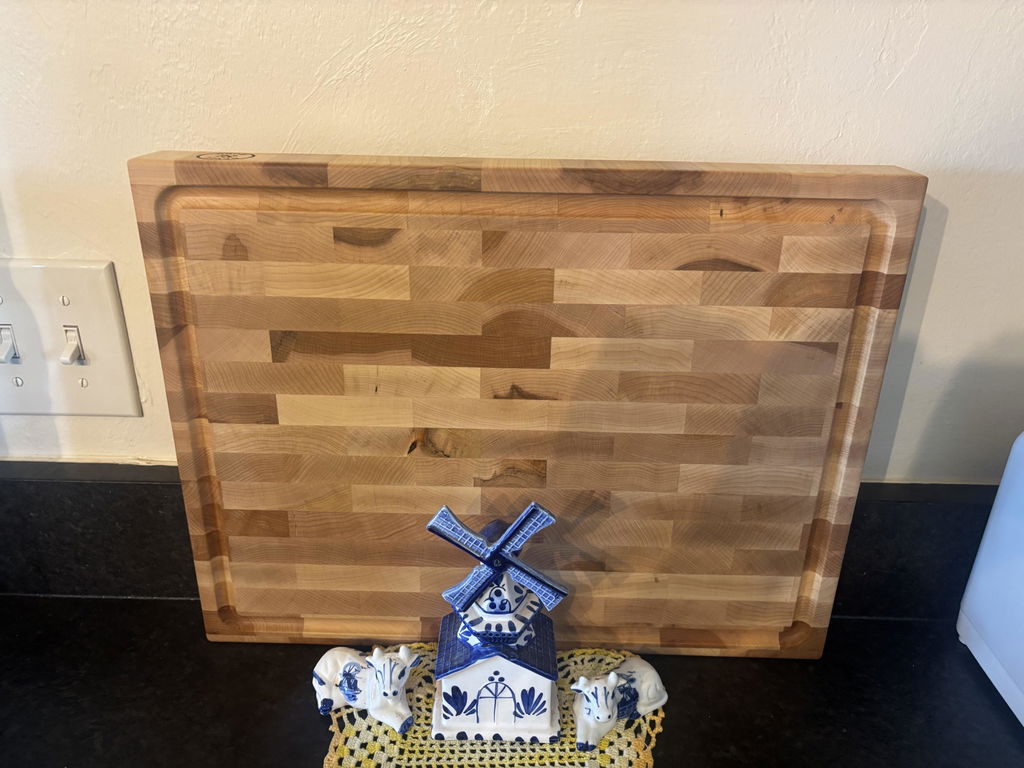
The verdict: Hard maple is the better cutting board for daily prep. Acacia measures around 2,300 lbf on the Janka hardness scale, harder than most knife edges are designed to cut against, so every chop shortens your knife's sharpening interval. Acacia is one of the species we ranked in the full guide to the best wood for a cutting board.
Buy maple for a board you cook on, acacia (Acacia genus, ~2,300 lbf, variable) for one you serve on. Hard maple (Acer saccharum) is a single consistent species at 1,450 lbf, built thick and solid. “Acacia” isn’t one wood at all — it’s a genus of hundreds of species, so hardness and quality swing wildly from board to board, and most are thin and glued from many small offcuts. Acacia is genuinely good-looking and cheap. It just isn’t predictable, and a prep board needs to be.
Walk through any home goods store and you’ll see stacks of acacia cutting boards — warm, swirly, inexpensive, and everywhere. Hard maple sits at a different price point and rarely shares the shelf. So is acacia the smart value buy, or are you paying for looks that won’t last? Here’s the honest comparison from people who work with hardwoods every day.
Key Takeaways
- Hard maple is one consistent species (Acer saccharum) at about 1,450 lbf on the Janka scale — you get the same board every time.
- “Acacia” isn’t one wood. It’s a genus of hundreds of species, so hardness and quality swing widely from board to board.
- Harder isn’t better. Maple’s mid-range hardness resists scarring while staying gentle on your knife edges.
- Most acacia boards are thin and glued from many small offcuts; quality maple is built thick and solid enough to be refinished for many years with proper care.
- For daily prep, maple wins on consistency, construction, and hygiene. Acacia makes a fine light-duty serving piece.
Acacia boards rarely carry meaningful coverage. Here’s what warranty coverage should include.
Maple vs. Acacia at a Glance
| Hard Maple | Acacia | |
|---|---|---|
| Janka hardness | ~1,450 lbf (consistent) | ~1,700–2,300 lbf (highly variable) |
| Source | North American, sustainably managed | Mostly imported, mixed species |
| Grain | Tight, closed, uniform | Open, dramatic, inconsistent |
| Construction | Often thick, solid blocks | Usually thin, many glued pieces |
| Knife feel | Firm but forgiving | Can be hard on edges |
| Consistency | Predictable board to board | Varies wildly by batch |

The Hardness Myth
Acacia often lists a higher Janka hardness than maple, and sellers lean on that number hard. But “acacia” isn’t one wood — it’s a catch-all for nearly 1,000 species harvested across multiple continents, with density The Wood Database describes as greatly variable. That means hardness swings dramatically from board to board. One acacia board might genuinely outlast maple; the next, cut from a softer cousin, dents under a thumbnail.
Hard maple (Acer saccharum) is a single, consistent species. Every Bevel & Bond maple end grain cutting board performs the same as the last because the wood is the same. With acacia, you’re rolling dice on what’s actually inside.
And harder isn’t automatically better. Wood that’s too hard can be unforgiving on your knife edges. Maple’s ~1,450 lbf sits in the sweet spot prized by professional kitchens for over a century — tough enough to resist scarring, soft enough to spare your blades. Our guide to the Janka scale explains why the raw number misleads so often.
Construction: Where Acacia Usually Loses
The bigger difference isn’t the wood — it’s how the board is built. Most mass-market acacia boards are thin (often under an inch) and assembled from many small offcuts glued together. That’s efficient for using up scrap, but it means more glue lines, more places for moisture to penetrate, and more opportunity for the board to crack or delaminate over time.
Quality maple boards are typically built thicker from larger, carefully matched pieces. Our boards run a full 1.75″ — thick end-grain construction built for years of daily use, and made to be re-sanded and refinished with proper care rather than tossed. A periodic application of our Board Balm keeps the grain sealed and the wood nourished between uses. If you want the full breakdown of why solid construction matters, see our guide on end-grain construction.

Looks vs. Longevity
Let’s be fair to acacia: it’s genuinely beautiful. The wild, swirling grain and rich color variation make for striking serving boards, and at its price, it’s a reasonable choice for a charcuterie piece that lives on the counter and rarely meets a knife.
But for a daily prep board — the one you chop onions and break down chicken on — maple’s tight, closed grain is the more sanitary, more durable, more knife-friendly surface. Acacia’s open grain can trap moisture and show wear faster under heavy use.
Sustainability
Acacia is frequently imported with limited transparency about sourcing. North American hard maple is harvested from well-managed forests close to home — more on why domestic hardwood matters in our guide to American-made cutting boards. If provenance matters to you, maple is the clearer conscience.
The Verdict
Buy acacia if: you want an inexpensive, good-looking serving board for light duty and don’t mind variability.
Buy maple if: you want a consistent, knife-safe, sanitary prep surface built to provide many years of service with proper care — and you’d rather know exactly what wood you’re getting.
For a board you’ll actually cook on every day, the consistency and construction of hard maple win. Every Bevel & Bond end-grain maple cutting board is produced in the USA, built 1.75″ thick, and backed by a five-year limited warranty covering qualifying manufacturing defects under normal household use. Still comparing woods? Our maple vs. walnut guide covers the other premium contender, and acacia vs. teak puts acacia head-to-head with the other popular import.
The Bevel & Bond Take
We build our boards from select US-grown hard maple because, after everything is weighed, it offers the best combination of durability, knife-friendliness, sanitation, and timeless looks of any American hardwood. Every Bevel & Bond end-grain maple cutting board is produced in the USA, backed by a five-year limited warranty covering qualifying manufacturing defects under normal household use, and built for years of everyday use with proper care.
Questions about wood choice? We answer every inquiry ourselves — get in touch.
Is acacia or maple better for a cutting board?
Maple for a board you actually cook on. Hard maple is a single consistent species at 1,450 lbf with tight closed grain and thick solid construction. Acacia is a catch-all for hundreds of species, usually built thin from many glued offcuts, so quality swings board to board. Acacia makes a fine looking serving piece, not a daily prep surface.
Is acacia good for cutting boards?
Acacia is acceptable for light-duty serving but not ideal for daily prep. Acacia’s open grain traps moisture and shows wear faster, and its thin, many-piece construction gives water more glue lines to attack. For charcuterie that rarely meets a knife it is a reasonable, attractive choice.
Why is acacia harder than maple but not better?
Because hardness without consistency and the right grain does not make a good board. Acacia can test 1,700 to 2,300 lbf, but that number swings by species and a too-hard surface is unforgiving on knife edges. Maple’s 1,450 lbf sits in the sweet spot: tough enough to resist scarring, soft enough to spare your blades, and identical from one board to the next.
Do acacia cutting boards last?
Some do, many do not, and you cannot tell which from the shelf. The thin, glued-offcut construction most acacia boards use invites cracking and delamination, and the variable species means a soft batch dents easily. A thick solid maple cutting board can be re-sanded and refinished for many years with proper care instead.
When was this article last reviewed?
This comparison was last reviewed in July 2026 by the Bevel & Bond workshop team and reflects our current view on hard maple and acacia cutting boards.
Want a board where you know exactly what wood you are getting? The Bevel & Bond hard maple end-grain cutting board is 1.75 inches of consistent American Acer saccharum, backed by a five-year limited warranty covering qualifying manufacturing defects under normal household use. Explore the full collection here.
Sources
- Hard Maple (Acer saccharum) Janka hardness, 1,450 lbf — The Wood Database
- Acacia genus diversity and variable hardness across species — The Wood Database
- Cliver, D.O. “Cutting boards in Salmonella cross-contamination,” Journal of AOAC International (2006) — PubMed
Keep reading
- Maple vs. Bamboo Cutting Boards: The Knife-Edge Truth
- Maple vs. Cherry Cutting Boards: Which Wood Belongs in Your Kitchen?
- Wood Hardness for Cutting Boards: The Janka Scale Explained
Ready to choose your board? Browse all our cutting boards.