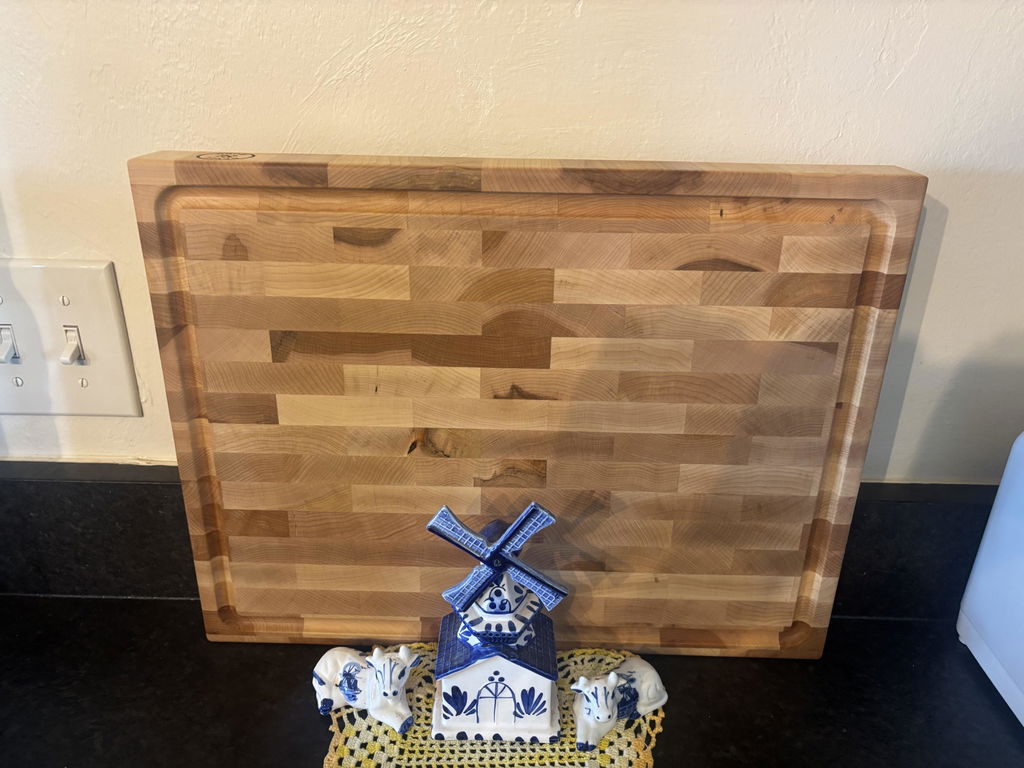
The verdict: Hard maple wins by a wide margin. Bamboo isn't wood at all — it's a fast-growing grass glued into strips, and the silica-rich fibers grind down knife edges over time. Bamboo is only one contender — here's how every common board material compares.
Buy maple if you own knives you care about. Bamboo only wins on price. Bamboo isn't wood at all — it's a grass whose tissue accumulates silica, the abrasive in glass and sand, so it wears edges faster than any hardwood. It's also glued from thin strips that delaminate, and light enough to slide while you chop. A hard maple cutting board is gentler on blades, heavy enough to stay put, and can be refinished for many years with proper care.
Bamboo cutting boards are marketed as the eco-friendly, budget-smart choice — lightweight, cheap, and renewable. Hard maple (Acer saccharum, 1,450 lbf Janka) is the traditional premium pick. If you're deciding between the two, there's one fact that settles most of the debate: bamboo (a grass in genus Bambusa, ~1,380 lbf but silica-rich) isn't actually wood, and it treats your knives very differently than maple does. Here's the honest comparison.
Key Takeaways
- Hard maple rates about 1,450 lbf on the Janka hardness scale — firm enough to last, but soft enough to cushion a knife edge.
- Bamboo is a grass, not wood. Its tissue naturally accumulates silica (the same mineral in glass and sand), which makes it more abrasive on blades than most hardwoods.
- A bamboo board is thin strips bonded with adhesive resin — and those glue lines are where water gets in and the board eventually delaminates.
- Maple's weight (10+ lbs) keeps it planted while you chop; bamboo's lightness makes it prone to sliding.
- Solid maple can be sanded and refinished for many years with proper care. A failed bamboo board is usually replaced, not repaired.
What are the downsides of bamboo cutting boards?
Five, and they compound. Bamboo is abrasive on knife edges, built from glued strips that separate, light enough to slide while you work, prone to surface splintering, and effectively unrepairable once it fails.
| Downside | Cause | When it shows up |
|---|---|---|
| Dulls knives faster | Silica in the fibres, the abrasive in sand and glass | Gradually, over months of use |
| Glue lines separate | Board is strips bonded with adhesive resin | First year, faster if washed heavily |
| Warps and cups | Thin construction reacts sharply to humidity | First seasonal change |
| Surface splinters | Fibrous grass structure, not continuous grain | After the finish wears through |
| Slides on the counter | Very light, often no feet | Immediately |
None of these are dealbreakers on their own. Together they explain why bamboo boards get replaced every few years while a hard maple board gets resurfaced and kept.
Maple vs. Bamboo at a Glance
| Hard Maple | Bamboo | |
|---|---|---|
| What it is | Hardwood (Acer saccharum) | Grass, not wood |
| Janka hardness | 1,450 lbf | 1,400–1,600 equivalent, plus silica |
| Knife impact | Gentle on edges | Hard — dulls knives faster |
| Construction | Solid wood blocks | Strips glued with adhesive resin |
| Weight | Substantial, stays put | Very light, slides easily |
| Repairability | Sand and refinish for many years with proper care | Difficult — usually replaced |
| Surface | hard-wearing under blade | Prone to surface splintering |

The Knife Problem
The silica in bamboo is the single biggest reason serious cooks avoid it. Bamboo is dense and contains natural silica — the same abrasive compound found in glass and sand. Every cut drags your blade across a slightly gritty surface, and over months that adds up to noticeably faster dulling. If you've invested in good knives, bamboo quietly works against them.
Hard maple does the opposite. At roughly 1,450 on the Janka scale, it's firm enough to last but soft enough to cushion your edge. The pros have trusted maple for many years with proper care precisely because it protects the tools that cost far more than the board. Our end-grain maple board takes this further — the upright grain fibers stand vertical to the blade, so the surface scars less. Why higher hardness isn't automatically better is covered in our guide to the Janka scale.
What's Holding It Together?
A bamboo board isn't a slab of bamboo — it's many thin strips bonded together with adhesive resin. The quality and food-safety of that glue varies by manufacturer, and the bond lines are the first place a bamboo board fails: they're where water seeps in, where splits start, and where the board eventually delaminates.
Solid maple has far less to go wrong. If you'd like to understand why glue lines matter for any board's lifespan, our guide on solid maple construction and glue safety breaks it down.
Do bamboo cutting boards crack or split?
Bamboo boards separate along their glue lines more often than they crack. A solid hardwood board can develop a check across the grain; a bamboo board usually comes apart along a glue line instead, because that joint is the weakest part of the construction.
Heat and standing water accelerate it. A bamboo board left wet, or put through a dishwasher, will open at the seams well before a solid maple board of the same age shows any damage. Once a glue line opens there is no practical repair, which is the difference between a board you maintain and a board you replace.

Weight and Stability
Bamboo's lightness sounds like a perk until you're actually chopping. A board that slides around the counter is a safety issue, which is why many bamboo boards need rubber feet or a damp towel underneath to stay put. A 10+ lb maple board simply doesn't move. The mass that makes maple feel premium also makes it safer to work on.
The Sustainability Question
Bamboo's headline selling point is that it grows fast and renews quickly — true. But the picture is more complicated than the marketing: most bamboo is grown overseas, processed with resins, and shipped long distances. North American hard maple is harvested from managed forests, and there's more on why domestic sourcing matters in our guide to American-made cutting boards. Both can be responsible choices, but "renewable" alone doesn't tell the whole story.
The Verdict
Bamboo makes sense if: you want the cheapest possible board, knife wear doesn't concern you, and you're fine replacing it when the glue lines give out.
Maple makes sense if: you care about your knives, want a stable surface that won't slide, and prefer a board you can refinish and maintain for long-term use.
For anyone who cooks regularly and owns knives worth protecting, hard maple is the clear winner. Every Bevel & Bond end-grain maple cutting board is produced in the USA and backed by a five-year limited warranty covering qualifying manufacturing defects under normal household use. Curious how maple stacks up against other woods? See our maple vs. cherry and maple vs. walnut guides, or the full list of woods to avoid for a cutting board.
The Bevel & Bond Take
We build our boards from select US-grown hard maple because, after everything is weighed, it offers the best combination of durability, knife-friendliness, sanitation, and timeless looks of any American hardwood. Every Bevel & Bond end-grain maple cutting board is produced in the USA, backed by a five-year limited warranty covering qualifying manufacturing defects under normal household use, and built for years of everyday use — a periodic coat of Board Balm is all it takes to keep the grain sealed and the surface conditioned.
Questions about wood choice? We answer every inquiry ourselves — get in touch.
Is maple or bamboo better for a cutting board?
Maple, clearly, for anyone who owns knives worth protecting. The trade is straightforward: bamboo costs less once, and maple costs less over the twenty years you keep it. If your knives came from a supermarket and you replace boards without thinking about it, bamboo is a defensible choice.
Do bamboo cutting boards dull knives?
Yes, faster than wood does. Bamboo contains natural silica, the same abrasive compound found in glass and sand, so every cut drags your edge across a slightly gritty surface. Over months that adds up to noticeably faster dulling. Maple at 1,450 lbf cushions the edge instead.
Is bamboo actually wood?
No, bamboo is a grass. A bamboo board is many thin strips bonded with adhesive resin rather than a solid slab of timber. Those glue lines are the first place it fails, letting water seep in and the board delaminate. Hard maple is a true hardwood with far less to go wrong.
Are bamboo cutting boards durable?
Not by hardwood standards. The glued-strip construction splits and delaminates, the surface is prone to splintering, and a failed bamboo board is usually replaced rather than repaired. A solid maple board can be sanded and refinished for many years with proper care.
When was this article last reviewed?
This comparison was last reviewed in August 2026 by the Bevel & Bond workshop team and reflects our current view on hard maple and bamboo cutting boards.
Protect the knives that cost more than the board. The Bevel & Bond hard maple end-grain cutting board is 1.75 inches of American Acer saccharum, heavy, hard-wearing, and backed by a five-year limited warranty covering qualifying manufacturing defects under normal household use. Explore the full collection here.
Keep reading
- Maple vs. Acacia Cutting Boards: Don't Buy Before You Read This
- Maple vs. Teak Cutting Boards: Which Wood Wins?
- Wood Hardness for Cutting Boards: The Janka Scale Explained
Ready to choose your board? Browse all our cutting boards.