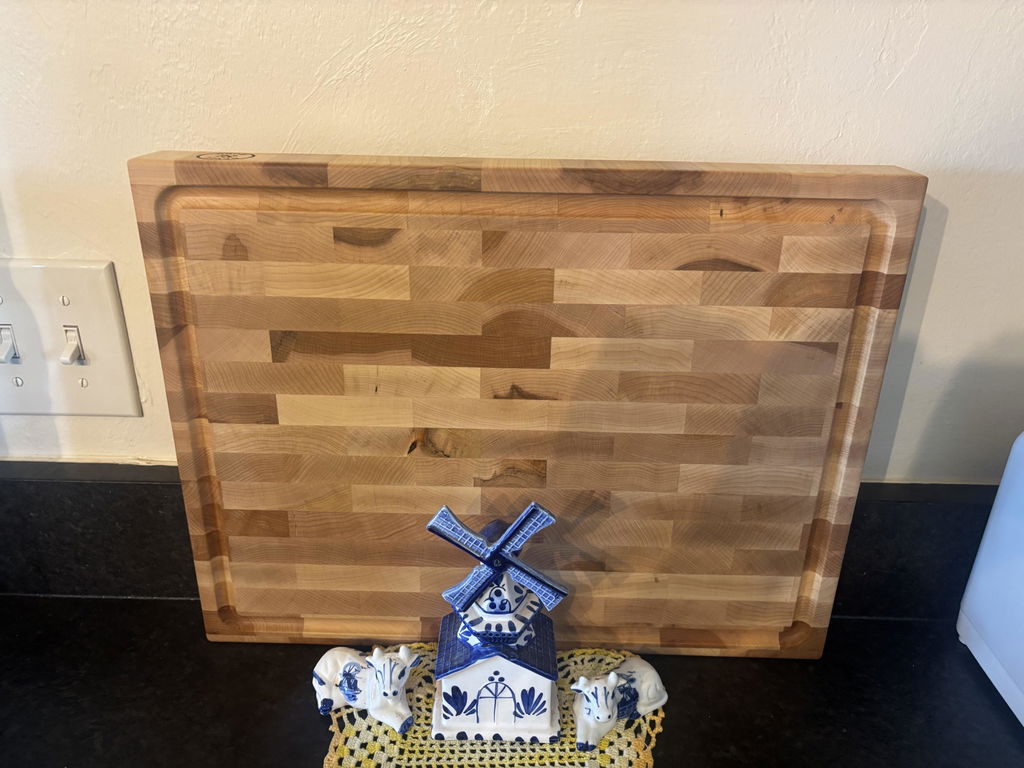
Search for a solid maple cutting board and you'll quickly run into a quieter question buried in the reviews: is there glue in this thing, and is it safe? It's one of the most common concerns we hear, and it deserves a straight answer. Here's how cutting boards are actually built, what "solid maple" really means, and why construction matters more than almost anything else.
What "Solid Maple" Actually Means
"Solid wood" means the board is made entirely from real maple lumber — not veneer over particleboard, not wood-look laminate, not composite. That's the baseline you want. But within solid-wood boards, there's an important distinction in how the pieces are joined.
Almost every quality cutting board — including the finest end-grain boards in the world — is made from multiple pieces of maple bonded together. A truly single-piece board of useful size would crack as the wood expanded and contracted with humidity. So the real question isn't "glue or no glue." It's "what glue, and how well is it built?"

The Glue Question, Answered Honestly
Reputable cutting board makers use food-contact-appropriate waterproof PVA adhesives — the type of adhesive commonly used in food-contact woodworking for many years with proper care. Once cured, it's inert, waterproof, and intended for food-contact woodworking when fully cured and used as directed. There is no meaningful health concern with a properly built, properly glued maple board.
What you actually want to avoid isn't glue itself — it's bad construction: cheap boards assembled from many tiny scrap pieces with sloppy bond lines, thin stock that flexes, or unknown adhesives from opaque overseas supply chains. Those are the boards that crack, delaminate, and warp. The glue isn't the villain; the craftsmanship is.
Why Construction Beats Everything
You can take the finest hard maple in North America and still build a board that fails if the construction is wrong. Three things separate a board you'll keep for many years with proper care from one you'll replace in a year:
- Thickness. A substantial board resists warping and can be re-sanded many times. Our boards are 1.75 inches thick, providing material for future resurfacing when structurally appropriate.
- Piece selection. Larger, carefully grain-matched pieces mean fewer bond lines and a more stable board than one cobbled from offcuts.
- Grain orientation. End-grain construction stands the wood fibers upright so the blade slips between them, creating a hard-wearing surface that's gentler on knives. Read more in our end-grain board overview.

How a Bevel & Bond Board Is Built
We start with select US-grown hard maple — a single, consistent species, not a mystery mix. Each board is built thick, joined with food-safe waterproof adhesive, then individually sanded, inspected, and conditioned with food-safe mineral oil by hand before it ships. No rushing, no mass production. The result is a board that's structurally sound enough to back with a 5-year warranty. You can read the full story behind that process on our Our Story page.
How to Spot a Well-Built Board
When you're shopping, look for: stated thickness of 1.5″ or more, a named wood species ("hard maple," not just "wood"), clear country of origin, food-safe finish disclosure, and a real warranty. A maker confident enough to guarantee the board for years is telling you something about the construction.
The Bottom Line
A "solid maple, no compromise" board doesn't mean zero glue — it means real maple, food-safe joinery, honest thickness, and craftsmanship you can trust. Done right, that board outlasts everything else in your kitchen. Every Bevel & Bond end-grain maple cutting board is produced in the USA from select hard maple and backed by a five-year limited warranty covering qualifying manufacturing defects under normal household use. Once it arrives, keep it in top shape with our cutting board care guide. A conditioning wax like our Board Balm protects the surface and keeps the grain sealed. Browse our full maple cutting boards collection to find the right fit.
Is there glue in a solid maple cutting board?
Almost always, yes, and that is normal. Nearly every quality board, including the finest end-grain ones, is built from multiple maple pieces bonded together, because a single-piece board of useful size would crack as the wood moves with humidity. The real question is not glue or no glue, but what glue and how well it is built.
Is the glue in a cutting board food-safe?
Yes, when the maker uses the right adhesive. Food-safe waterproof glue cures inert, which is why it has been standard in commercial kitchenware for many years with proper care. The risk is not the bonding itself but supply chains that will not name what went into the board.
What does "solid maple" actually mean?
It means the board is real maple lumber all the way through, not veneer over particleboard, laminate, or composite. It does not mean a single piece of wood. A solid maple board is still built from multiple bonded pieces; "solid" refers to the material, not the joinery.
How can you tell if a maple cutting board is well built?
Five things on the listing: thickness of 1.5 inches or more, a named species rather than just "wood," country of origin, a disclosed food-safe finish, and a warranty with an actual number attached. Anything vague on those five points is usually vague for a reason.
When was this article last reviewed?
This guide was last reviewed in August 2026 by the Bevel & Bond workshop team and reflects our current view on solid maple construction and glue safety.
Want a board built to be backed for years? The Bevel & Bond hard maple end-grain cutting board is 1.75 inches of select American hard maple, food-safe joinery, backed by a five-year limited warranty covering qualifying manufacturing defects under normal household use. Explore the full collection here.
Keep reading
- American-Made Cutting Boards: Why Buy USA Hardwood
- End-Grain Workhorses: Value, Durability, and Use Cases
- Maple Cutting Boards: Benefits, Care Tips, and How Patina Makes Them Better Over Time
Ready to choose your board? Browse all our cutting boards.