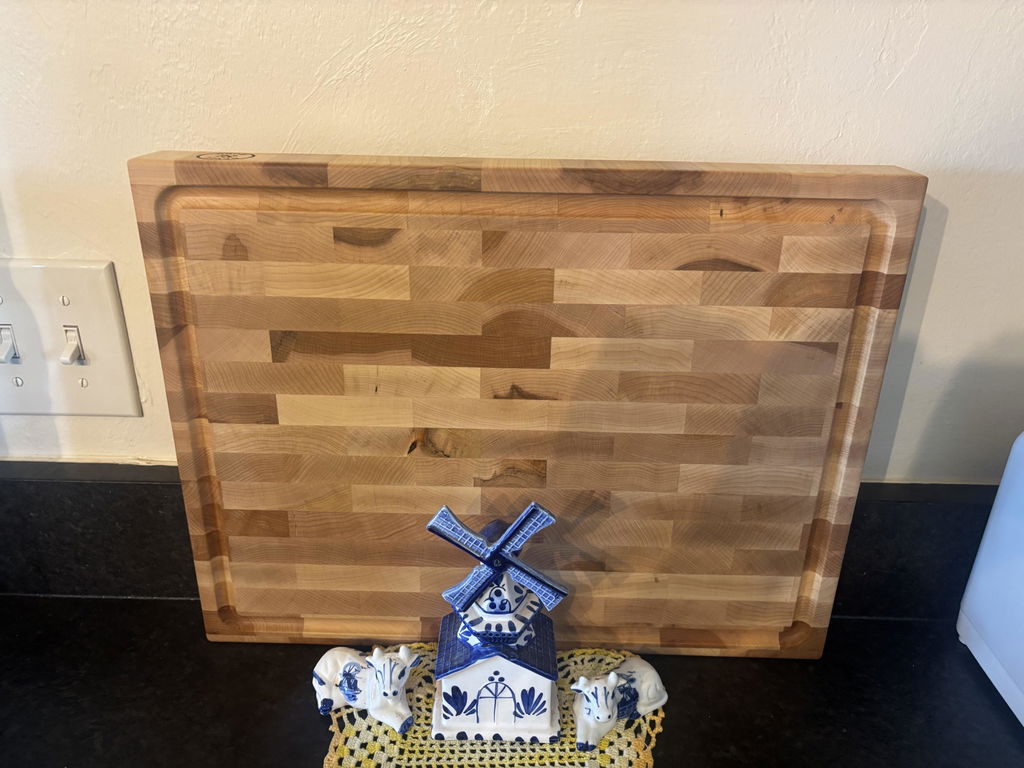
Short answer: for most home cooks, the best maple cutting board in 2026 is an end-grain board made from named hard maple, at least 1.5 inches thick, with a written warranty. We scored five of them against the same five-part rubric. The Bevel & Bond End-Grain Hard Maple board finished first at 97 points, the John Boos R-Board finished as the value pick at 77, and if you want the most wood for your money, The Boardsmith beats us on sheer mass.
We built this rubric, and our own board sits at the top of it. That's a fair thing to be skeptical about. So every score is broken out below, every price and warranty was checked at the brand's own website on August 19, 2026, and there's a section near the bottom that says plainly where our board loses.
If you're still deciding on species, start with why maple is a strong wood for cutting boards, then come back here to pick the actual board.
The scoring rubric
Five dimensions, 20 points each, 100 total. Nothing subjective about "feel" or "beauty" — every point comes from something a brand publishes or refuses to publish.
| Dimension | What earns full points |
|---|---|
| 1. Species named | The listing says hard maple, sugar maple, rock maple, or Acer saccharum. Generic "maple" loses points, because soft maple, silver maple and box elder are all legally maple. |
| 2. Grain direction | End-grain scores highest, edge-grain in the middle, face-grain lowest. |
| 3. Thickness and mass | 1.75 inches and up earns full marks. 1.5 inches is solid. Under 1 inch loses most of the points. |
| 4. Construction detail | Named adhesive, juice groove, feet or grips, finish, and how much the brand is willing to tell you. |
| 5. Origin and warranty | Where it's made, plus a written warranty you can read before you buy. |
A quick note on the first row. "Maple" is a category, not a species. Hard maple — Acer saccharum — rates 1,450 lbf on the Janka scale, against 1,010 for walnut and 950 for cherry. The soft maples run well below that. If a brand won't name the species, the score reflects that silence.

The rankings at a glance
| Rank | Board | Species | Grain | Size | Thick | Price | Warranty | Score |
|---|---|---|---|---|---|---|---|---|
| 1 | Bevel & Bond End-Grain Hard Maple | Acer saccharum, named | End | 17" × 13" | 1.75" | $139.99 | 5 years | 97 |
| 2 | The Boardsmith Maple End Grain | "Premium maple" | End | 12" × 18" | 2" | from $230 | 60 days | 87 |
| 3 | Brooklyn Butcher Blocks End Grain Maple | "Maple" | End | 12" × 18" | 1.75" | $230 | not published | 84 |
| 4 | John Boos R-Board | Northern hard rock maple | Edge | 18" × 12" | 1.5" | $94.95 | 1 year | 77 |
| 5 | Virginia Boys Medium Maple | "Certified sustainable maple" | not stated | 17" × 11" | 0.75" | $85 | 120-day money back | 54 |
All prices, specs and warranty terms checked at each brand's own website on August 19, 2026. Prices move; the sources are linked at the end so you can re-check.
1. Bevel & Bond End-Grain Hard Maple — 97 points
Species 20 · Grain 20 · Thickness 20 · Construction 17 · Origin and warranty 20
Best for: the cook who wants one end-grain hard maple board for the next twenty years and doesn't want to spend $230 to get it.
This is our board, so here's the case in plain numbers. It's 17" × 13" × 1.75", over 10 pounds, end-grain Acer saccharum bonded with food-safe PVA, with a juice groove, side handles and non-slip feet. It's built by a wood shop in Oregon, and it carries a written 5-year warranty at $139.99 with free U.S. shipping.
Nothing else in this field pairs 1.75 inches of end-grain hard maple with a five-year written warranty under $150. That combination is the whole reason it tops the rubric.
Where it drops points: construction scores 17, not 20, because we make exactly one size. If 17 × 13 isn't your size, we can't help you, and two of the boards below can.

2. The Boardsmith Maple End Grain — 87 points
Species 16 · Grain 20 · Thickness 20 · Construction 18 · Origin and warranty 13
Best for: anyone who wants a genuine 2-inch bench block and treats the board as a permanent fixture.
The Boardsmith builds made-to-order end-grain boards in a 7,500 square foot shop in Frisco, Texas, with a team of eight. The maple end grain starts at $230 for a 12" × 18" × 2" block and runs up through 16" × 22" and 18" × 24". Finger grooves and juice grooves are paid options.
Two inches is more board than we build, and if mass is what you're after, they win that outright. Their adhesive is described as a waterproof, FDA-approved-for-indirect-contact glue, and boards take one to two weeks to make.
Where they drop points: their listing says "premium-grade maple" rather than naming hard maple by species, and their published guarantee runs 60 days from receipt against defects. That's a short window for a board at this price. Buy it for the wood, not the paperwork.
3. Brooklyn Butcher Blocks End Grain Maple — 84 points
Species 16 · Grain 20 · Thickness 20 · Construction 17 · Origin and warranty 11
Best for: buyers who want a 12" × 18" end-grain block from a small American shop and don't mind waiting for stock.
Same thickness as ours at 1.75 inches, a slightly different footprint at 12" × 18", and about 12 pounds. It's $230, and the shop says roughly 90% of its material is sourced within 400 miles of the facility, which is a more specific sourcing claim than most brands bother to make.
Where they drop points: the listing says "maple" without the species, and we could not find a published warranty term anywhere on the product page or site. The 12 × 18 was also showing sold out when we checked on August 19, 2026, which is worth knowing before you plan a gift around it.

4. John Boos R-Board — 77 points
Species 20 · Grain 12 · Thickness 14 · Construction 16 · Origin and warranty 15
Best for: the cook who wants a bigger work surface for less money and doesn't need end-grain.
Boos has been making boards in Effingham, Illinois since 1887, and the track record is real. The R-Board is NSF certified Northern hard rock maple — species named, which earns full marks on the first dimension — reversible, with recessed finger grips and an oil finish. The 18" × 12" × 1.5" is $94.95 and the 20" × 15" × 1.5" is $124.95.
That 20 × 15 hits America's Test Kitchen's recommendation of at least 20 by 15 inches for an all-purpose board. Ours doesn't. If working area is your priority, this is the honest answer and it costs less than our board.
Where they drop points: edge-grain rather than end-grain, and 1.5 inches rather than 1.75. Their origin line reads "Made in the USA with domestic and imported materials," which is a softer claim than a fully domestic supply chain. Their warranty is one year, limited, with return shipping on you.
If you want end-grain from Boos, the MCS1 square chopping block is 3 inches thick at $188.95 — a different animal, and a good one.
5. Virginia Boys Medium Maple — 54 points
Species 12 · Grain 8 · Thickness 6 · Construction 13 · Origin and warranty 15
Best for: a light second board, a gift under $100, or a first wood board for someone stepping away from plastic.
It's 17" × 11" × 0.75", 3.8 pounds, made in Virginia, $85 at the time of checking. It's reversible with a juice groove on one side and ships pre-oiled.
The best thing about it isn't the board, it's the terms: Virginia Boys publishes a 120-day money-back guarantee. Four months to decide is longer than anyone else in this field gives you, us included.
Where it drops points: three quarters of an inch is thin, and thin wide boards are the ones that cup. The listing says "certified sustainable maple" without naming hard maple, and doesn't state the grain orientation. At 3.8 pounds it will move on the counter unless you put a damp towel under it.
Where our board loses
Four honest ones.
On working area, John Boos wins. The 20" × 15" R-Board gives you 300 square inches for $124.95. Ours gives you 221 for $139.99. If you routinely break down whole chickens or prep for eight, buy the bigger Boos and don't think twice.
On mass, The Boardsmith wins. Two inches of end-grain maple is more board than 1.75 inches, full stop.
On return terms, Virginia Boys wins. Their 120-day money-back window is longer than our return window, even though our warranty is longer.
On choice, everyone wins. Boos, Boardsmith and Brooklyn all sell multiple sizes. We sell one. If 17 × 13 is wrong for your kitchen, we're the wrong brand for you, and that's fine.
What we'd actually tell a friend
If you cook most nights and want an end-grain hard maple board you'll still be using in twenty years, our board at $139.99 is the strongest combination of thickness, species and written warranty in this field. That's why it scores first.
If your counter is deep and you want the biggest work surface for the least money, buy the 20 × 15 John Boos.
If you want a 2-inch block and the budget is open, buy The Boardsmith.
And if you just need something decent under $100 to try wood for the first time, the Virginia Boys with its 120-day window is a low-risk way in. Just don't expect a 0.75-inch board to be a lifetime tool. Some boards are a decade-long relationship, others are more of a summer fling.
Frequently asked questions
What is the best wood for a maple cutting board? Hard maple, Acer saccharum, also sold as sugar or rock maple. It rates 1,450 lbf on the Janka scale with a tight closed grain, hard enough to resist scarring yet gentle on knife edges. Soft maple, silver maple and box elder are all legally "maple" but run well softer, so insist on the species by name.
How thick should a maple cutting board be? At least 1.5 inches, with 1.75 inches or more as the sweet spot. A thicker board sits solid, resists the seasonal bowing that ruins thin boards, and handles hard chopping without flex. Under 1 inch is where cupping shows up first.
Is end-grain or edge-grain better for a maple cutting board? End-grain for a durable, repairable work surface; edge-grain for a solid everyday option that is often lighter and less expensive. End-grain stands the fibers vertical, so the surface scars less and shows knife marks less than edge-grain. It costs more because it takes more lumber and more glue-up steps.
How can you tell if a board is real hard maple? The listing names the species. Real hard maple boards say Acer saccharum, sugar maple, or rock maple, and they publish thickness, origin and a written warranty. A vague "maple" listing with no species, dimensions, or written warranty does not provide enough information for a reliable comparison; verify the details before buying.
Are expensive maple cutting boards worth it? The good ones, yes. A well-built, repairable end-grain hard maple board may offer better long-term value than repeatedly replacing lower-quality boards, but actual value depends on service life and care. What you're paying for is the species, the thickness, food-safe construction and a warranty that backs it.
Which maple cutting board has the longest warranty? Of the five here, Bevel & Bond at five years. John Boos and Sonder LA each publish one year, The Boardsmith publishes 60 days against defects, and Brooklyn Butcher Blocks doesn't publish a term. Virginia Boys leads on returns instead, with a 120-day money-back guarantee.
When was this article last reviewed? August 19, 2026. Every competitor price, spec and warranty above was checked at that brand's own website on that date.
Want the board that tops the rubric? The Bevel & Bond End-Grain Hard Maple Cutting Board is 17" × 13" × 1.75" of American Acer saccharum, built in Oregon and backed by a written 5-year warranty at $139.99. Browse the full collection if you'd like to see it alongside Board Balm.
Keep reading
- Maple Cutting Boards: Benefits, Care Tips, and How Patina Makes Them Better Over Time
- What Size Cutting Board Do You Actually Need?
- The Best Made-in-USA Cutting Boards Under $150