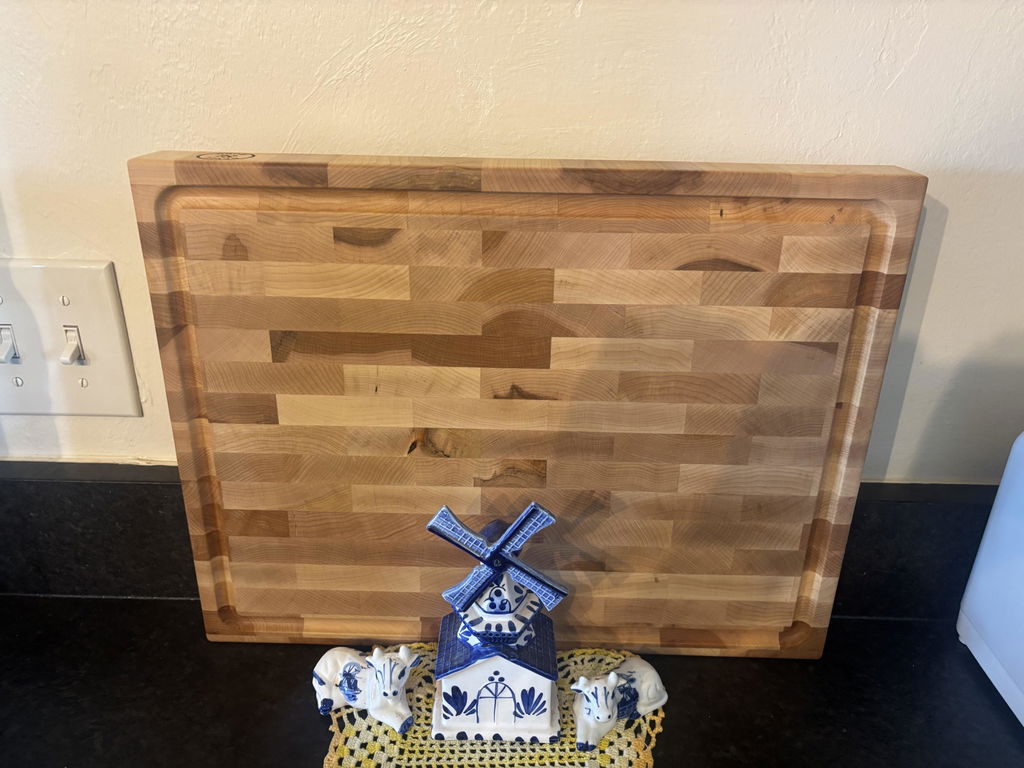
The short answer: a butcher block is a thick, heavy maple work surface built for serious chopping... usually 2" or thicker, often built into a counter or table. A cutting board is a portable version of the same idea, typically 1.25" to 2" thick. The materials are the same. The dimensions, weight, and how you use them are what separate the two terms.
This is one of the most common confusions in the kitchenware aisle, and it costs real shoppers real money. People search for "maple butcher block" and end up looking at full counter installations. Others search for "cutting board" and end up with a thin face-grain slab that splits in six months. The terms overlap... but they aren't synonyms.
Here's the honest breakdown.


Butcher Block vs. Cutting Board: Quick Comparison
| Feature | Butcher Block | Cutting Board |
|---|---|---|
| Typical thickness | 2" to 4"+ | 1.25" to 2" |
| Typical weight | 30 lbs to 200+ lbs | 5 lbs to 12 lbs |
| Portability | Built-in or stand-mounted | Portable, washable at the sink |
| Common construction | End-grain | End-grain, edge-grain, or face-grain |
| Primary use | Heavy butchery, all-day prep stations | Daily home cooking, prep, serving |
| Price range | $300 to $3,000+ | $25 to $250 |
What "Butcher Block" Actually Means
The term "butcher block" comes from exactly what it sounds like: the thick maple work surfaces used by butchers from the late 1800s onward. These were typically end-grain hard maple, 4" to 6" thick, mounted on a heavy timber frame at counter height. The thickness wasn't decorative. It was so the surface could be resurfaced (scraped down, planed, or sanded) repeatedly over decades as the cut marks accumulated.
Today, "butcher block" generally refers to two things:
- Counter-installed butcher block — a maple work surface built into a kitchen island or counter, usually 2"–3" thick, often custom-cut to fit.
- Standalone butcher block tables — freestanding maple work surfaces on a frame, popular in commercial kitchens and serious home prep stations.
What unites both: heavy, thick, and not meant to be moved.
What "Cutting Board" Actually Means
A cutting board is the portable version. Same material category (hard maple is the gold standard), same construction options (end-grain, edge-grain, face-grain)... but built to be lifted, washed, oiled, and stored.
The 17"×13"×1.75" form factor that's become a standard for serious home cooks is essentially a "personal butcher block." It uses the same end-grain construction as a commercial butcher's block, scaled down to a size one person can manage in a home kitchen.
That's where the confusion in search terms comes from. A modern end-grain hard maple cutting board like ours is functionally a small butcher block. The brand uses "cutting board" because the dimensions and weight (about 10 lbs) put it in the portable category. But the construction, the wood species, and the surface behavior are identical to what's underneath the meat hook at a real butcher shop.
Where the Two Overlap
The overlap zone is the 1.75" to 2" thickness range. Boards in this range are heavy enough to function as small butcher's blocks for serious home use... carving a brisket, breaking down a whole chicken, processing root vegetables in volume... but still portable enough to lift, wash, and store.
Some brands market these as "butcher block cutting boards" to cover both search terms. The naming is marketing. The functional distinction is whether you can lift it.

Which One Do You Actually Need?
For 95% of home cooks, the answer is a thick cutting board... not a butcher block. Here's why:
- Counter butcher block only makes sense if you're renovating your kitchen or you have an existing prep station built for one. It's a furniture decision, not a kitchenware decision.
- Freestanding butcher block tables make sense for serious home butchers (whole-animal processing), avid bakers (dough work), or anyone with a dedicated prep room. The footprint and weight are a real commitment.
- Thick cutting boards (1.5" to 2") cover everything most home cooks actually do: daily prep, carving roasts, charcuterie boards, herb work, serving. They wash. They store. They go where you need them.
If you're shopping the maple aisle and you keep seeing "butcher block cutting board" listings, what you're really looking at is a thick end-grain cutting board with butcher-block construction. That's the sweet spot.
The Bevel & Bond Approach
Our 17"×13"×1.75" end-grain hard maple board sits squarely in that overlap zone. It uses the same Acer saccharum and the same end-grain construction as a commercial butcher block, in a portable home-kitchen size. About 10 lbs, hand-finished with Board Balm, and backed by a written 5-year warranty.
If you want the butcher-block surface without the butcher-block real estate... a thick end-grain cutting board is exactly the tool you're describing. The terminology just had to catch up.
For the next level of detail, our grain direction guide covers why end-grain is the right pick for either category, and answers the block-versus-board question in its own FAQ.
What separates a butcher block from a cutting board?
Thickness, weight, and portability, not the wood. A butcher block is a thick, heavy maple surface, usually 2 inches or more and often built into a counter or a stand. A cutting board is the portable version of the same idea, typically 1.25 to 2 inches thick and light enough to lift, wash, and store. Same material, different scale.
Can you use a cutting board as a butcher block?
A thick end-grain board, yes. A 1.75 to 2 inch end-grain hard maple board handles brisket, whole chickens, and volume root-vegetable prep like a small butcher block, while still fitting your sink and your cabinet. A thin face-grain board cannot, which is why thickness is the line that matters.
How thick is a butcher block compared to a cutting board?
Butcher blocks run 2 to 4 inches or more; cutting boards run 1.25 to 2 inches. The extra butcher-block thickness exists so the surface can be resurfaced again and again over decades. For home use you rarely need that much mass, which is why the 1.75-inch board is the practical sweet spot.
Is end-grain better for a butcher block or a cutting board?
Both. End-grain stands the fibers vertical so the knife slips between them, which shows cuts less and protects your edge, and it is the traditional butcher-block construction. In a portable board you get that same surface behavior in a size you can lift.
Do you need a butcher block or a cutting board at home?
For most kitchens, a thick cutting board. A built-in or freestanding butcher block is a furniture and floor-space commitment that only makes sense for whole-animal butchery or a dedicated prep station. A 17 by 13 by 1.75 inch end-grain board covers daily prep, carving, and serving for 95% of home cooks.
When was this article last reviewed?
This comparison was last reviewed in August 2026 by the Bevel & Bond workshop team and reflects our current view on butcher blocks and cutting boards.
Want a portable board with real butcher-block construction? The Bevel & Bond hard maple end-grain cutting board is 17 by 13 by 1.75 inches of American Acer saccharum, backed by a 5-year warranty. Explore the full collection here.
Keep reading
- End-Grain Workhorses: Value, Durability, and Use Cases
- What Size Cutting Board Do You Actually Need?
Ready to choose your board? Browse all our cutting boards.