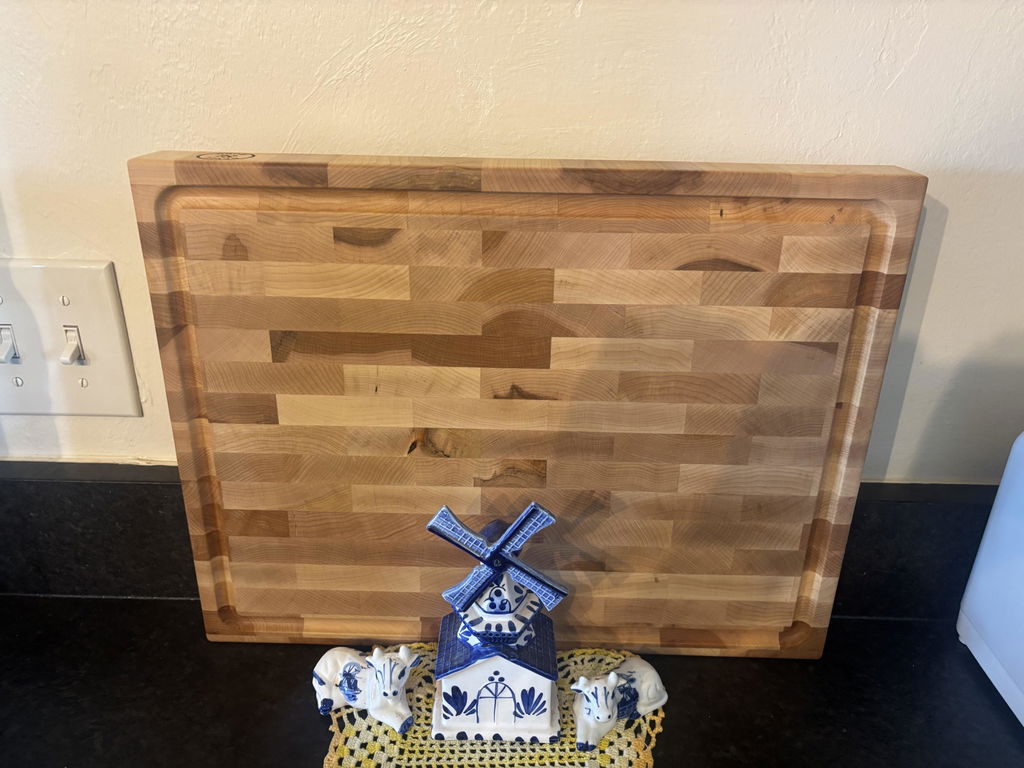
The short answer: Most home cooks need a 17×13-inch cutting board as their primary board. This size fits standard countertops, gives you room to work, and handles everything from daily chopping to holiday meal prep.
Key Takeaways
- 17×13” is the ideal primary board — big enough for real cooking
- A small 10×8” board works as a second board for citrus, garlic and raw protein
- Go as big as your counter and sink allow, and no bigger
- 1.5–2” thickness adds mass and stability
- Match size to your most common cooking tasks, not your smallest counter
The verdict: For most kitchens, a 17 by 13 inch board is the sweet spot; small kitchens are better served by about 13 by 9, heavy prep benefits from 20 by 15 or larger. Thickness matters as much — 1.5 to 1.75 inches minimum.
In practice: most home cooks are best served by a single 17"×13"×1.75" board for daily prep and main carving, plus a smaller 10"×8" board for citrus, garlic, and protein cross-contamination. Boards smaller than 12" frustrate serious cooks. Boards larger than 20" rarely fit standard kitchen sinks for cleanup. Below is the size math that should drive your pick... not what the marketing says.
Cutting board sizing is one of those decisions that feels arbitrary until you've owned the wrong one. A too-small board pushes food off the edges. A too-large board doesn't fit your sink, your counter, or your storage. And weight... a 20" hard maple board can hit 14 lbs, which sounds impressive in a product listing and feels different when you're carrying it across the kitchen at 9pm.
Here's the framework.

Cutting Board Size Guide at a Glance
| Size | Best for | Typical weight (end-grain maple) | Fits standard sink? |
|---|---|---|---|
| Small (8"×6" to 10"×8") | Garlic, citrus, herbs, raw protein | 2–4 lbs | Yes |
| Medium (12"×9" to 15"×11") | Everyday prep, small households | 5–8 lbs | Yes |
| Large (16"×12" to 18"×13") | Serious cooks, family meals, carving | 9–12 lbs | Usually yes |
| Oversized (20"+ wide) | Entertainers, whole-roast carving, charcuterie | 13–18 lbs | Often no |
What is the average cutting board size?
There is no official standard. The common full sizes are 18 × 12, 20 × 15 and 24 × 18 inches; John Boos's best-known R-Board line comes in exactly those three (example listing). End-grain boards from smaller workshops tend to sit around 17 × 13 to 18 × 12 inches. Small prep boards usually run 8 × 6 to 12 × 9 inches.
Counter Space: The Real Constraint
Before you pick a size, measure your prep zone. The usable area is whatever sits between your sink and your stove, minus 4"–6" of clearance on each side for your hands and your knife handle.
For most home kitchens, that working zone is 18" to 30" wide. A 17"×13" board fits comfortably in that range, with room for a small bowl of prepped onions or a discard tray. A 20"×15" board, in the same zone, leaves you with nowhere to put the things you're prepping to.
Bigger isn't better. The right board is the one your counter can actually accommodate, with room left for the rest of your workflow.
The Sink Test
The sink test — whether a board fits a standard 22-inch sink — tells you the largest size you'll actually live with. Standard residential kitchen sinks are 22" wide and 18" front-to-back. A 17"×13" board fits diagonally for full rinsing. A 19"×14" board fits, but barely. A 20"×15" board does not... you'll be wiping it down with a cloth on the counter, which is a real annoyance when you've just butchered a chicken.
Hard maple is closed-grain, but like all wood it takes on and releases water, so it benefits from being able to drain freely after a rinse. Wood swells as it takes on moisture and shrinks as it releases it, and when one face absorbs more than the other the board cups — the USDA Forest Products Laboratory covers this dimensional behavior in detail in the Wood Handbook. Practically: if your board can't lay flat in the sink, water sits on it, and water that sits on maple causes the cupping that ruins boards.
Pick a size your sink can handle, or commit to wiping it down on the counter every wash. If a board has already cupped, our guide to fixing a warped board walks through the recovery.
The Weight Reality
End-grain hard maple is dense — Acer saccharum rates 1,450 lbf on the Janka scale, and that density is what you feel when you lift it. A 1.75" thick board comes in at roughly 4–5 lbs per square foot. So:
- 12"×9" = ~5 lbs
- 17"×13" = ~10 lbs (our standard)
- 20"×15" = ~14 lbs
- 24"×18" = ~20 lbs
The 10 lb range is the sweet spot for most home cooks. Heavy enough to feel solid and stay put under aggressive chopping. Light enough to lift one-handed for rinsing, drying, and storing. Above 12 lbs, you'll start storing the board flat (because lifting it gets old)... and a board that lives on the counter takes a lot of counter.

Recommended Sizes by Kitchen Type
Small kitchen or apartment (under 18" of prep zone): A 13"×9"×1.5" board is your max practical size. You'll still want a 8"×6" small board for protein-specific work.
Standard home kitchen: The 17"×13"×1.75" sweet spot handles 95% of what you do. Pair it with a smaller 10"×8" prep board for separation.
Serious home cook / family kitchen: Same 17"×13" board as the main, plus an 8"×6" for citrus and garlic, plus a 13"×10" or similar mid-size for protein prep before it hits the main board.
Entertainer / charcuterie host: Consider an oversized 20"+ board, but commit to storage planning first. These are display boards as much as cutting boards.
Why 17"×13"×1.75" Hits the Sweet Spot
We built our end-grain hard maple board at 17"×13"×1.75" deliberately. It's the dimension that fits standard 22" sinks, sits inside a typical 24"–30" prep zone, weighs about 10 lbs, and still handles a full carving brisket, a whole roast chicken, or charcuterie for 8.
For most home cooks, that's the only board you need... and the one that ends up doing the most work for the longest. It's hand-finished with Board Balm and backed by a 5-year written warranty against manufacturing defects.
If you want the full criteria framework before you commit, our 2026 Best Maple Cutting Board buying guide covers wood species, grain direction, and warranty in addition to size.
Choose a size you can comfortably use, wash, dry, and store; service life will depend on construction and care.
What size cutting board do I actually need?
For most kitchens, a 17 by 13 by 1.75 inch main board plus a small 10 by 8 board for citrus, garlic, and raw protein. That pairing covers daily prep, carving, and cross-contamination without crowding your counter. Boards under 12 inches frustrate serious cooks, and boards over 20 inches stop fitting a standard sink.
Is a bigger cutting board better?
Only up to the point your counter and sink can handle. A board needs 4 to 6 inches of hand clearance on each side, so in a typical 24 to 30 inch prep zone a 17 by 13 board leaves room for your bowls and trays while a 20 by 15 board leaves you nowhere to put what you prep. Right-sized beats oversized.
What size cutting board fits in a standard sink?
Up to about 17 by 13 inches. A standard residential sink is roughly 22 by 18 inches, so a 17 by 13 board fits diagonally for a full rinse. Bigger than 19 by 14 and you are wiping it down on the counter, which lets water sit on the maple and invites cupping.
How much does a large maple cutting board weigh?
Roughly 4 to 5 pounds per square foot at 1.75 inches thick. That puts a 17 by 13 board near 10 pounds, a 20 by 15 near 14, and a 24 by 18 near 20. The 10 pound range is the sweet spot: heavy enough to stay put under hard chopping, light enough to lift one-handed to the sink.
Do you need more than one cutting board?
Two is the practical system for most cooks: a large main board for prep and carving, and a small board kept for citrus, garlic, and raw protein. The small board protects your main board's finish from acidic foods and keeps raw meat separate. A third mid-size board is optional and mostly for high-volume protein prep. The food-safety side is covered in separate boards for meat and vegetables.
Why does a cutting board cup or warp?
Because wood swells and shrinks with moisture, and uneven moisture between the two faces bends the board. Washing one side, leaving the board flat on a wet counter, or drying it against a surface all create that imbalance. Store it on edge with airflow on both faces and the moisture equalizes.
When was this article last reviewed?
This size guide was last reviewed in July 2026 by the Bevel & Bond workshop team and reflects our current sizing recommendations for home kitchens.
Sources
- USDA Forest Service, Forest Products Laboratory — Wood Handbook: Wood as an Engineering Material (FPL-GTR-282, 2021), Ch. 13 on moisture content and dimensional change
- The Wood Database — Hard Maple (Acer saccharum), Janka hardness 1,450 lbf
- John Boos R-Board edge-grain maple cutting boards, sold in 18 × 12, 20 × 15 and 24 × 18 inch sizes (retailer listing)
Want the size that fits the sink, the counter, and the workload? The Bevel & Bond hard maple end-grain cutting board is 17 by 13 by 1.75 inches, about 10 pounds, backed by a 5-year warranty. Explore the full collection here.
Keep reading
- Carving vs. Chopping: How to Choose the Best Carving Board
- Are Maple Cutting Board Sets Worth It?
- Cutting Board Thickness Guide
Ready to choose your board? Browse all our cutting boards.