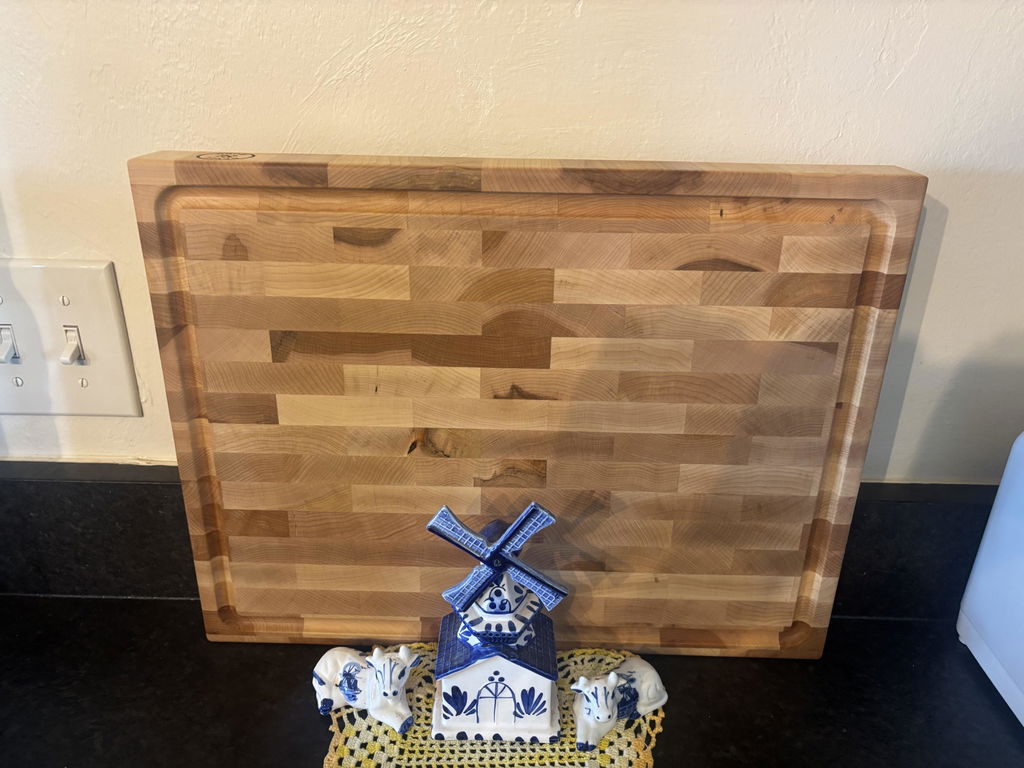
The short answer: most pre-packaged maple cutting board sets are not worth it. The boards are thinner, the lumber is lower-grade, and the matching packaging hides what would otherwise be obvious quality compromises. A better strategy: buy one excellent 17"×13"×1.75" main board, then add a small 8"×6" prep board separately. You'll end up with a real two-board system for less than most "sets" cost... and the boards will outlast them by a decade.
"Maple cutting board sets" sounds like a value proposition: three boards for the price of one premium board. The boxes look great. The marketing photos show neat stacks of three matching sizes. It's an attractive idea.
But here's what's actually happening on most of those listings.

Gift baskets follow different rules from matched sets — we covered that separately.
Why Sets Are Tempting
The pitch is real. Most home cooks do benefit from more than one board. Cross-contamination is a legitimate kitchen concern... using the same board for raw chicken and then for the salad isn't ideal even if you wash thoroughly. Having a dedicated small board for citrus (which strips wood finish faster) and a separate main prep board makes sense.
A matching set also looks tidy on a counter. There's an aesthetic logic.
The trouble starts when you look at the spec sheet.
The Spec Compromise Hidden in Most Sets
Pull up almost any "maple cutting board set" listing and you'll find the same pattern of compromises:
- Thinner boards. Most set boards are 0.6" to 1.0" thick... well under the 1.5" baseline for a real board. Thinner boards can be more susceptible to movement, especially with uneven moisture exposure.
- Face-grain construction. End-grain is too expensive to put into a 3-board set at a competitive price. Set boards are almost always face-grain, which dulls knives faster and is more prone to splitting.
- Vague species labeling. "Maple" without a species (no Acer saccharum, no "hard maple," no "sugar maple" specification) usually means soft maple, silver maple, or birch dressed up as maple. We covered this in our hard maple vs. soft maple breakdown.
- Warranty terms vary. Many set listings do not clearly display a written warranty. Check the current seller and manufacturer terms before buying.
The math works out to this: you may be paying $60–$120 for several thinner boards. A similarly priced, thicker repairable board may offer better long-term value, depending on use and care... and add small accent boards as you need them.
The Two-Board System That Actually Works
Serious home cooks don't typically use three matching boards. They use a two-board system:
- A main prep and carving board. 17"×13"×1.75" end-grain hard maple. This handles 80% of all kitchen work... vegetable prep, herb work, carving roasts, charcuterie, serving cheese.
- A small dedicated board. 8"×6" or 10"×8". Used for citrus, garlic, raw protein... anything you want kept separate from the main board.
This system covers cross-contamination, keeps your main board's finish protected from acidic foods like lemon and lime, and gives you a small board to bring out for cocktail garnishes without hauling out the full 10 lb main slab.
Notice what's not in this system: a third "medium" board. Most kitchens don't need one. Medium boards in sets exist because three boards photograph better than two, not because the third board has a clear job.
Building Your Own Set the Right Way
Here's what a real two-board kit looks like, built deliberately:
1. Main board. The Bevel & Bond 17"×13"×1.75" end-grain hard maple board. Acer saccharum, food-safe PVA glue-up, juice groove, non-slip feet, Board Balm hand-finish, premium gift box, 5-year written warranty. $139.99 with free U.S. shipping.
2. Small prep board. A separately-purchased 8"×6" hard maple board. Plenty of options at $20–$40 from small workshops or specialty kitchen brands.
Total: Around $160–$180 for a genuine two-board system... usually less than what a 3-board "premium" set costs, and dramatically better in spec quality.

When a Set Might Make Sense
Sets aren't categorically bad. There are two cases where they can work:
- Gift purchases for casual cooks. If you're buying for someone who isn't going to prep dinner every night, a matching 3-board set looks impressive in a gift wrap and gets the job done for occasional use.
- Apartment or temporary kitchens. For temporary or light use, a budget set may be practical.
For everyone else... particularly anyone shopping for boards they want to use for the next decade or longer... the set strategy is a false economy. The math doesn't favor it.
The Honest Recommendation
Buy one excellent board. Add a small prep board separately. Skip the matching-set marketing entirely.
Our end-grain hard maple board is built to be that main board... 1.75" thick, hand-finished, USA-made, with a 5-year warranty. Pair it with whatever small prep board fits your aesthetic, and you've built a system that will outlive any pre-packaged set on the market.
For the full board-buying framework, our 2026 Best Maple Cutting Board buying guide walks through every criterion that should drive your pick.
One great tool beats three average ones. Every time.
Are maple cutting board sets worth it?
Usually not. Most sets hit a price by cutting corners you cannot see in the photo: boards 0.6 to 1 inch thick, face-grain construction, vague species labeling, and unclear warranty terms. You may pay $60 to $120 for several thinner boards; a similarly priced, thicker end-grain hard maple board may offer better long-term value depending on construction, use, and care.
How many cutting boards do you actually need?
Two. A large main board for daily prep and carving, and a small board reserved for citrus, garlic, and raw protein. That covers cross-contamination and protects the main board's finish from acidic foods. The third "medium" board in most sets exists because three boards photograph better, not because it has a job.
What is wrong with cheap cutting board sets?
They are thin, soft, and unbacked. Thin boards can be more susceptible to movement, face-grain surfaces may show wear differently from end grain, and vague species labeling makes comparison harder. Check construction details and the written warranty before buying.
Should you buy a cutting board set or a single board?
Buy one excellent board and add a small prep board separately. A 17 by 13 by 1.75 inch end-grain hard maple main board plus a $20 to $40 small board runs about $160 to $180, usually less than a "premium" three-board set, and it outlasts the set by a decade.
When was this article last reviewed?
This article was last reviewed in July 2026 by the Bevel & Bond workshop team and reflects our current view on cutting board sets versus single boards.
Build the two-board system around a board that lasts. The Bevel & Bond hard maple end-grain cutting board is 17 by 13 by 1.75 inches of American Acer saccharum, backed by a 5-year warranty. Explore the full collection here.
Keep reading
- What Size Cutting Board Do You Actually Need?
- Maple Cutting Boards: Benefits, Care Tips, and How Patina Makes Them Better Over Time
Ready to choose your board? Browse all our cutting boards.