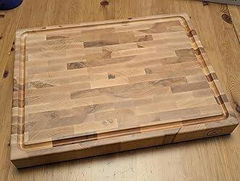
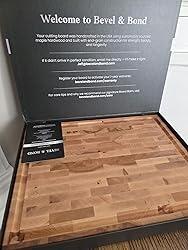
End-Grain Maple Cutting Board — Made in USA
4.9 from 135 verified reviews
- “The quality is top notch. I love a heavy/dense cutting board and this one is exactly that.” Shelley L., verified buyer
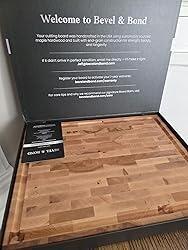
- “The presentation box it arrived in is gorgeous and makes it feel like a truly special gift for any occasion.” Kathleen, verified buyer
- “These are beautiful well finished cutting boards. So nice I bought 2!” Margo C., verified buyer
Every maple end grain cutting board we make starts as select US-grown hard maple. That makes it a true hard maple cutting board, built with the end grain facing up.
At 1.75 inches thick and over 10 pounds, it sits still while you work, feels balanced under a chef's knife, and looks the part on a kitchen counter or a Sunday spread. Made in Oregon, USA, built to age well, and backed by a 5-year limited warranty against manufacturing defects. If you call it a maple end grain chopping board, a small butcher block, or simply the board you reach for every day, it is the same construction that lives at professional butchery stations.
Read what customers say in our verified customer reviews.
What Makes This a Hard Maple End Grain Cutting Board
The species is the part most listings leave out. This board is US-grown hard maple, Acer saccharum, the sugar maple. Soft maple is a different and less dense wood that often gets sold as plain “maple,” so we name ours. Hard maple measures roughly 1,450 lbf on the Janka scale, which lands it in a useful middle ground: hard enough to resist knife marks, soft enough to spare your edge. Its grain is closed and tight, with fewer open pores than oak or ash.
Construction carries the rest. Each block is cut on the end and joined in a double glue-up with food-safe PVA glue, then finished at 17 x 13 x 1.75 inches and over 10 pounds. That mass keeps the board still while you work, and the vertical fibers meet the blade end-on rather than across the grain.
Key Features
End-Grain Maple Construction
Knife-friendly surface that reduces blade wear and promotes long-term durability.
Extra-Thick Butcher Block Design
Substantial weight and balance for secure, professional-level prep.
Generous Working Size
17″ × 13″ surface provides ample space for slicing, chopping, and serving.
Precision Juice Groove
Captures liquids from meats, fruits, and vegetables while preserving cutting space.
Non-Slip Feet
Keeps the board firmly in place and helps protect your countertops.
Hand-Finished in Oregon, USA
Crafted, inspected, and conditioned for lasting performance and beauty.
Premium Gift Box Included
Ready for gifting or raised storage straight out of the box.
How to Choose a Maple Cutting Board
A good maple cutting board comes down to five checks. Species: look for hard maple (Acer saccharum), not unnamed "maple", because soft maples are noticeably softer. Construction: end grain is easiest on knife edges and hides cut marks; edge grain is lighter and costs less. Thickness: 1.5 inches or more gives the board enough mass to stay put and enough wood to resurface later. Features: a juice groove if you carve, and feet that keep it off a wet counter. Warranty: read the written terms, because coverage varies widely between makers.
This board checks all five: US-grown hard maple, end grain up, 1.75 inches thick, a juice groove with non-slip feet, and a 5-year limited warranty against manufacturing defects, for $139.99.
Hard Maple End Grain Cutting Board Specifications
| Size | 17 × 13 inches (221 sq in of cutting surface) |
|---|---|
| Thickness | 1.75 inches |
| Weight | Over 10 lb |
| Wood | Solid US-grown hard maple (Acer saccharum) |
| Hardness | About 1,450 lbf (Janka) |
| Construction | End grain, double glue-up with food-safe PVA glue |
| Features | Juice groove, non-slip feet, gift box |
| Finish | Conditioned with Board Balm (food-grade mineral oil and beeswax) |
| Made in | Oregon, USA |
| Warranty | 5-year limited warranty against manufacturing defects |
| Care | Hand wash, dry right away, condition every few weeks. Not dishwasher safe. |
Frequently Asked Questions
Is an end grain maple cutting board better than edge grain?
For daily prep, yes, end grain is easier on knife edges and hides cut marks because the blade meets the fiber ends rather than crossing them. Edge grain is lighter and usually costs less, so it's a fine choice for light work or a secondary board. If you're chopping most days, end grain is the one that lasts. Here's how they compare side by side:
| Feature | End Grain | Edge Grain |
|---|---|---|
| Knife-friendliness | Best, blade meets the fiber ends | Good |
| Visible cut marks | Hides them | Shows them |
| Weight | Heavy (10+ lbs) | Lighter (5–7 lbs) |
| Best for | Daily prep, meat, serving | Light chopping, secondary board |
| Typical lifespan | 15–30 years with care | 8–15 years with care |

Full breakdown: end grain vs. edge grain cutting boards.
How thick should a maple cutting board be?
For serious kitchen use, look for at least 1.5 inches thick. Ours is 1.75 inches, thick enough for years of daily use with proper care and heavy enough not to slide when you're breaking down a chicken or slicing brisket. Thin boards generally have less mass and may be more sensitive to uneven moisture exposure; construction and care also matter. More on this in our cutting board thickness guide.
How do I clean an end grain maple cutting board?
Hand wash with mild soap and warm water, then dry it right away with a towel. Never submerge it, never put it in the dishwasher. Every few weeks, rub in a cutting board conditioner (our Board Balm works, so does food-grade mineral oil) to keep the wood from drying out. Step-by-step: how to clean a wooden cutting board.
Why maple over walnut, cherry, or teak?
Hard maple sits in the sweet spot on the Janka hardness scale, hard enough to resist knife marks, soft enough to protect your edge. Walnut is softer and darker (beautiful, but marks faster). Cherry is softer still. Teak has silica that dulls blades over time. Maple is the workhorse pros reach for, which is why it's what we build with.
What do professional kitchens use?
Hard maple end grain for butchery and carving, and color-coded plastic on the line where health codes require a dish machine. The construction we build is the one that lives at the butchery station. More in what professional chefs use for cutting boards.
Is a maple end grain chopping board the same as a cutting board?
Yes. "Chopping board" is the everyday term in the UK, Australia and much of the trade; "cutting board" is the American term. It is the same board either way: 17 x 13 x 1.75 inches of end-grain hard maple with a juice groove and non-slip feet, built for chopping, slicing and carving. If you have been searching for a maple end grain chopping board, this is it.
What does the 5-year warranty cover?
Manufacturing defects, for five years from purchase: a glue joint that opens, warping, or a structural fault in the wood or construction. It does not cover damage from soaking, dishwashers or heat, which no wood board survives. Warranty coverage varies by maker, so compare the written terms before buying. Details in what a good maple cutting board warranty covers.
Is this board solid maple?
Yes. It's solid US-grown hard maple (Acer saccharum) all the way through: end-grain blocks joined in a double glue-up with food-safe PVA glue. There's no veneer or filler wood.
What is a hard maple cutting board?
A hard maple cutting board is made from sugar maple (Acer saccharum), the dense, closed-grain species behind most American butcher blocks. At about 1,450 lbf on the Janka scale it resists deep knife scars without dulling your edge, and its tight grain limits how much liquid soaks in. Plain "maple" can mean softer soft maple, so look for the species name. This board is US-grown hard maple, built end grain up.
Is an end grain maple cutting board worth the price?
For a board you use every day, yes. An end grain maple cutting board takes far more cutting, gluing and flattening to build than an edge-grain board, which is why it costs more. In return you get a surface that is kinder to knives, hides cut marks and can be resurfaced for years. Ours is 17 x 13 x 1.75 inches and over 10 lb, and it costs $139.99 with a gift box and a 5-year limited warranty.
Further Reading
If you're still deciding, these guides walk through the trade-offs: the best wood for cutting boards, Maple vs walnut vs cherry, How to oil a cutting board, and end grain vs. edge grain. Comparing brands? Read our honest reviews of John Boos, The Boardsmith and every other major cutting board brand.
Care & Maintenance
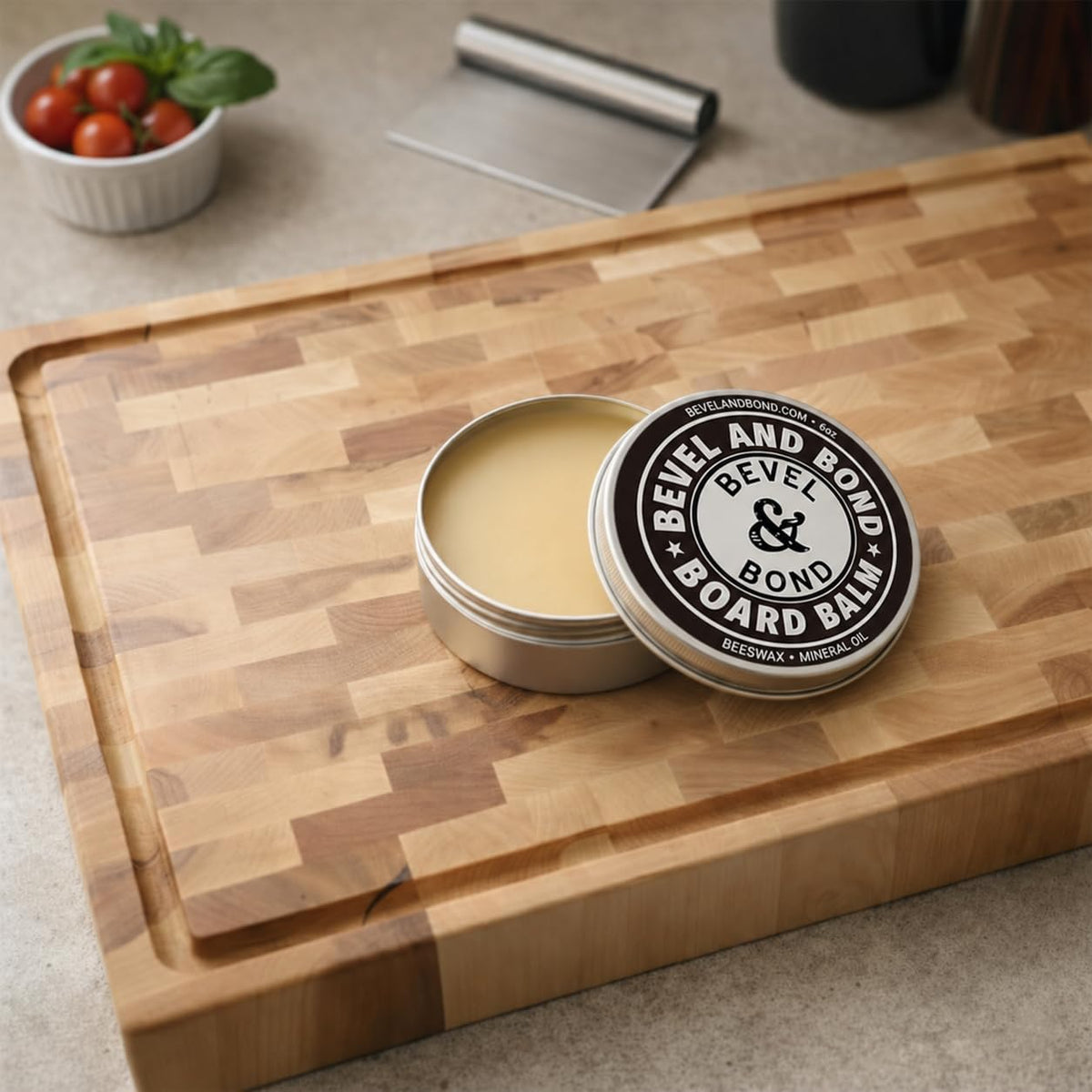
To maintain the board's finish and performance, hand wash with mild soap and dry immediately. Condition regularly with Bevel & Bond Board Balm Cutting Board Conditioner, our signature blend designed to nourish the wood, enhance the natural grain, and help protect against drying or cracking over time.
With proper care, this board is made to age beautifully, developing character with every use.
Trusted & Crafted with Care
Coverage for qualifying manufacturing defects; registration required.
Crafted from select US-grown hard maple, the Bevel & Bond Signature Maple Board is built for cooks who refuse to compromise on their tools.
The end-grain construction allows knives to glide between wood fibers rather than across them, helping preserve your blades while maintaining the integrity of the board over years of daily use.
At 1.75″ thick, this board earns its place on the counter. It stays firmly grounded during prep, delivers professional-grade stability, and develops character with every meal prepared. It simply performs, meal after meal, year after year.
Every board is made in Oregon, USA, finished with food-safe mineral oil, and packed in our premium black gift box. No seasoning required on arrival, it is ready to use from the moment it arrives.
Dimensions: 17″ × 13″ × 1.75″
Material: Select US-grown hard maple
Construction: End-grain butcher block
Finish: Food-safe mineral oil, hand-applied
Features: Precision juice groove · ergonomic side handle · non-slip rubber feet
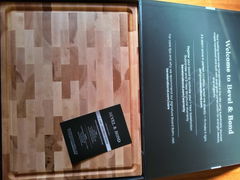
Packaging: Premium black magnetic gift box with welcome card and care instructions
Origin: Made in Oregon, USA
Care: Hand wash only · Dry immediately · Do not soak · Do not dishwasher · Oil every 3–4 weeks
Daily care: Hand wash with mild soap and warm water. Dry immediately, never leave wet on the counter or soak in water.
Monthly conditioning: Apply a thin coat of food-safe mineral oil. Let absorb for 20 minutes, wipe the excess. Repeat every 3–4 weeks or whenever the wood looks dry.
What to avoid: Dishwasher · prolonged soaking · cooking or vegetable oils (they go rancid) · direct heat sources · air-drying vertically while wet.
Long-term: With proper care, this board will deepen in color and character over time. That is not wear, that is a board earning its history.
Shipping: free standard U.S. shipping on this board
Every board ships free anywhere in the U.S. (free on all orders of $100 or more).
Processing & delivery
Orders are processed within 1–2 business days. Standard delivery takes 5–7 business days after shipping. You will receive a tracking number by email once your order ships.
Estimated total time to delivery: 6–9 business days.
30-day returns
We stand behind every board we ship. If you are not completely satisfied with your purchase, you may return it within 30 days of delivery for a refund, less a 15% restocking fee. Defective boards get a full refund under our 5-Year Warranty.
To initiate a return, email us at Jeff@bevelandbond.com with your order number. We will send you a prepaid return label within 3 business days.
Returned items must be unused and in original condition. Boards showing signs of use are not eligible for return, but may be covered under our 5 year warranty if there is a defect.
Damaged or incorrect orders
If your board arrives damaged or you received the wrong item, email us at Jeff@bevelandbond.com with a photo and your order number. We will replace or refund your order immediately, no need to return the damaged item.
Questions?
Email Jeff@bevelandbond.com or visit bevelandbond.com/pages/contact. We respond to every inquiry personally.
What is covered
Every Bevel & Bond cutting board is backed by a 5-year warranty against manufacturing defects. This covers:
· Structural separation or splitting along glue lines
· Warping or cracking under normal use conditions
· Surface defects present at the time of delivery
· Any failure resulting from a defect in materials or craftsmanship
What is not covered
The warranty does not cover damage resulting from:
· Dishwasher use or prolonged soaking in water
· Use of cooking or vegetable oils for conditioning
· Exposure to direct heat sources (ovens, stovetops, grills)
· Normal wear, darkening, or surface marks from regular use
· Boards that have not been maintained with food-safe mineral oil
How to make a claim
Email Jeff@bevelandbond.com with:
· Your order number
· A photo showing the issue
· A brief description of what happened
We will review your claim within 3 business days and either send a replacement board or issue a full refund, your choice. We do not require you to return the defective board.
Register your board
To activate your warranty, register your board at bevelandbond.com/warranty. Registration is required to make a claim.
Warranty questions?
Email Jeff@bevelandbond.com directly. Every claim is handled personally by our co-founders, James Taylor and Jeff Deveau.
The greenest board is the one you never replace.
US-grown hard maple, cut end grain and glued up by a wood shop in Oregon. When the surface wears, it gets sanded flat and re-oiled rather than thrown away. Kept that way, a wood board lasts 15 to 30 years.

End-Grain Maple Cutting Board — Made in USA
Top Features: Crafted to Last
No shortcuts in the wood. No shortcuts in the build. Four deliberate decisions separate a board you will replace from one you will keep for decades.


Built for every meal.
From weeknight prep to weekend feast.
The Bevel & Bond Signature Maple Board is built to handle everything the kitchen demands: raw meat, fresh vegetables, warm bread, charcuterie spreads, and everyday prep.
The generous 17″ × 13″ surface gives you room to work comfortably, while the end grain maple construction remains gentle on your knives through years of daily use.
Built for the cook who uses their tools, not just displays them.
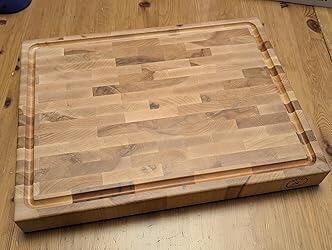
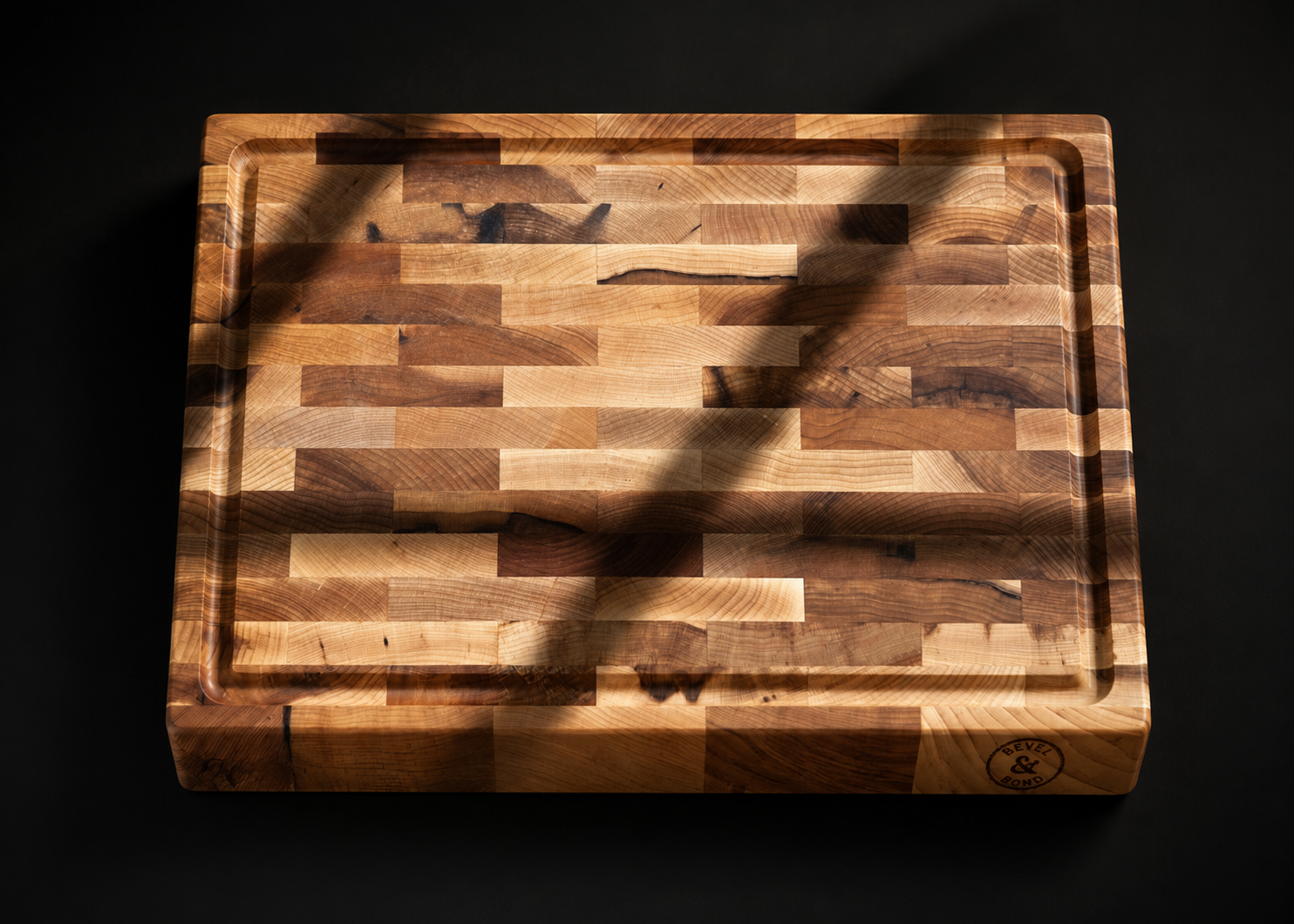 Actual end-grain surface
Why End-Grain
The surface professional kitchens choose.
In an end-grain board the wood fibers stand upright, like a tight bundle of straws. Your knife settles between them instead of slicing across them, so the surface scars less and your edge survives.
Face-grain and bamboo behave differently under a knife; durability and edge wear depend on species, construction, thickness, and care. Ours is solid US-grown hard maple, Acer saccharum, a traditional closed-grain choice for cutting boards.
- 1.75″ Thick
- 10+ Pounds
- 5 yr Warranty
- USA Handcrafted
- Species US-grown hard maple
- Dimensions 17″ x 13″ x 1.75″
- Construction End-grain, juice groove, non-slip feet
Wood species, not boards
Which wood makes the best cutting board? Eight species, compared
This table compares wood species. The board-to-board comparison, on thickness and warranty, is a separate section on this page.
Cutting board woods are ranked here on two properties: Janka hardness, the force in pounds (lbf) needed to embed a steel ball halfway into the wood, and grain structure, which decides whether a cut surface closes back up or leaves open pores that hold moisture and food residue.
Our own Janka guide sets the useful window plainly: “The ideal range is 900 to 1,500 lbf. Below 900, the wood dents and scars too easily for daily chopping. Above roughly 1,500, the surface starts wearing knife edges faster.”
Every figure in the table below is taken from that article, Wood hardness for cutting boards: the Janka scale explained, published on this site.
| Wood species | Janka hardness (lbf) | Grain | Verdict as a cutting surface |
|---|---|---|---|
| Hard mapleThis boardAcer saccharum | 1,450 | Closed | Best all-around |
| WalnutJuglans nigra | 1,010 | Closed | Excellent, softer |
| CherryPrunus serotina | 950 | Closed | Good, lighter duty |
| TeakTectona grandis | 1,070 | Closed, oily | Good, dulls knives slightly |
| Red oakQuercus rubra | 1,220 | Open | Poor, too porous |
| Acacia | 1,700+ | Wild, interlocked | Fair, unstable and hard on knives |
| Bamboo | 1,400–1,600 | Fibrous, glue-laden | Poor, dulls knives fast |
| Hinoki cypress | ~400–500 | Softwood | Specialist, dents easily |
Harder is not better, and two of these are harder than maple
Two woods in this table are harder than hard maple, and we are not going to pretend otherwise. Acacia measures 1,700+ lbf and bamboo 1,400–1,600 lbf, at or above maple’s 1,450 lbf. On a cutting surface that works against you: past roughly 1,500 lbf the board stops yielding and the knife edge yields instead, which is why bamboo has a reputation for dulling blades fast. Acacia adds a second problem on top of hardness, a wild interlocked grain that moves and makes the board unstable.
Softer woods trade the other way. Cherry at 950 lbf and walnut at 1,010 lbf are gentler on an edge than maple is, and they dent and scar sooner under daily chopping. Hinoki cypress, a softwood at roughly 400–500 lbf, is valued in Japanese kitchens for exactly that gentleness, and it dents if you treat it like a chopping block.
Grain is a separate axis, not a footnote. Red oak sits inside the ideal hardness range at 1,220 lbf and is still a poor cutting board, because its open pores hold moisture and food residue. Teak is closed-grained and comfortably in range at 1,070 lbf, and its natural oils and silica still dull knives slightly.
So hard maple’s 1,450 lbf is not the top of the table, and it is not meant to be. It is the point just inside the upper limit of the ideal range where the surface is hard enough to resist denting and scarring, closed enough not to trap moisture, and still soft enough to let a blade settle in rather than skate off it. That is the whole case for maple. It is a trade-off, not a clean sweep.
Where this board sits: the Bevel & Bond board on this page is US-grown hard maple, Acer saccharum, 1,450 lbf, closed grain, built in end-grain construction at 1.75″ thick. $139.99.
Janka values, grain descriptions and verdicts on this page are taken from our own guide, Wood hardness for cutting boards: the Janka scale explained.
The Comparison
Thicker. Backed longer. Fairly priced.
A thicker board than most, a five-year limited warranty, at a price that is not trying to impress anyone. Here is how it compares.
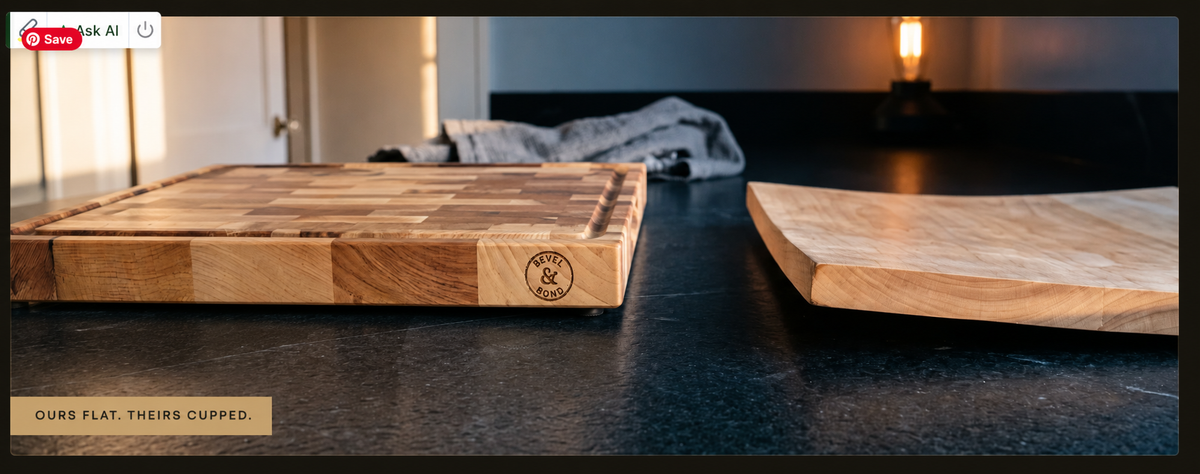 Ours flat. Theirs cupped.
| Board | Thickness | Warranty | Notes |
|---|---|---|---|
| Lower-cost thin board | 0.75″ | None | Less mass; stability depends on construction and care |
| Standard premium board | 1.5″ | None | Compare materials, construction and warranty |
| Bevel and BondOurs | 1.75″ | 5 years | Made in Oregon, USA, ready to use |
Figures reflect commonly sold boards in each category. We do not name competitors.
Before You Buy
Why this board, and why it costs what it costs.
The honest answers to what people ask us most before ordering.
Why buy this instead of a 30 dollar board?
A cheap board is a consumable. It scars, absorbs water, warps, and quietly ruins your knife edges, then you replace it in a year or two. This one is 1.75″ of solid end-grain hard maple, hand-finished and backed for five years. You buy it once.
Why end-grain instead of edge-grain or bamboo?
In end-grain the wood fibers stand upright, so your knife meets the fiber ends rather than crossing them. Edge-grain boards get sliced across the fiber, so they scar and stay scarred. Bamboo can be harder than many common cutting-board woods, so knife wear varies by board construction and use.
Does 1.75″ really matter, or is 1.5″ fine?
It matters twice. Mass keeps the board still while you work. And thickness leaves more wood for years of use and future resurfacing. With non-slip feet and that much solid maple, it stays put while you work.
Why hard maple and not walnut, teak or acacia?
Hard maple sits in the sweet spot: dense enough to resist scarring, soft enough to spare your edge, tight-grained so it does not harbor moisture. Teak contains silica that dulls blades. Acacia varies by species and construction; compare the stated material, build, and care requirements.
Is it worth it if I only cook a few times a week?
Yes, for a different reason. Occasional cooks keep a board far longer, so warping and staining are what retire it, not wear. A board that's cared for and refinished with a rub of oil still looks good in ten years.
What makes the 5-year warranty meaningful?
It provides defined manufacturing-defect coverage for five years. If a manufacturing defect shows up within five years we repair or replace it, no runaround. We can promise that because each board is made to our specifications in Oregon, USA.
Will it actually protect my knives?
Yes, and people underestimate this. Every cut on a hard surface rolls the edge of your blade a little. End-grain maple lets the edge pass between fibers instead of hammering across them, so you sharpen less often.
What if I get it and do not love it?
Send it back within 30 days. Beyond that the five-year warranty covers manufacturing defects.
Bevel & Bond 5 Year Warranty
Exceptional quality. I prefer a heavy, dense cutting board because a board that slides around is dangerous, and this one stay firmly in place. I was impressed by how thick and substantial it is. I received it as a gift, and it’s clearly built to last. Thank you!
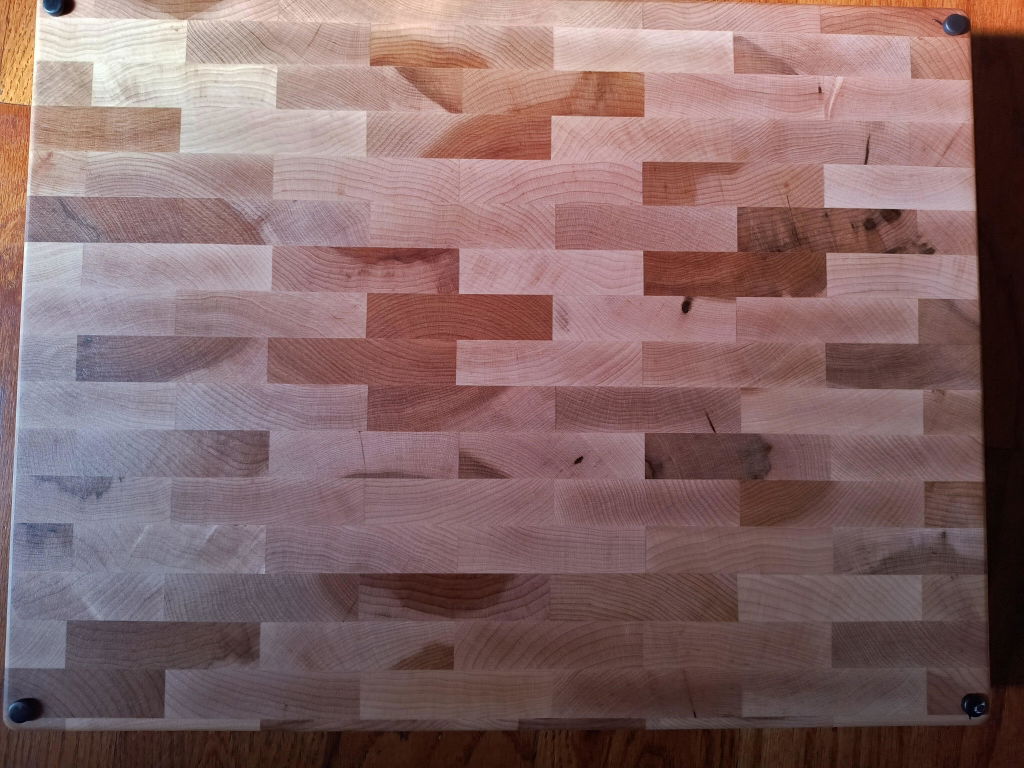
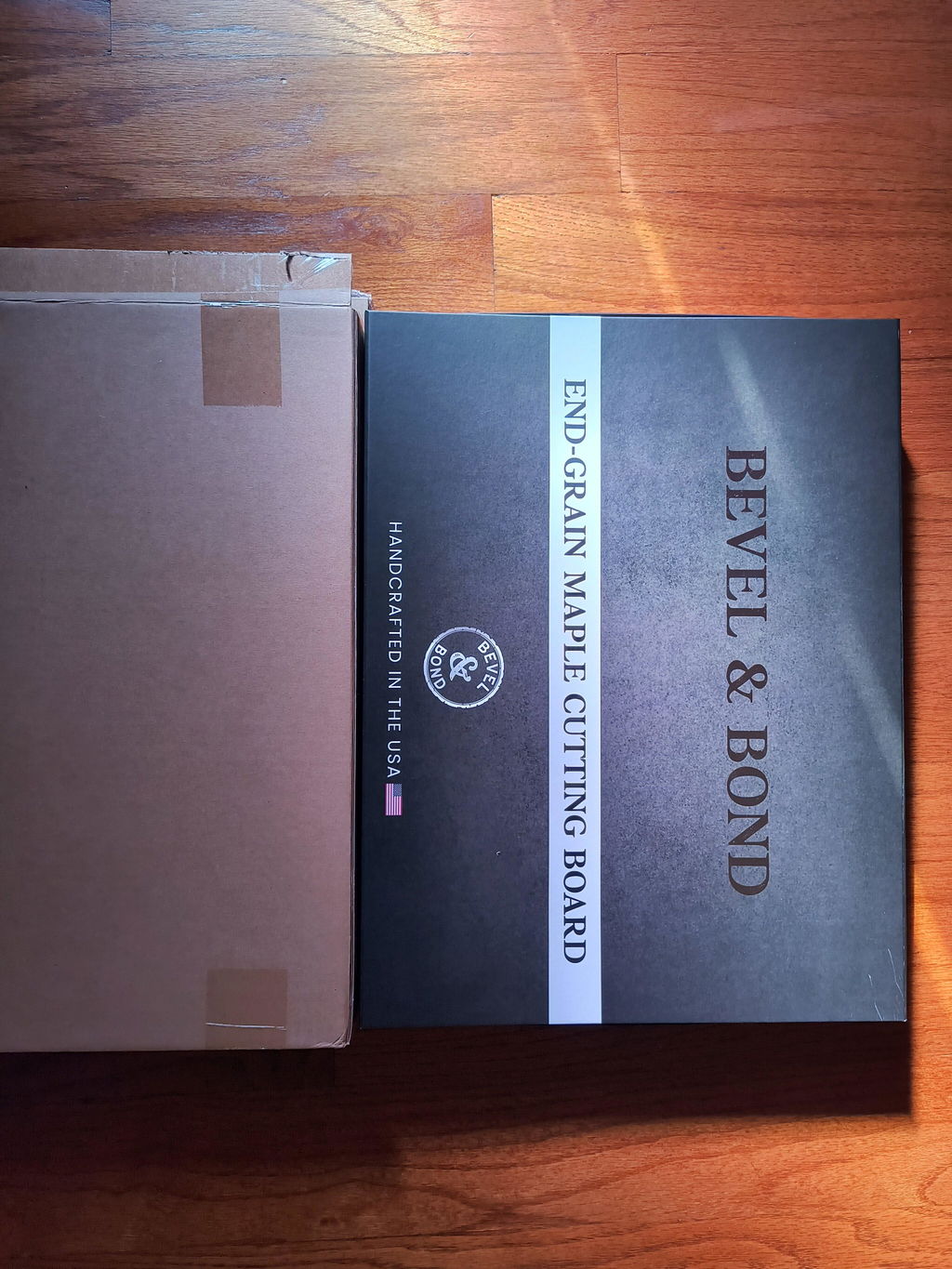
Over the last 40 years, I've used many different cutting boards. I've had various types of wood, plastic, and synthetic. All of these have been thrown away because of wearing too fast. Then we found out about micro-plastics getting into our food.
We now use wood and don't use it for cutting meat. I purchased one for my kitchen, but the deep cuts are unsightly and the knives dull very quickly.
I was extremely excited when I received the Bevel & Bond Cutting Board. This cutting board is the real deal. It's very heavy and will not slide on your counter or island. It looks very different from other cutting board.
This board uses end-grain hard maple wood, grown in the USA. When the knife cuts across the end-grain wood it doesn't make marks easily and protects the knife edge. So your sharp knives are not needing to be sharpened as quickly.
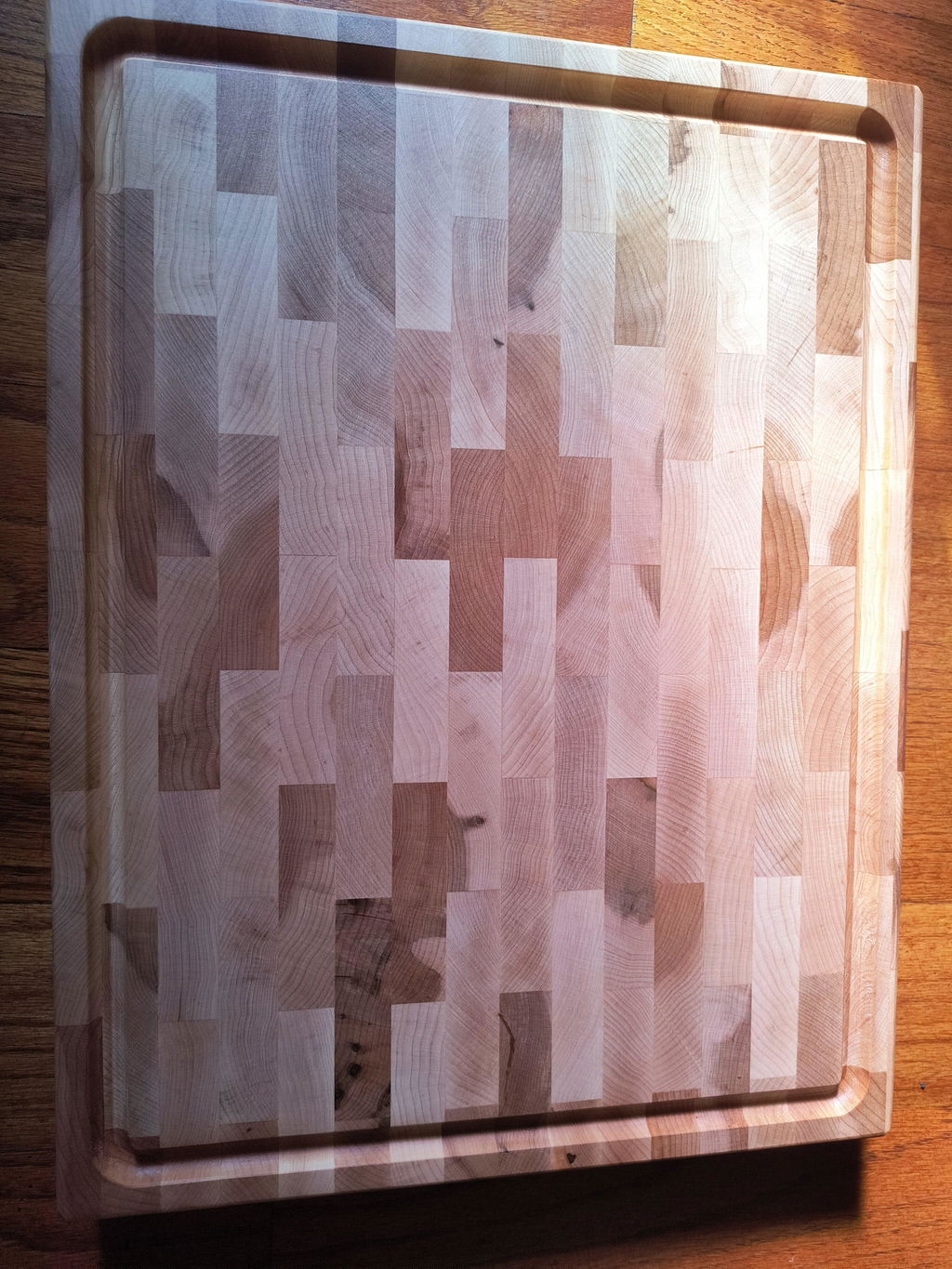
This beautiful wood board measures at 17 x 13 x 1.75 and weighs 10 pounds! I've never seen one as substantial. I wondered about the thickness and weight. Why does it need to be so heavy? The thickness is because of the end grain choice of design. The end choice means the the slice of wood faces the top.
This board weathers very well and gets a deeper color with age. If it's taken care of well, it will last and last. It even has a 5-year warranty on workmanship. It doesn't cover soaking, machine washing, or heat. No cutting board will survive those things.
Instead use this care method: Hand wash with mild soap and dry immediately. Condition regularly with Bevel & Bond Board Balm, the signature blend designed to nourish the wood, enhance the natural grain, and help protect against drying or cracking over time.
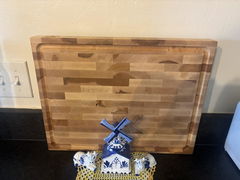
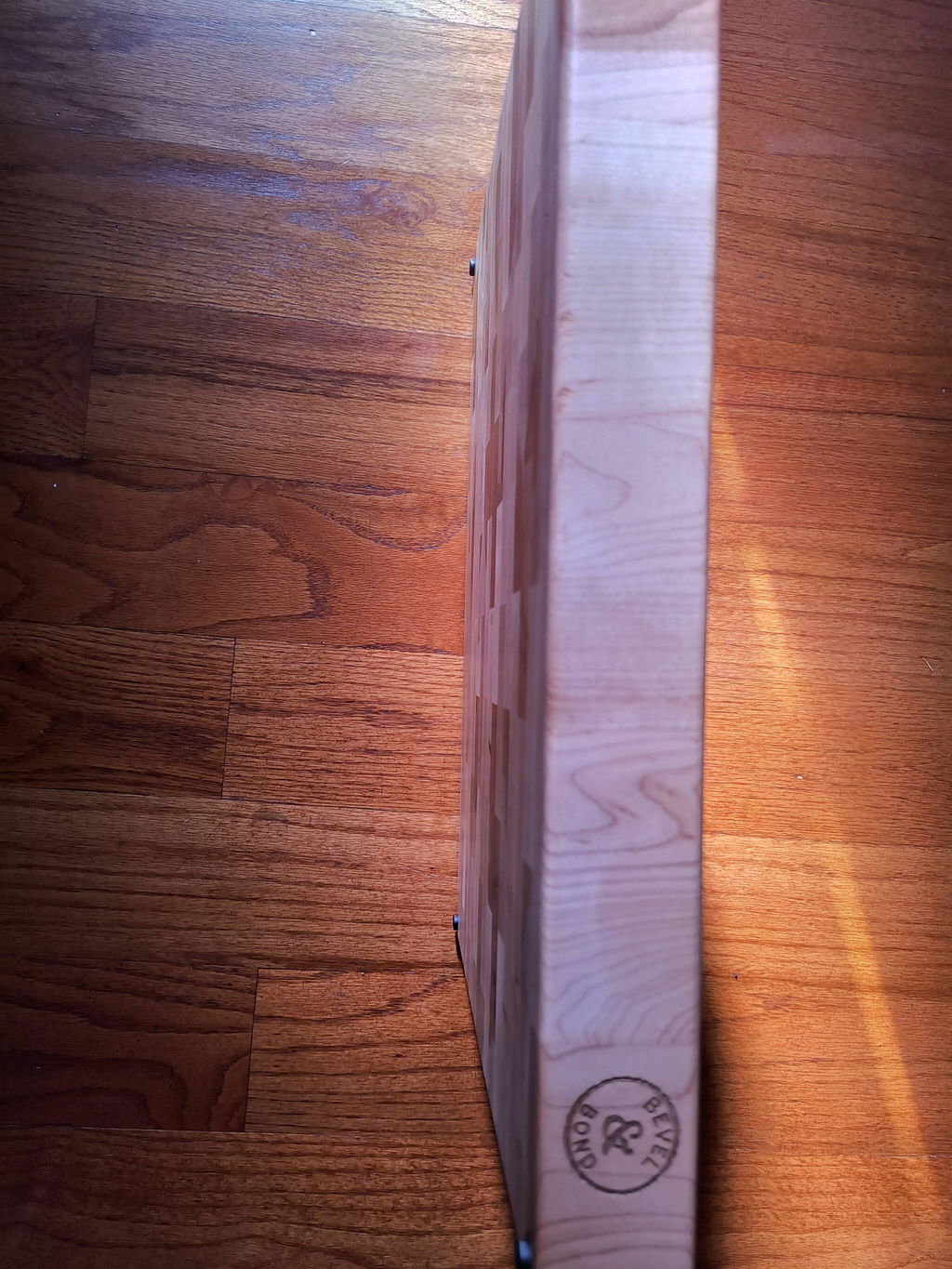
It has a deep juice groove for those messy vegetables and fruits. It also has handles built in, so there aren't attached to the wood, but are part of it. Another plus is that it won't move: because it's heavy and has rubber feet that hold it's place.
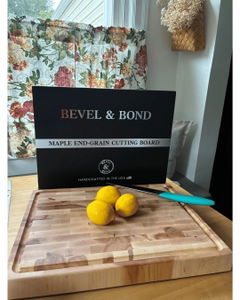
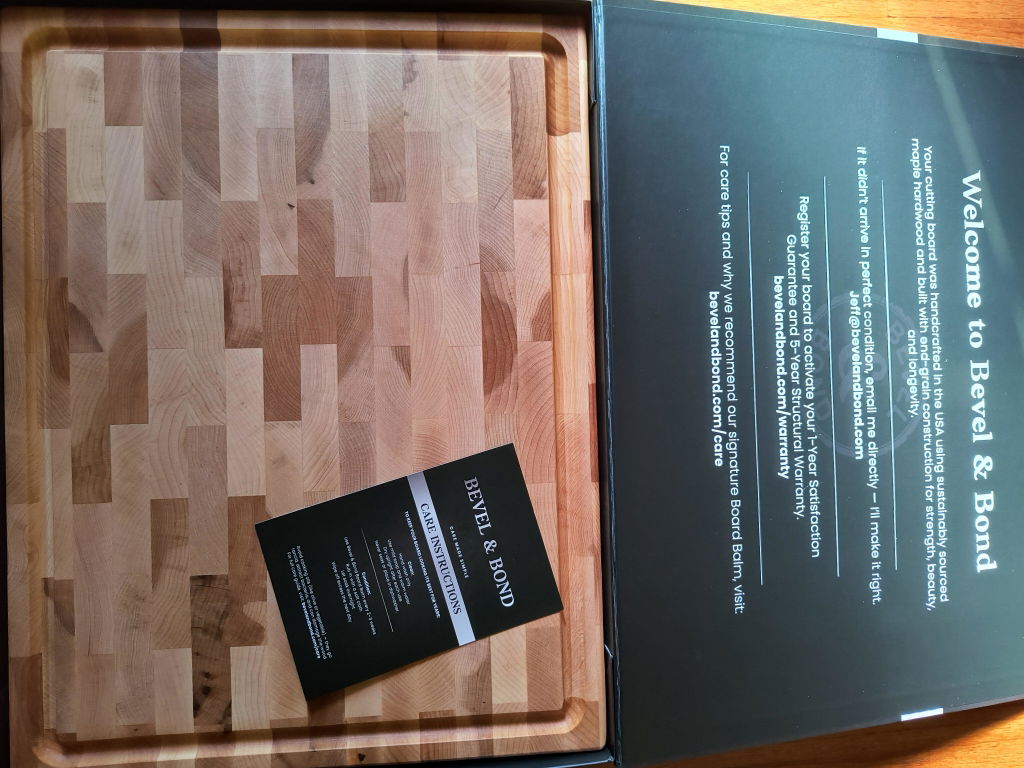
I hope that you'll also look into getting one for your family. It comes in a gorgeous box with a magnetic latch. It would make a lovely gift for a birthday. or Christmas.
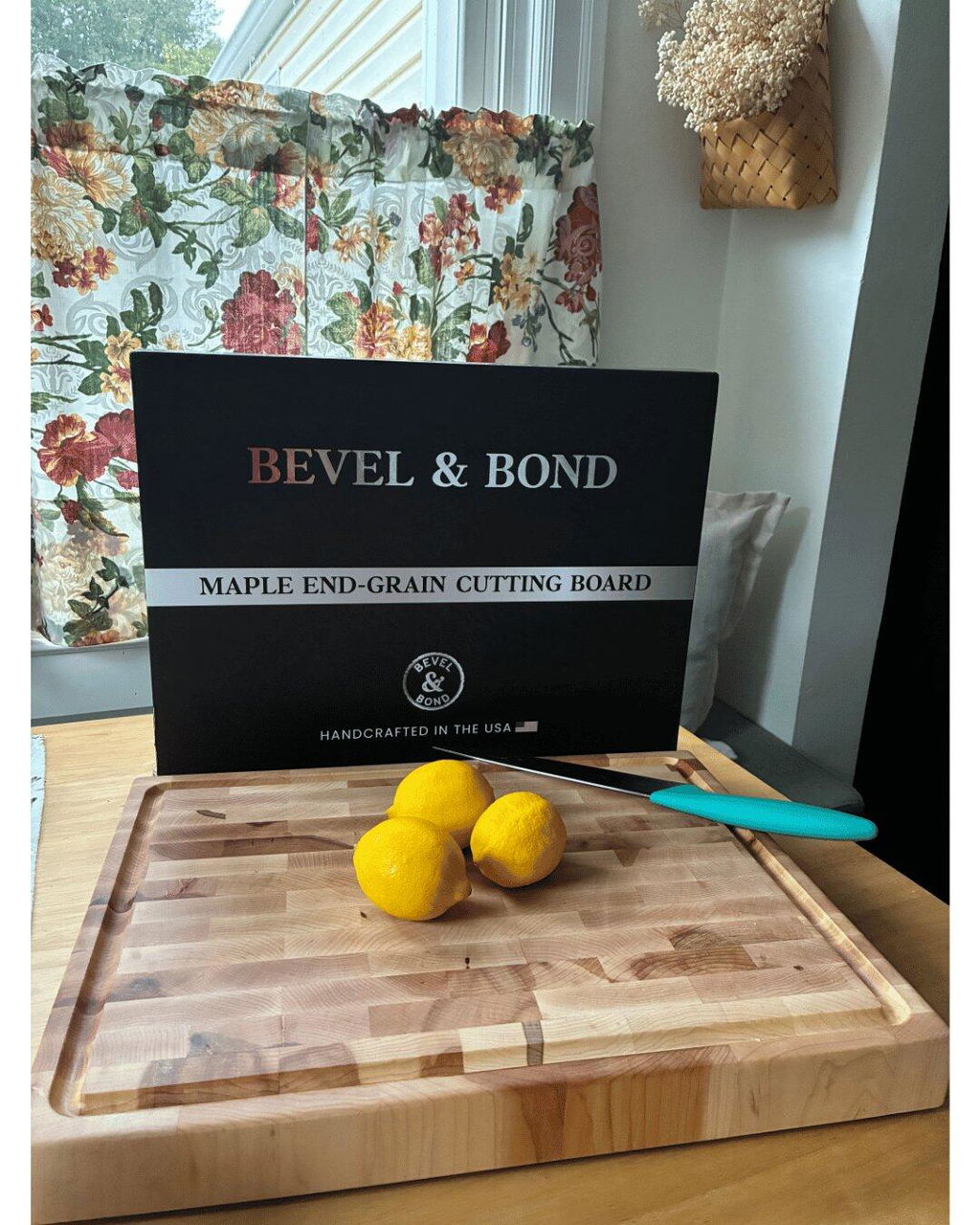
These are beautiful well finished cutting boards. So nice I bought 2! Great price for the quality.
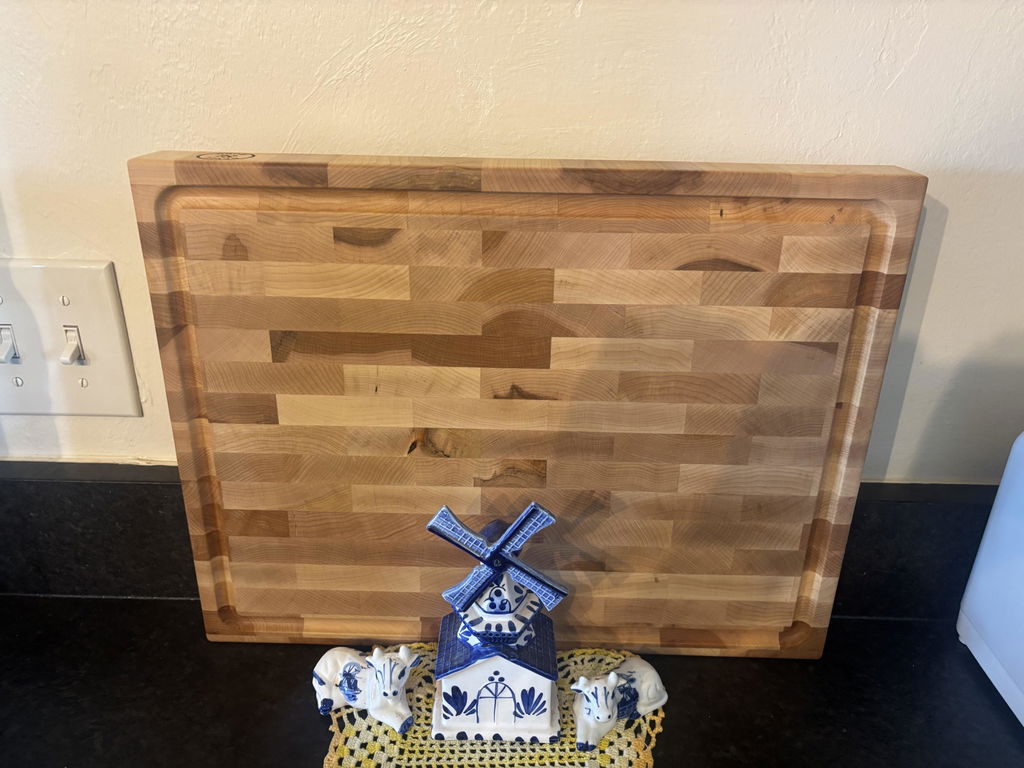
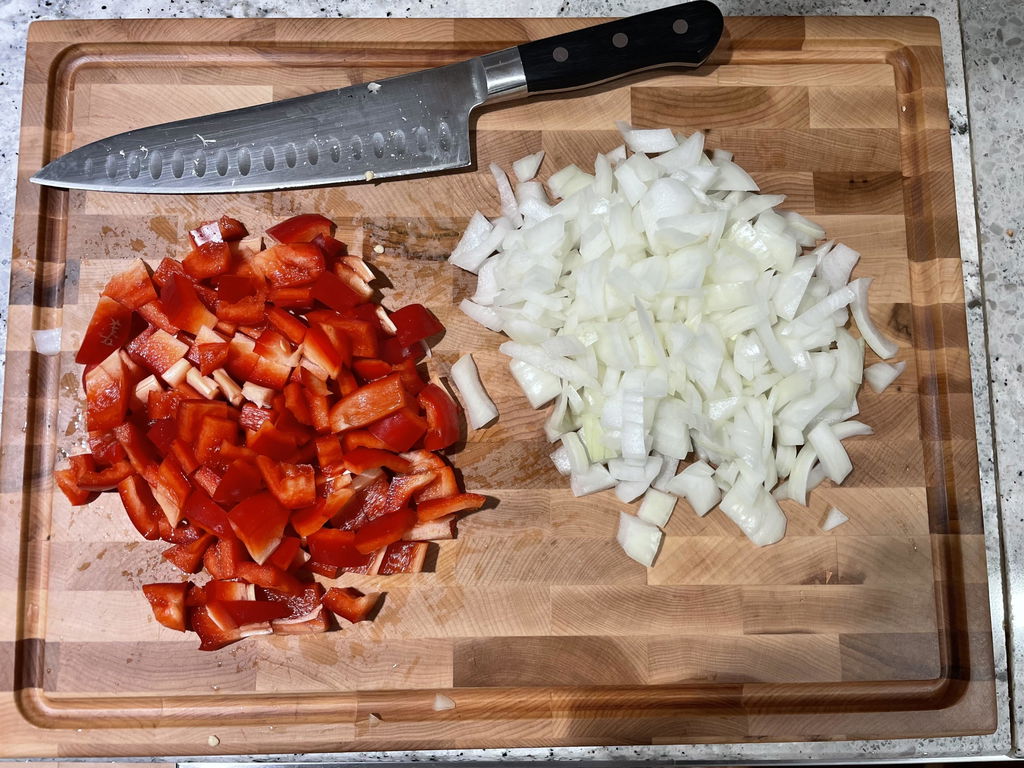
The board functions perfectly and doesn't slip at all, but it requires dedicated conditioning with mineral oil to keep it from looking dull after multiple washes.
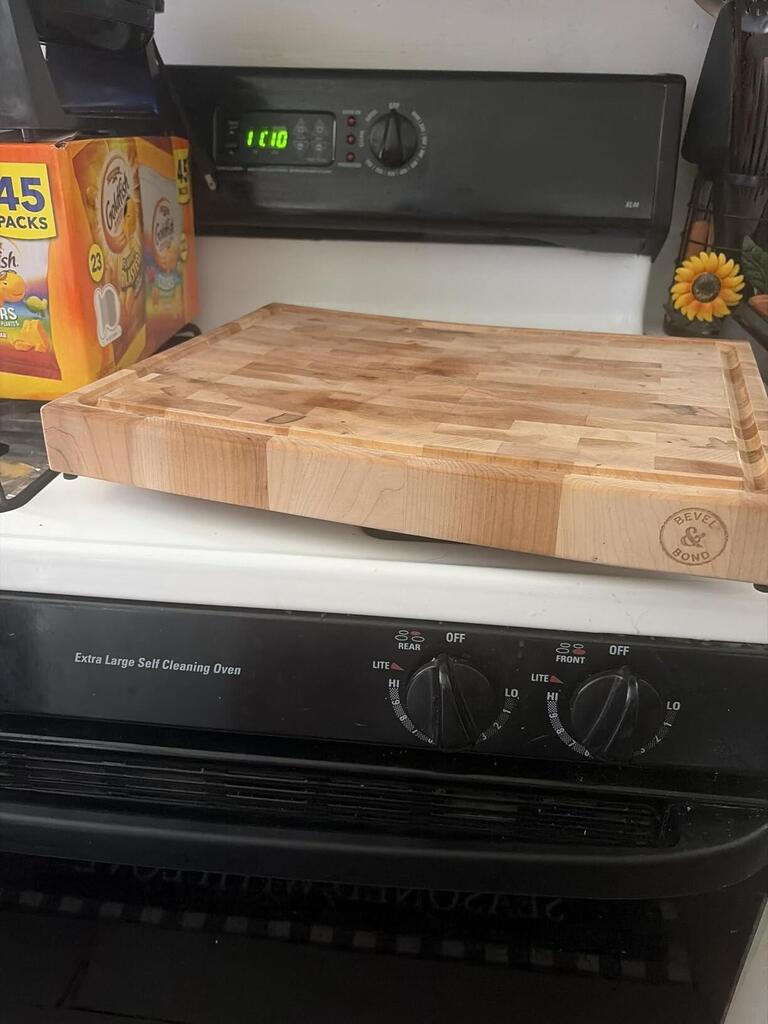
Thick, rock-solid, and incredibly durable. It can easily withstand aggressive chopping with heavy butcher cleavers without chipping or cracking. Great block.
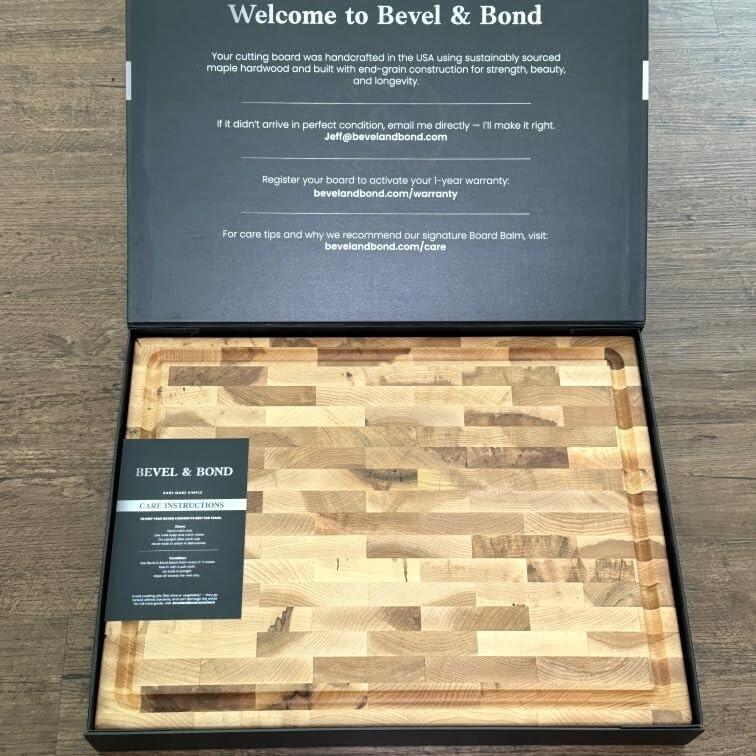
The juice groove on this maple board is a lifesaver when resting prime ribs or slicing into juicy steaks. It easily holds all the liquid without overflowing.
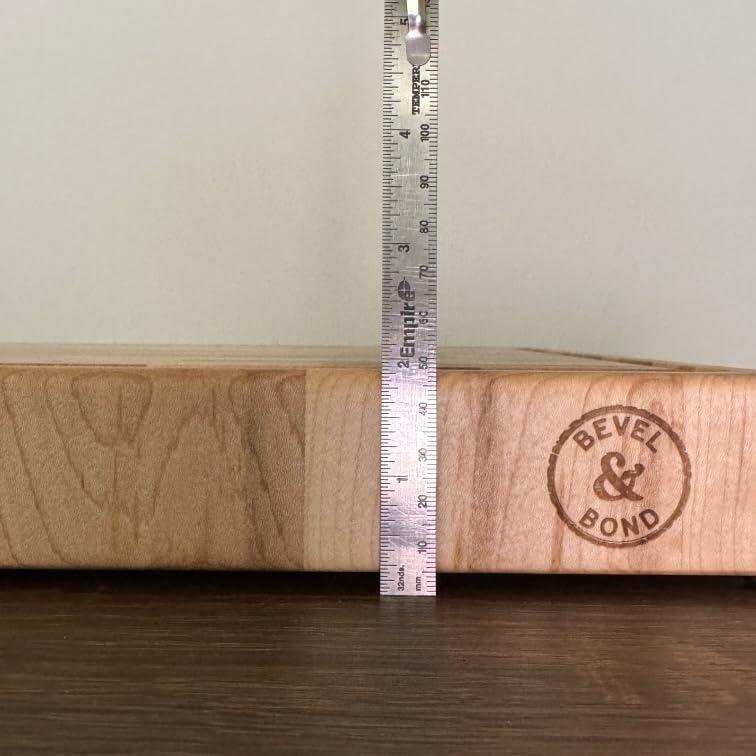
This board has a serious 10 lb presence on my countertop. The rubberized feet lock it safely onto my granite surface, so there is zero sliding during heavy meal prep.
The packaging alone makes this worth it if you are looking for a high-quality gift. The product itself is incredibly premium, smooth, and heavily built.
Beware it can warp,I’m giving five stars, cause their customer service is impeccable and very responsive they were able to ship me out one at no cost and I did not even have to return it.

I could not be happier with the Bevel & Bond End Grain Maple Cutting Board! From the moment you unbox it, you can tell the craftsmanship is top-notch. The end-grain construction is not only breathtaking with its natural wood pattern, but it’s also incredibly gentle on my chef's knives. If you are looking for a high-end, durable, and gorgeous cutting board that brings both functionality and warmth into your kitchen, this is worth every single penny. Highly recommended!
Beautiful Board, the size and weight makes it very easy to use . I highly recommend it
Absolutely stunning cutting board! This is a beautifully crafted, high-quality board made in the USA, and I’m sure it will last for many years to come. The presentation box it arrived in is gorgeous and makes it feel like a truly special gift for any occasion.
I love my Bevel & Bond cutting board so much that I ordered another one as an anniversary gift. I couldn’t be happier with this unique and beautiful product. Thank you, Bevel & Bond!
The quality is top notch. I love a heavy/dense cutting board and this one is exactly that. I do not like my cutting boards to move around. It’s dangerous. These are heavy, and it’s just perfect!
Excellent customer service!
Love It! Solid and seems like it’ll last a lifetime!
This is beautiful. Well made heavy duty and came in a nice case! Would make a very nice gift . It’s end grain so it high quality and better for your knives. It’s great size for cutting. I am excited to use this over my scratched up plastic cutting boards that leach plastic into all my foods.
This is amazing!!!!! I went on a deep dive for end grain cutting boards and so glad I found this one.
Very pleased with this gift that I received from a good friend of mine. I wasn't expecting a 10 pound piece of wood like this! fits well in the kitchen
Heavy Board with great craftsmanship. Recommended to anyone looking for a great cutting board that can be used for any type of cooking
Quality about all else and this delivered. Happy with the purchase. Everything is made her in the USA, which makes it easy. I was able to exchange my board without any issues. Customer service number 1
I was very impressed by how heavy and thick this cutting board was. I got it as a gift and was highly impressed. It's something that will last a long time! Thank You
Love it! Amazing quality, fast shipping - gorgeous board!
Already registered it, we are very pleased with it.
I could see their passion for their product when I opened the well packaged shipping container which revealed a very classy and functional protective storage box. Inside, the actual cutting board was so beautiful that I initially struggled to use it! I’ve been using it daily now for about three weeks and it’s obvious that the quality is incredible! I clean it after every use and it still looks as beautiful as when I opened it. I have every confidence that if I continue to use and maintain it per the factory recommendations that I’ll get decades of use and satisfaction with this product! I was also very appreciative of receiving the complimentary balm after registering my board. Using it is a part of the recommended maintenance, and it’s impressive what it does maintain the beauty, and I’m sure, the life of my board.
You expect to pay a little more for an American made product and is certainly justified in my Bevel & Bond board!
Amazing Item! I can't wait to use it this weekend when I get back for the family gathering. it's heavy, but its made with such durablilty.