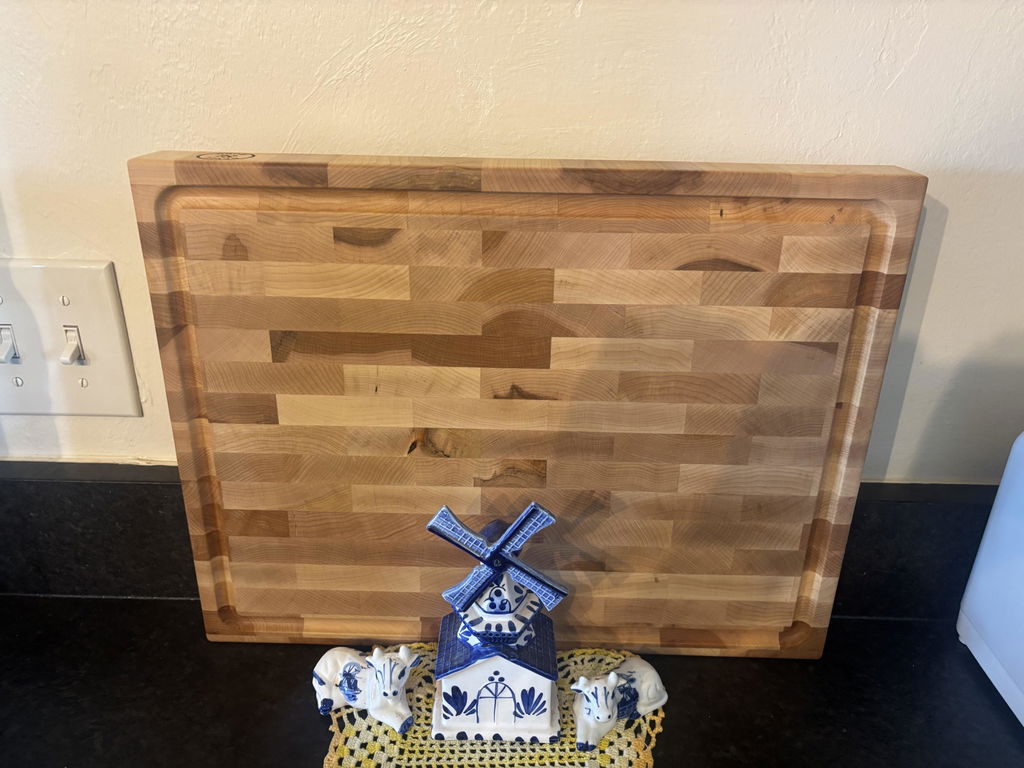
Maple resists odors well. Its closed, tightly packed grain gives smells very little room to settle into, which is why a well-oiled maple board holds onto garlic and onion far less than bamboo, worn plastic, or an open-grained wood like oak.
"Resists" isn't "immune," though. A dry, unoiled maple board that just met six cloves of garlic will smell like it. The good news is that it's temporary and easy to fix.
Scorching leaves a smell that won't wash out. Here's what happens with hot pans on wood cutting boards.
Why does maple hold odors less than other materials?
Because odor molecules travel in liquid, and liquid needs somewhere to go. Maple is diffuse-porous with small, uniform pores, so there are no large open channels for onion juice to sink into.
Open-grained woods like oak and ash have visible vessels running through them, which is exactly where smells collect. Plastic behaves differently but ends up worse: once knife scoring opens grooves, food residue lodges in them and the board keeps the smell permanently.

How different boards handle odor
| Material | Odor resistance | Why |
|---|---|---|
| Hard maple | Very good | Tight closed grain, seals with oil |
| Walnut / cherry | Very good | Also closed-grain |
| Oak / ash | Poor | Open vessels trap residue |
| Bamboo | Fair | Glue seams and hard scoring |
| Plastic (new) | Good | Non-porous surface |
| Plastic (scored) | Poor | Residue lodges in knife grooves |
Does oiling actually reduce odor absorption?
Yes, and it's the single biggest factor you control. A conditioned board is already saturated with mineral oil, so there's no room left for onion juice to soak in. Liquid beads up and wipes away instead.

A dry board is the opposite: thirsty wood pulls in whatever liquid touches it, smell included. If your board has started holding odors it didn't used to, it's telling you it needs oil. Our oiling guide covers the method.
Which foods are most likely to leave a smell?
Garlic, onion, and fish are the usual three. All are high in volatile sulfur or amine compounds that bind readily to any surface. Curry, chili, and strong cheeses come next.
These will scent almost any board briefly. The difference is whether the smell is gone after a wash and a dry, or whether it's still there next Tuesday.
How do you get a smell out of a maple board?
Start simple. Wash with hot water and dish soap, then dry on edge. That handles most cases on its own.
If the smell lingers, cut a lemon in half, sprinkle coarse salt on the board, and scrub with the cut face of the lemon. The salt lifts residue mechanically and the citric acid neutralizes what's left. Rinse, dry standing up, and re-oil when fully dry. Full steps are in how to get the smell out of a wooden cutting board.
Does baking soda work?
It does, especially for stubborn smells. Make a paste with a little water, spread it over the area, leave it 15 minutes, then scrub and rinse. Baking soda neutralizes acidic odor compounds rather than masking them.
Skip bleach. It's harsh on wood, strips the finish, and leaves its own smell behind. Trading garlic for chlorine isn't much of an upgrade.
Does maple transfer flavors between foods?
Rarely, on a maintained board. A properly oiled surface doesn't hold enough residue to move flavor from onions to strawberries. If you're tasting transfer, the board is either dry, unwashed, or overdue for resurfacing.
Many cooks still keep a separate board for alliums and fish, which is a reasonable habit rather than a necessity. Our take on multiple boards is in separate cutting boards for meat and vegetables.
Does end grain absorb more odor than edge grain?
Slightly, in theory, because exposed fiber ends are more absorbent than fiber sides. In practice the difference is negligible on a conditioned board, since the oil is doing the sealing either way.
Can an old smell be sanded out?
Yes, and it's the reliable fix for a board that's been neglected. Sanding removes the top layer where residue lives. Start at 120-grit, work up to 220, then oil generously several times. Our refinishing guide walks through it.
Why does my board smell sour or musty?
That's usually moisture, not food. A board stored damp or left flat in a puddle can develop mildew in the surface layer. Wash, dry standing on edge, and if there are dark spots see mold and black spots.
When was this article last reviewed?
This article was last reviewed in August 2026 by the Bevel & Bond workshop team.
The takeaway
Maple's closed grain makes it one of the better odor-resistant board surfaces available, and keeping it oiled is what preserves that. Wash, dry upright, oil monthly, and reach for lemon and salt on the rare day the garlic wins.
A tin of Board Balm keeps that seal intact, and our end-grain hard maple board ships already conditioned.