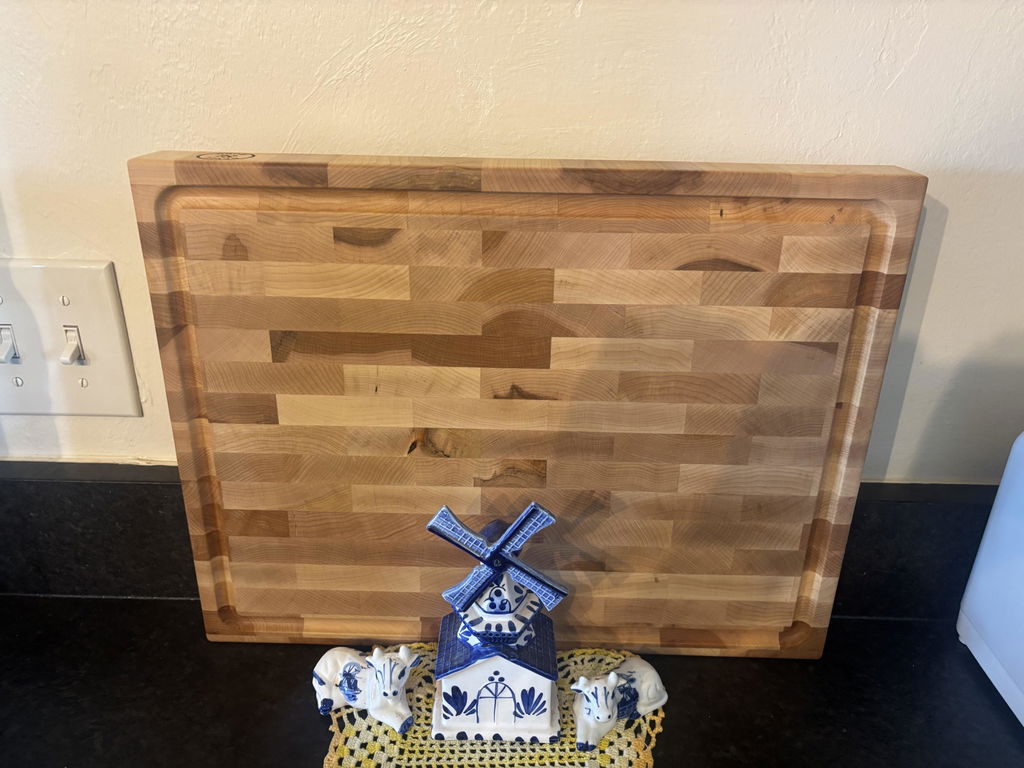
Yes, your maple board will change color, and most of that change is patina rather than damage. New hard maple is pale, almost white. Over a few years it deepens to a warm honey tone as the wood oxidizes and absorbs oil. That's normal, expected, and to many people the best thing that happens to the board.
Actual staining, the kind that leaves a mark you didn't want, is a separate and much smaller category. Here's how to tell them apart.
Butcher block ages differently again — butcher block countertops, pros and cons explains the proportions behind that.
What's the difference between patina and a stain?
Patina is even. It develops across the whole surface, slowly, and looks like the board deepened a shade. Stains are localized, sharply edged, and usually show the shape of whatever caused them.
If your board is uniformly warmer than it was in year one, that's patina and it's doing fine. If there's a purple ring the size of a beet slice, that's a stain.
Which foods actually stain maple?
The heavy hitters are turmeric, beets, red wine, berries, tomato paste, and anything with strong natural pigment. Turmeric is the champion, and it will mark almost any porous surface within minutes.
Most everyday prep, onions, carrots, bread, meat, leaves nothing behind. It's the concentrated pigments you need to move quickly on.
Stain risk by food
| Food | Stain risk | Act within |
|---|---|---|
| Turmeric / curry | Very high | Immediately |
| Beets | High | A few minutes |
| Red wine | High | A few minutes |
| Berries | Moderate | 10 to 15 minutes |
| Tomato / paste | Moderate | 15 minutes |
| Raw meat juices | Low | Wash after use |
| Onion, carrot, herbs | Very low | Normal washing |
How fast you need to move
The same data, read as urgency. The longer the bar, the less time you have before the pigment sets.
Does oiling prevent staining?
It's the best prevention there is. A board saturated with mineral oil has no room left to absorb pigment, so beet juice sits on the surface instead of soaking in. You wipe it away and nothing remains.

An unoiled board is thirsty and takes in everything. This is why the same board can shrug off red wine one year and stain from it the next. The board didn't change; the oil ran out. Our maintenance schedule covers timing.
Why does my board look gray or dull instead of darker?
That's dryness, not patina. Gray, chalky, or cloudy surfaces mean the oil has depleted and the exposed wood fibers are raised and light-scattering. It looks like discoloration but it's a moisture problem.

A single generous oiling usually brings the color straight back. If it doesn't, a light sanding followed by oil will. See sticky, rough, or gray boards and how to whiten a wooden board.
Can you remove a stain once it's set?
Usually. Because maple's closed grain keeps pigment shallow, most stains live in the top fraction of a millimeter. A salt-and-lemon scrub lifts fresh ones, a baking soda paste handles moderate ones, and sanding removes almost anything.
Start with the least aggressive option and work up. Our step-by-step is in how to remove stains from a wooden cutting board.
Will dark water marks come out?
Light water marks and white cloudy rings usually do, with oil alone. Dark gray or black marks are different, they're often tannin reactions with metal or the beginning of mildew, and they need a targeted approach. See rust and metal marks.
Do knife marks count as discoloration?
They can look like it, because cuts catch oil and food differently than the surrounding surface, so they darken first. On an end-grain board cuts stay shallower, which is why these boards stay visually cleaner for longer.
Is discoloration a food safety problem?
Color change on its own isn't. Patina, deepening tone, and faint stains are cosmetic. What does warrant attention is black spotting that doesn't sand out, a musty smell, or a fuzzy surface, since those point to mold rather than staining. Our guide to mold and black spots covers the difference.
Should you try to keep the board looking new?
Honestly, no. Chasing the original pale color means sanding a board that isn't damaged, and every resurfacing costs material. A maple board that's deepened to honey after five years of dinners is a board that's been used well.
Keep it clean, keep it oiled, and sand when there's an actual reason. Our article on how patina makes maple better over time goes further into this.
When was this article last reviewed?
This article was last reviewed in August 2026 by the Bevel & Bond workshop team.
The takeaway
Expect your maple board to warm in tone, and treat that as a feature. Guard against the handful of genuinely staining foods by wiping quickly and keeping the board oiled, and remember that maple's tight grain keeps almost every stain shallow enough to remove.
Regular conditioning with Board Balm is most of the job. Our end-grain hard maple board ships conditioned and ready to start its own patina.