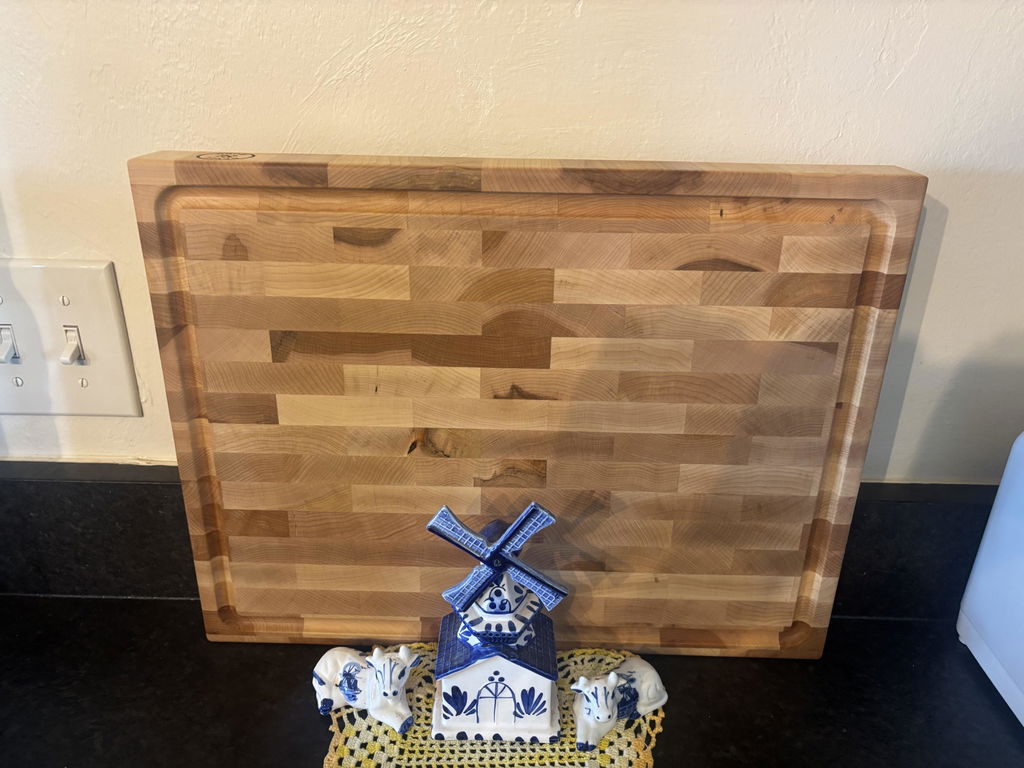
The best cutting board for Japanese knives is a medium-soft wood surface: end grain hard maple, hinoki, or a well-kept edge grain hardwood board. Avoid glass, stone, ceramic, metal and titanium, which chip hard, thin edges quickly. Japanese knife makers say the same thing, and the reason comes down to how their steel is made.
Why do Japanese knives need a softer cutting board?
They are harder and thinner at the edge. Shun, for example, hardens its VG10 and VG-MAX steels to 60 to 61 on the Rockwell scale and sharpens to 16 degrees per side, and describes fine Japanese knives as "harder, thinner, and sharper than comparable European-style knives" (Shun FAQ).
Hard steel holds a keen edge for a long time, but it is less forgiving. Where a softer Western blade rolls when it hits something hard, a hard Japanese edge is more likely to chip. A board that gives slightly under the edge protects it.
Which cutting board surfaces damage Japanese knives?
Shun's own list: "Please avoid cutting on metal, tile, ceramic plates, marble, granite, plastic, or acrylic, as these hard surfaces will dull and chip your blade very quickly." It also warns specifically against titanium boards (Shun FAQ).
| Surface | Effect on a hard, thin edge | Verdict |
|---|---|---|
| Glass, marble, granite, ceramic | No give at all. Chips and dulls fast. | Avoid |
| Titanium or steel | Harder than or close to the blade. | Avoid |
| Bamboo | Hard fibers and a lot of glue. | Poor |
| Hard plastic or acrylic | Hard and slick. Shun advises against it. | Poor |
| Edge grain hard maple | Firm but gives. Knife cuts across the fibers. | Good |
| End grain hard maple | Edge slips between fiber ends. | Very good |
| Hinoki | Soft, fragrant cypress. Very gentle. | Very good, marks easily |

We cover titanium in detail in our titanium cutting board review, and bamboo in maple vs bamboo.
Is end grain or edge grain better for Japanese knives?
End grain is gentler. On end grain the edge slides between the ends of the wood fibers instead of cutting across them, so the board absorbs more of the impact and the cut marks close up. On edge grain the blade cuts across the long fibers. That is still far kinder than any hard surface, but the edge meets a little more resistance and the board shows marks sooner.
If you use a Japanese gyuto or santoku daily, end grain earns its price. If you mostly slice with good technique, a quality edge grain maple board is a perfectly good home for a Japanese knife. We go deeper in why end grain is easier on knives.
Is hinoki better than maple for Japanese knives?
Hinoki is softer, so it is even gentler on the edge, and it is the traditional choice in Japan. The trade-off is durability: it scores and stains faster and usually needs resurfacing sooner. Hard maple at about 1,450 lbf on the Janka scale (The Wood Database) is a middle ground that handles heavier prep, meat and daily washing. Our full comparison is hinoki vs maple cutting boards.
How does technique affect chipping?
As much as the board does. Shun recommends "cutting in a smooth slicing motion, not a forceful, up-and-down 'chopping' manner" (Shun FAQ). A few habits help:
- Slice, don't chop. Push or pull the blade through the food.
- Don't twist in the cut. Lateral force on a thin edge causes micro chips.
- Skip bones and frozen food. Use a heavier Western knife or a cleaver for those.
- Don't scrape with the edge. Flip the knife and use the spine to move food across the board.
What should you look for in a board for Japanese knives?
- Species named: hard maple, hinoki or another close-grained hardwood. See our Janka hardness guide.
- Construction: end grain if knife feel is your priority, edge grain if you want lighter and lower cost.
- Thickness and weight: a board that does not slide keeps the blade path steady. See how to stop a cutting board from sliding.
- A smooth, oiled surface: dry, rough wood drags on the edge.
Frequently asked questions
Are plastic cutting boards bad for Japanese knives?
Shun lists plastic and acrylic among the surfaces to avoid. Soft rubber-style boards are gentler than hard plastic, but wood is the usual recommendation.
Can I use a Japanese knife on a bamboo board?
You can, but it is hard on the edge. Bamboo is dense and full of glue lines. A hardwood board is the better match.
Why did my Japanese knife chip on a wooden board?
Usually from twisting in the cut, hitting a bone, or chopping hard. Check technique first. A very hard or dry board can add to it.
Is maple too hard for Japanese knives?
No. Hard maple sits in the useful middle of the hardness range for board woods, and the FDA Food Code names it for cutting boards. End grain maple is especially forgiving.
Last reviewed September 2026 by James at Bevel & Bond.
Give your best knife the right surface. Our end grain maple cutting board lets the edge slip between the fibers, and at over 10 pounds it stays put while you slice. Keep the surface smooth with Board Balm.