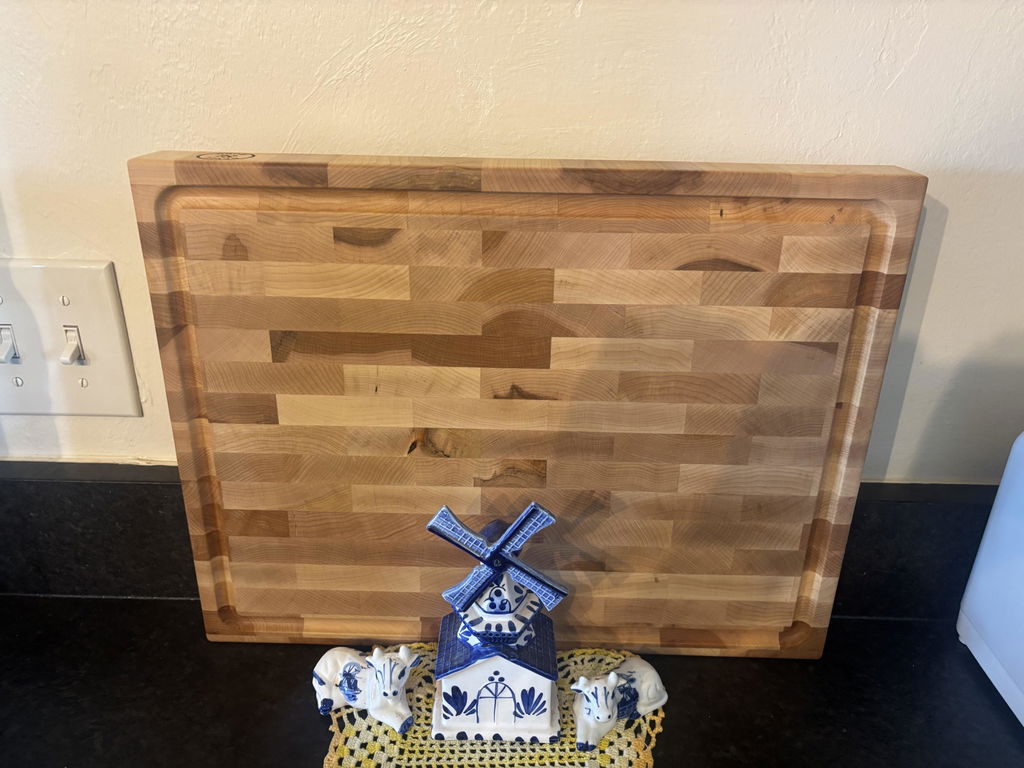
An edge grain maple cutting board is made from long strips of hard maple glued side by side, with the edges of the boards facing up. It is lighter, flatter and cheaper to build than end grain, and it is the board we would hand to anyone who wants one good board for daily vegetable prep and does not want to baby it.
Customers ask us this a lot, usually with an end grain board in one hand and a price tag in the other. Here is how we answer it across the counter: end grain is the better cutting surface, edge grain is the better everyday value, and hard maple is the right wood for either one.
What is an edge grain maple cutting board?
It is a board built from hard maple strips laid on their sides, so the long grain runs the full length of the board and the narrow edges form the cutting surface. The strips are glued into one slab, planed flat and finished with food-safe oil. That is the same construction most butcher block countertops use. We walk through every step in how edge grain cutting boards are made.
Three grain orientations exist, and the difference is which face of the wood your knife hits:
| Construction | Cutting surface | Knife feel | Weight and thickness | Build cost | Upkeep |
|---|---|---|---|---|---|
| Face grain | Wide flat face of a plank | Firm, shows scratches fast | Thinnest and lightest | Lowest | Low |
| Edge grain | Narrow edges of strips | Firm, even, durable | Mid weight | Middle | Low to moderate |
| End grain | Cut ends of the wood fibers | Softest, fibers part and close | Heaviest and thickest | Highest (two glue-ups) | Moderate, drinks more oil |
If you want the long version of that comparison, read our end grain vs edge grain comparison. This post stays on edge grain maple specifically.
Is a long grain cutting board the same as edge grain?
Yes. "Long grain" is another name for the same construction. It describes the wood fibers running the long way along the board, as opposed to end grain, where the fiber ends face up. You may also see "edge grain" used loosely for face grain boards, so check how the strips are laid: narrow edges up means edge grain. Our edge grain vs face grain guide shows the difference.

Why is hard maple the right wood for an edge grain board?
Hard maple (Acer saccharum) sits at about 1,450 lbf on the Janka hardness scale, which is hard enough to shrug off daily chopping and soft enough not to wreck a knife edge (The Wood Database). It is also closed grain, so it does not trap juice and grit the way open-grained oak or ash does.
Edge grain puts more of the hard side-grain under your blade than end grain does, so the species matters even more here. Soft maple, beech or birch sold as "maple" wears faster on an edge grain board. Our hard maple vs soft maple guide shows how to tell them apart.
Is an edge grain maple cutting board good for your knives?
Yes, it is kind to knives, just not as kind as end grain. On edge grain the blade cuts across the wood fibers instead of slipping between them, so the edge meets a little more resistance and the surface shows knife marks sooner.
For a home cook who hones regularly and sharpens a few times a year, the difference is small. For someone running a Japanese gyuto every night, end grain earns its price. Glass, stone and bamboo are the real knife killers, and an edge grain maple board is miles ahead of all three. More in the best cutting board for Japanese knives.
Which lasts longer, edge grain or end grain maple?
Both last decades with basic care, and they age differently. Edge grain shows scratches on the surface but stays flatter because the long grain is stable along the board's length. End grain hides cuts better because the fibers close back up, but it moves more with humidity and needs more oil to stay healthy.
Neither construction makes a board immune to cracking or cupping. Both come from the same habits: soaking the board, standing it wet, or letting it dry out for months. Our guide on why cutting boards warp covers what actually causes it, and vertical grain vs flat grain strips explains the construction detail that affects movement most.

Want the end grain version today? Our end grain maple cutting board is 17 x 13 x 1.75 inches of American hard maple, made in the USA, with a 5-year warranty. Edge grain maple is the next board we are building.
When should you choose edge grain maple over end grain?
Choose edge grain if you want a lighter board you will actually move to the sink, a lower price, or a second board for raw meat so your main board stays for produce. It also makes more sense for large carving and serving boards, where end grain gets heavy fast, and for bread. See the best cutting board for slicing bread.
Choose end grain if the board lives on the counter, you care most about knife feel, and you do not mind oiling it a little more often. Plenty of kitchens end up with one of each. If you are comparing specific boards, our best edge grain cutting boards guide lists sizes and prices.
How do you care for an edge grain maple cutting board?
Wash it by hand with warm water and mild soap, dry it standing on edge, and oil it once a month. Edge grain absorbs less oil than end grain, so one light coat of food-grade mineral oil followed by a wax-based conditioner such as Board Balm is usually enough.
Never put it in the dishwasher and never leave it soaking. Our step-by-step guides on cleaning and oiling apply to edge grain exactly as written.
What should you check before buying an edge grain maple cutting board?
Check four things: the species, the thickness, the glue lines and the finish.
- Species: the listing should say hard maple or Acer saccharum, not just "maple" or "hardwood".
- Thickness: 1.25 inches or more for a board you chop on daily. Thin edge grain boards flex and move more.
- Glue lines: tight, straight and even, with no gaps you can catch a fingernail in.
- Finish: food-grade mineral oil or an oil and beeswax blend. Avoid lacquer or any film finish on a cutting surface.
Is an edge grain maple cutting board sanitary?
Yes, when it is cleaned and dried properly. In a well-known study by Dean Cliver's team, bacteria on plastic boards were readily recovered for minutes to hours, while realistic levels on wood were absorbed within minutes and could not be recovered (Ak, Cliver and Kaspar, Journal of Food Protection, 1994). That is not a reason to skip cleaning: wash with hot soapy water, sanitize when needed, and dry on edge. University of Maine Extension gives ½ teaspoon of unscented chlorine bleach per quart of water as a sanitizing option (UMaine Extension). Use a separate board for raw meat, and read our post on whether wooden boards are sanitary for the details.
Does an edge grain maple board need a juice groove?
Only if you carve roasts or slice juicy fruit on it often. A groove catches liquid but gives up cutting space, so a flat side for prep and a grooved side for carving is the most useful layout.
How thick should an edge grain maple cutting board be?
Aim for 1.25 to 1.5 inches for an everyday board. Thinner boards are fine for bread or serving, but a daily chopping board benefits from the extra mass and stability.
Can an edge grain maple board be refinished?
Yes. Edge grain sands flat easily, so deep knife marks can be taken out with 120 then 180 grit and a fresh coat of oil. See how to refinish a cutting board.
When was this article last reviewed?
This article was last reviewed in September 2026 by James at Bevel & Bond.
Ready for a maple board that lasts? Start with our American-made end grain maple cutting board, and keep it conditioned with Board Balm.