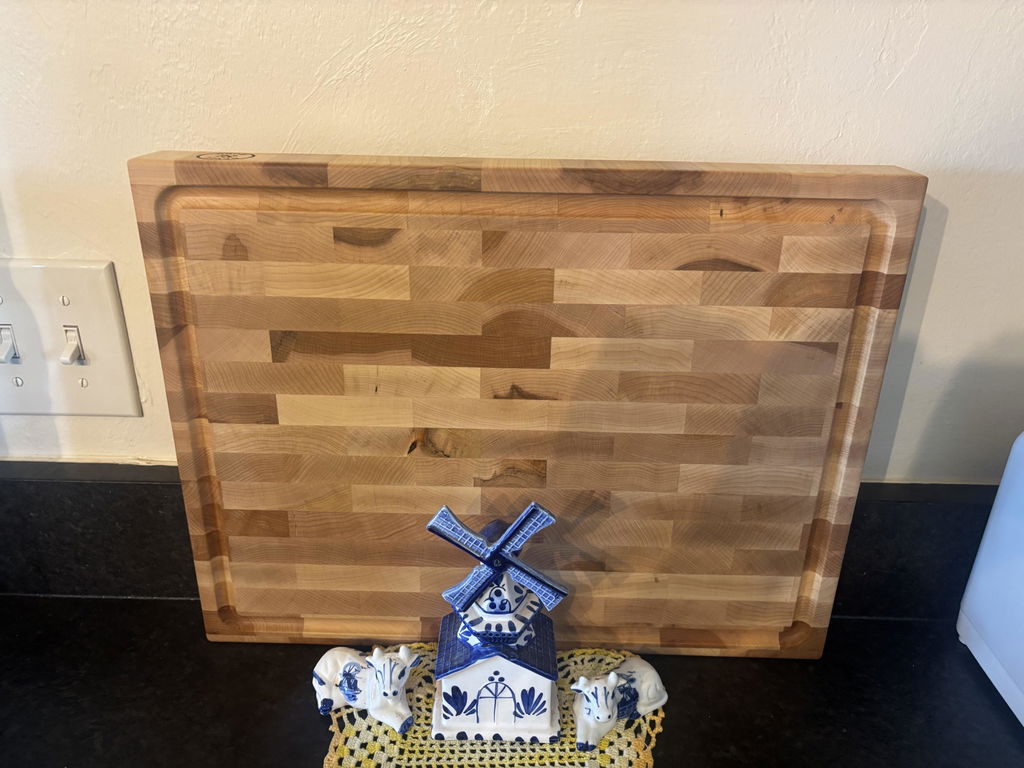
An edge grain cutting board is made by ripping hard maple lumber into strips, turning each strip on its side, gluing the strips edge to edge with a water-resistant food-safe glue, then flattening, sanding and oiling the slab. That is the whole process in one sentence. The quality lives in the details of each step, and knowing them is the fastest way to judge a board before you buy it.
We build end grain boards today, and edge grain uses the same first half of the process. Here is how it works, what can go wrong at each stage, and what to look for on the finished board.
Step 1: Which wood is chosen for an edge grain cutting board?
Hard maple, Acer saccharum, is the standard choice. It rates about 1,450 lbf on the Janka hardness test and has a closed, tight grain (The Wood Database). Health codes based on the FDA Food Code name it directly: "hard maple or an equivalently hard, close-grained wood" is allowed for cutting boards and blocks in food service (Minnesota Rule 4626.0490, adopting Food Code 4-101.17).
Makers buy kiln-dried lumber, usually graded for clear, defect-free sections. Soft maple and other look-alikes are cheaper and softer, so the species should be named on any listing. Our hard maple vs soft maple guide explains the difference.
Step 2: Why does the lumber need to acclimate first?
Wood takes on or gives off moisture until it matches the air around it, a point called equilibrium moisture content. At 70°F that is about 6% moisture at 30% relative humidity and about 9% at 50% (USDA Forest Products Laboratory, Wood Handbook, ch. 4). Good shops let lumber sit in the workshop before milling so the strips do not keep moving after glue-up.
Step 3: How is the lumber milled into strips?
- Face and edge jointing. One face and one edge are made dead flat and square.
- Planing. Boards are planed to an even thickness.
- Ripping. The boards are ripped into strips, commonly around 1.5 to 2 inches wide. The strip width becomes the board's thickness once each strip is turned on its side.
- Defect removal. Knots, cracks and mineral streaks that affect strength are cut out.

This is where most of the waste happens, and it is one reason a well-made board costs more than its weight in lumber suggests.
Step 4: How are the strips laid out?
Each strip is rotated 90 degrees so its narrow edge faces up. That edge becomes the cutting surface. The maker then arranges the strips for color and for grain direction.
Grain direction matters more than most buyers realize. When strips are turned on edge, the growth rings on the end of each strip tend to run up and down. That orientation moves roughly half as much with humidity across the board's width as flat-sawn wood does. We explain the numbers in vertical grain vs flat grain strips.
Careful makers also alternate the direction of the growth-ring curve from strip to strip, so any small movement in one strip is balanced by its neighbor instead of adding up across the board.
Step 5: What glue holds an edge grain cutting board together?
Most makers use a PVA wood glue rated for water resistance and food contact. Titebond III, one of the most common, is listed by its maker as "U.S. FDA approved for indirect food contact (cutting boards)" and passes the ANSI/HPVA Type I water-resistance test (Titebond III product data). The underlying FDA rule for adhesives in food-contact articles is 21 CFR 175.105.
Glue is spread on every mating edge, the strips are clamped with even pressure, and the slab stays clamped while the glue sets. A thin, continuous glue line is the goal. Our post on cutting board glue safety covers what happens to that glue once it cures.
Step 6: How is the glued slab flattened?
After curing, the slab is flattened with a planer or a wide drum sander, then trimmed square and cut to final length. The corners and edges are eased or rounded, and some boards get a juice groove or finger grips routed in at this stage.
Step 7: How is the board sanded and finished?
The board is sanded through progressively finer grits. Many makers raise the grain by wiping the surface with water, letting it dry, then sanding again, so the first wash at home does not leave it fuzzy. The finish is food-grade mineral oil, a mineral oil and beeswax blend, or both. A film finish like lacquer or polyurethane does not belong on a cutting surface.

At home, the same oil keeps it going. Board Balm is our 80/20 blend of food-grade mineral oil and beeswax, and our step-by-step oiling guide works the same on edge grain.
How is edge grain construction different from end grain?
| Step | Edge grain | End grain |
|---|---|---|
| Glue-ups | One | Two (strips, then crosscut blocks) |
| Cutting surface | Long side of the fibers | Fiber ends |
| Flattening | Planer or drum sander | Drum sander only (end grain tears out in a planer) |
| Typical weight at similar size | Lighter | Heavier |
| Labor and waste | Lower | Higher |
That second glue-up and the slower flattening are most of the reason end grain costs more. See why end grain cutting boards cost more and our full end grain vs edge grain comparison.

What should you inspect on a finished edge grain board?
- Glue lines: thin, straight and continuous from end to end. Run a fingernail across them. You should not catch a gap.
- Flatness: set it on the counter and press each corner. It should not rock.
- Growth rings on the ends: mostly vertical lines on the end of the board is a good sign of stable strip orientation.
- Surface feel: smooth, not fuzzy, with no planer ridges.
- Species and finish named: "hard maple" and "mineral oil" or "oil and beeswax" on the listing.
More checks are in how to tell if a maple cutting board is high quality.
Frequently asked questions
Is an edge grain board one solid piece of wood?
No. It is many strips glued into one slab. A single wide plank laid flat is a face grain board, which moves more with humidity. See edge grain vs face grain.
Is the glue in an edge grain cutting board safe?
Glues sold for cutting boards are made to comply with FDA rules for indirect food contact, such as 21 CFR 175.105, and cured glue lines are a tiny share of the surface. Ask the maker which glue they use.
How thick is a typical edge grain cutting board?
Most are 1 to 1.5 inches thick, with heavier butcher-style boards around 2 to 2.25 inches. The strip width sets the thickness.
Can a glue joint on an edge grain board fail?
It can, usually after soaking, a dishwasher cycle or long periods of very dry air. A joint that opens soon after purchase points to a manufacturing fault. Our guide to fixing a separated glue joint walks through the repair.
Last reviewed September 2026 by James at Bevel & Bond.
Want the two-glue-up version? Our end grain maple cutting board is 17 x 13 x 1.75 inches of US-grown hard maple, made in Oregon, with a 5-year limited warranty.