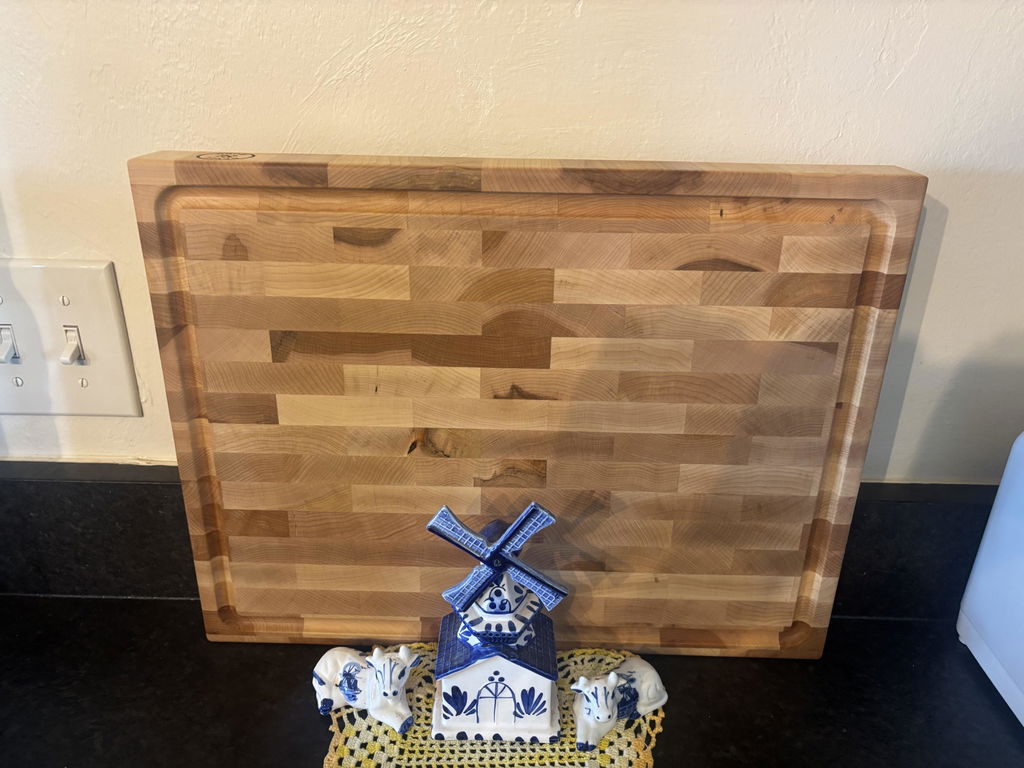
The verdict: Edge-grain wins for kitchen use. Edge-grain shows knife marks but stays durable for years; face-grain uses the widest, softest exposed grain and wears out fast — fine for a serving board, not for daily prep.
For daily knife work, buy edge-grain. Face-grain is the prettiest of the three grain orientations and the least expensive to make, but it is the hardest on your edges and the first to scar and split. Keep face-grain for serving cheese, not for breaking down a chicken.
People come to my bench asking which board looks best, and that is the wrong first question. A cutting board earns its keep under a knife. I have watched face-grain boards that photographed beautifully in a catalog show deep knife scars within a season of real cooking, while a plain edge-grain maple board next to it kept a flat, clean surface for years. The grain you cut into matters more than the grain you look at.

Grain settles durability. Shape settles how it feels to work on — round vs rectangular cutting board covers that half.
What is the real difference between edge-grain and face-grain?
Edge-grain shows the narrow edges of the boards standing up, face-grain shows the wide flat plank face up. That single choice decides how the wood meets your knife, how it wears, and what it costs. Face-grain presents long fibers side-on to the blade, which is decorative but hard on the edge and prone to splitting along those fibers. Edge-grain presents a tighter, more stable surface that takes an impact better and gives your knife an easier ride.
Why grain direction matters this much comes down to how wood is built. Wood is not uniform in all directions — it shrinks, swells, and resists load differently along the grain than across it, which the USDA Forest Products Laboratory's Wood Handbook documents in detail. That anisotropy is exactly why the same maple behaves like three different materials depending on which face you cut on.
| Factor | Face-grain | Edge-grain | End-grain |
|---|---|---|---|
| Surface shown | Wide plank face | Narrow board edges | Fiber ends, vertical |
| Knife friendliness | Hardest on edges | Gentle | Gentlest |
| Durability under chopping | Scars and splits soonest | Stable and durable | Most durable |
| Cost to make | Lowest | Affordable | Priciest |
| Best job | Serving, charcuterie | Daily chopping | Heavy daily prep |
End-grain is the third orientation, and it is a longer conversation about wear and price. I broke that comparison down in end-grain vs edge-grain. For this article, the fight is edge-grain against face-grain, and the wood underneath both is hard maple (Acer saccharum, 1,450 lbf Janka) either way.
Which is easier on your knives, edge-grain or face-grain?
Edge-grain, by a clear margin. On a face-grain board the blade meets wood fibers side-on, so it drags across and cuts into the length of the fiber, which dulls the edge faster and tears the wood surface. Edge-grain gives the blade a firmer, more uniform surface that flexes less and blunts the knife more slowly. It is not as forgiving as end-grain, but for a home cook putting a chef knife through onions and herbs every night, edge-grain is the right amount of gentle without the end-grain price tag.
Which one lasts longer with daily chopping?
Edge-grain lasts longer under a knife. Face-grain splits along the long fibers and collects deep, visible scars because you are cutting into the flat of the grain. An edge-grain hard maple board takes years of daily chopping and stays flat and serviceable, especially at 1.5 inches thick or more. Face-grain earns its place as a serving board because it never has to survive a cleaver, so the decorative figure stays clean.
Is a face-grain board ever the right buy?
Yes, as a serving and display board, not as your daily cutter. A face-grain maple board shows the widest, most decorative figure in the wood, which is exactly what you want under a wedge of brie and a fan of salami. It is also the least expensive to build, so it is a fair budget pick if you already own a proper cutting board and just want something handsome for the table. Ask it to do knife work, though, and it will disappoint you inside a year.
Does the wood species change the answer?
No, grain orientation decides knife friendliness and durability before species does, and I build both in hard maple for a reason. Hard maple runs about 1,450 lbf on the Janka scale, hard enough to resist denting but closed-grain enough to stay food-safe and easy on a blade. You can read more on why hardness matters in the Janka scale explained and why maple wins in best wood for cutting boards. Put a soft wood in edge-grain and it still dents, so start with the right species and the right grain together.
How do you care for each type?
Edge-grain and face-grain boards want the same routine — hand wash, dry on edge, oil regularly — but face-grain shows neglect faster. A dry face-grain board splits along its long fibers quickly, so it needs oil more often to stay stable. Edge-grain is more forgiving but still deserves a monthly coat. I walk through the full method in how to oil a cutting board, and I use a food-grade mineral oil and hard-wax conditioner — white mineral oil is FDA-permitted for direct food contact — rather than olive oil, which goes rancid and smells.
Our flagship hard maple board is USA-made, food-safe, and backed by a 5-year warranty. Browse the full lineup in the complete collection.

Is face-grain the same as a butcher block?
No. A traditional butcher block is end-grain, with the fibers standing vertical so the blade slips between them. Face-grain is the opposite, with the flat of the grain up, which is why it scars under heavy chopping. People confuse the two because both can look like thick slabs, but the grain orientation is doing completely different work.
Why is face-grain cheaper than edge-grain?
Face-grain uses fewer glue joints and less labor, so it costs the least to build. You are essentially looking at a single plank or a few wide planks joined face up. Edge-grain requires cutting boards into strips and gluing them edge up, which takes more time and more precise work, and end-grain takes the most of all. Less expensive to make does not mean less expensive to own, since a face-grain board used for chopping wears out first.
Can you chop on a face-grain board occasionally?
Occasionally, yes, but it will show. Slicing a loaf or plating a cheese course is fine. Daily knife work on face-grain leaves deep cuts along the fibers that trap moisture and food, and those cuts open into splits as the board dries and rehydrates. If you want one board that does everything, make it edge-grain or end-grain and let the face-grain board serve.
What thickness should an edge-grain board be?
Aim for 1.5 inches or more for daily use. Thin edge-grain boards under an inch cup and flex, which stresses the glue joints and warps the surface. A thicker slab stays flat, absorbs impact, and gives you enough wood to sand and refinish years down the line. Our flagship runs 1.75 inches for exactly that reason. More on sizing and weight in our thickness guide.
When was this article last reviewed?
This article was last reviewed in July 2026 by the Bevel & Bond workshop team. We update our grain and care guidance as we build and test boards through the year, so the recommendations here reflect what is currently on the bench.
Sources
- USDA Forest Service, Forest Products Laboratory — Wood Handbook: Wood as an Engineering Material (FPL-GTR-282, 2021), on grain direction and dimensional behavior
- The Wood Database — Hard Maple (Acer saccharum), Janka hardness 1,450 lbf
- 21 CFR 172.878 — White mineral oil, FDA-permitted for direct food contact
Start with our hard maple cutting board and keep it in shape with Board Balm.