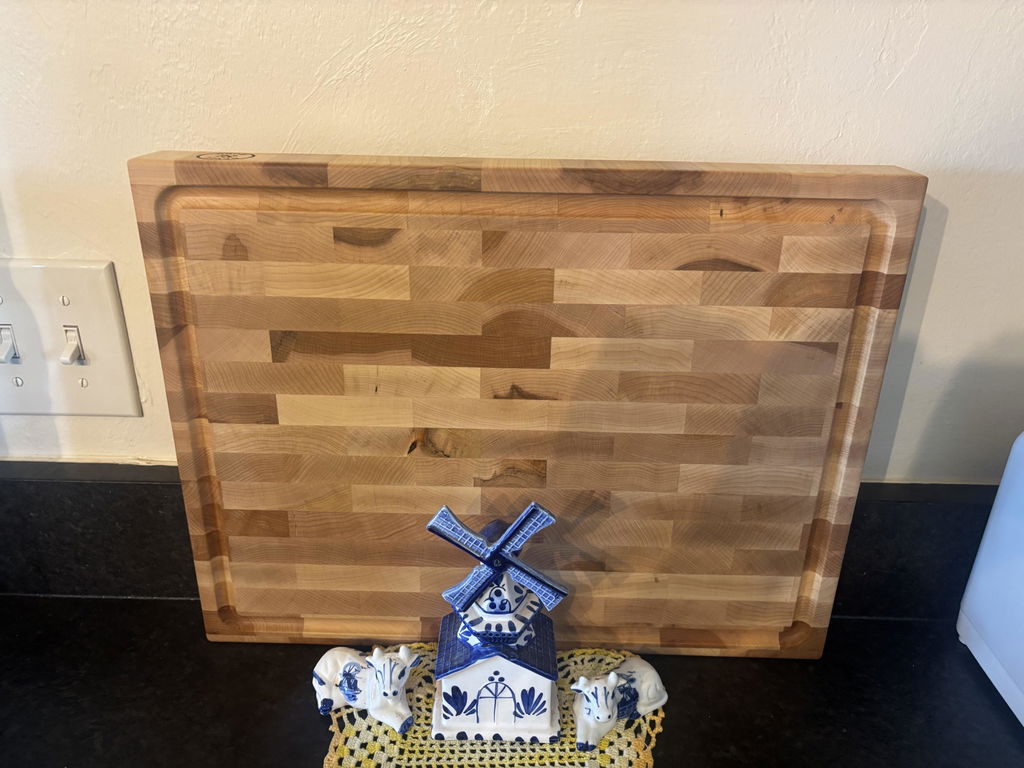
Yes. The FDA Food Code, which most US states adopt as the basis of their restaurant rules, allows cutting boards made of "hard maple or an equivalently hard, close-grained wood." The boards have to stay cleanable, and they must be resurfaced or thrown out once scoring means they can no longer be cleaned and sanitized. Your local health department has the final say, so check its adopted code before you buy.
We get this question from caterers, food truck owners and home cooks who have heard that wood is "illegal" in commercial kitchens. It is not. Here is what the code actually says, where the confusion comes from, and what inspectors look for.
What does the FDA Food Code say about wooden cutting boards?
Section 4-101.17 of the Food Code limits wood as a food-contact surface in general, then makes specific exceptions. Minnesota's adopted version reads: "Hard maple or an equivalently hard, close-grained wood may be used for: cutting boards, cutting blocks, bakers' tables, and utensils" (Minnesota Rule 4626.0490). Most states use the same model language from the FDA Food Code.
Two things stand out. The code names hard maple specifically, and it says "close-grained." Open-pored woods like red oak are a poor match for that wording. Our post on open vs closed grain explains the difference.
When does a restaurant have to replace a wooden cutting board?
Section 4-501.12 covers cutting surfaces of any material. In Minnesota's adopted text: surfaces "subject to scratching and scoring must be resurfaced if they can no longer be effectively cleaned and sanitized, or discarded if they are not capable of being resurfaced" (Minn. R. 4626.0740).
This is where solid hardwood has an advantage. A worn maple board can be sanded flat again. A deeply scored plastic board usually cannot, and has to be replaced. Our refinishing guide shows how resurfacing works.
So why do so many restaurants use plastic?
Mostly because of the dish machine. Commercial kitchens often sanitize boards by running them through a high-temperature or chemical dish machine, and wood cannot go through one without damage. Plastic can. Color-coded plastic also makes it easy to keep raw meat, fish and produce on separate boards across a busy line.
That is a workflow choice, not a ban. Many butcher shops, bakeries and pizza kitchens run hard maple boards and blocks and sanitize them by hand. We cover what pros actually use in what professional chefs use for cutting boards.
Is a wood cutting board less sanitary than plastic?
The research does not support that. In a University of Wisconsin study led by Dean Cliver, bacteria applied to plastic boards were readily recovered for minutes to hours, while realistic levels of bacteria on wood were absorbed within minutes and could not be recovered. Even with very high doses, recovery from wood after 12 hours fell by at least 98% (Ak, Cliver and Kaspar, Journal of Food Protection, 1994).
That does not mean wood cleans itself. Both materials need washing, sanitizing and drying. More in are wooden cutting boards sanitary?
Do wood cutting boards need NSF certification in a restaurant?
It depends on your jurisdiction. Many health departments require commercial food equipment to meet a recognized sanitation standard, and NSF/ANSI 2 is the common one for food equipment. Some hard maple boards carry NSF certification. For example, John Boos lists its R-Board edge grain maple boards as NSF certified (John Boos). Our own boards are built for home kitchens and are not NSF certified, so if your inspector requires certification, buy a certified board.
How should a commercial kitchen clean a wooden cutting board?
- Scrape and wash with hot water and detergent after each task, not just at the end of the shift.
- Rinse with clean water.
- Sanitize with an approved sanitizer at the concentration on your test strips and label. University of Maine Extension gives ½ teaspoon of unscented chlorine bleach per quart of water as a home option (UMaine Extension Bulletin #3108).
- Air dry on edge so both faces dry evenly. Never stack wet boards.
- Oil regularly with food-grade mineral oil so the surface does not dry out and split.

For raw meat specifically, see how to sanitize a cutting board after raw meat.
What do health inspectors look for on a wooden board?
- Species: hard maple or an equally hard, close-grained wood.
- Condition: no deep grooves, cracks or open glue joints that hold food.
- Cleanliness: no residue, odor or dark staining that suggests poor sanitizing.
- Storage: stored clean and dry, off wet surfaces.
- Separation: a clear system that keeps raw animal products away from ready-to-eat food.
Frequently asked questions
Is it illegal to use a wooden cutting board in a restaurant?
No. The FDA Food Code allows hard maple and equivalently hard, close-grained wood for cutting boards. Local rules can add requirements, so confirm with your health department.
Can I use a bamboo cutting board in a restaurant?
Bamboo is a grass, not a hardwood, so it does not fit the Food Code's wording cleanly. Ask your inspector before relying on it.
Can a wooden cutting board go in a commercial dish machine?
No. The heat and long exposure to water can split the wood and open glue joints. Wash and sanitize by hand.
Is edge grain or end grain better for a commercial kitchen?
Edge grain boards are lighter and easier to move to a sink for cleaning. End grain is easier on knives and hides cut marks. Many butcher shops use end grain blocks at a fixed station and lighter boards elsewhere. Compare them in our end grain vs edge grain guide.
Last reviewed September 2026 by James at Bevel & Bond. This is general information, not legal advice. Your local health authority's adopted code is what applies to your kitchen.
Cooking at home? Our end grain maple cutting board is made from US-grown hard maple, the species the Food Code names, and finished with food-grade oil. Keep it conditioned with Board Balm.