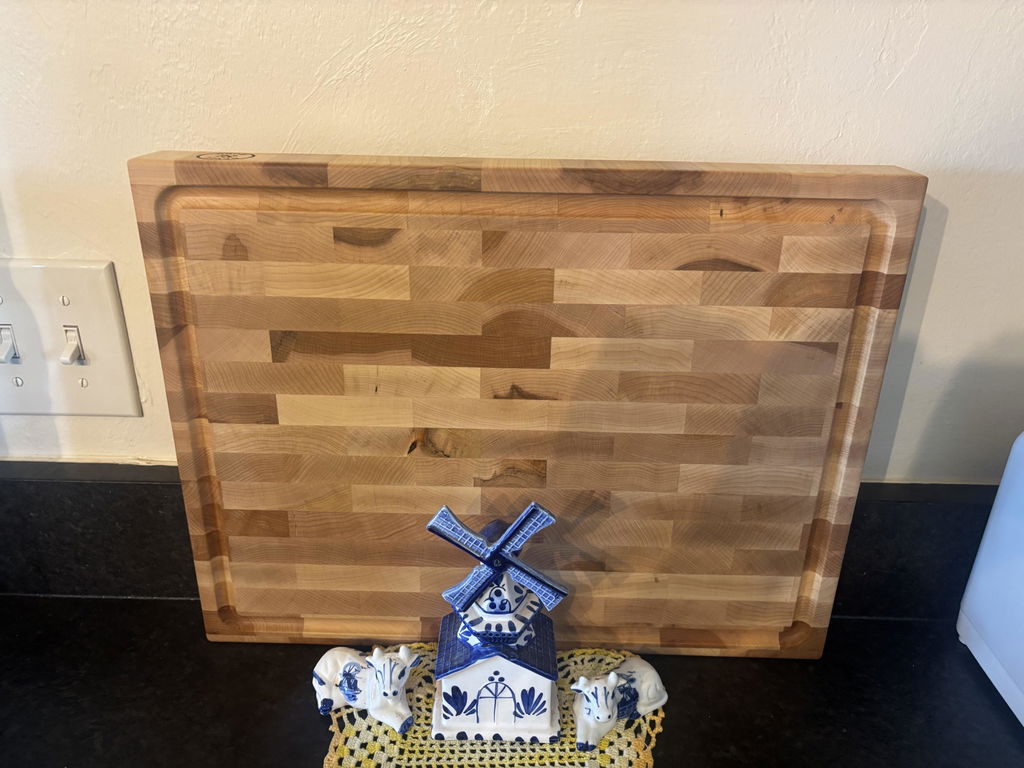
The best cutting board for bread is a flat, firm hardwood board at least 16 inches long, kept separate from the board you use for raw meat. Edge grain hard maple is a natural fit: it gives a serrated knife a steady surface, it is lighter than end grain so you can carry it to the table, and the crumbs brush straight off.
What makes a good bread board?
- A firm, flat surface. A serrated knife saws back and forth. A board that rocks or flexes makes uneven slices.
- Enough length. A long sourdough batard or baguette needs 16 to 20 inches so your knuckles clear the edge.
- A tight, smooth grain. Crumbs and seeds should brush away, not lodge in open pores.
- No juice groove on the bread side. Grooves collect crumbs. A flat face works better.
- Light enough to serve on. Bread often goes straight to the table.
Why does edge grain maple work well for bread?
Bread is soft, so knife protection matters less than it does for daily chopping. What matters is a stable, even surface, and edge grain delivers that at a lower weight and price than end grain. The long strips run the length of the board, which keeps it flat along the direction you saw.
Hard maple, Acer saccharum, has a closed, tight grain and pale, even color, so it looks clean with a crusty loaf on it and does not hold crumbs (The Wood Database). It is also mild in scent, so it does not add flavor to bread. See does a maple cutting board absorb odors?
Should a bread board be separate from your main cutting board?
Yes, if your main board ever sees raw meat. Bread is ready to eat and is not cooked after slicing, so it should never share a board with raw meat, poultry or fish without a full wash and sanitize in between. University of Maine Extension suggests using wooden boards for lower-risk foods like bread and vegetables (UMaine Extension Bulletin #3108). Our guide to separate cutting boards for meat and vegetables lays out a simple system.

A dedicated bread board also keeps garlic and onion off your toast.
What size should a bread board be?
| What you slice | Suggested board size |
|---|---|
| Sandwich loaves, rolls | 12 x 9 inches or larger |
| Boules and sourdough rounds | 14 x 11 inches or larger |
| Baguettes and long batards | 18 inches long or more |
| Serving bread, cheese and butter together | 18 x 12 inches or larger |
For more on sizing, see what size cutting board you actually need.
Is end grain or edge grain better for bread?
Both work. End grain is kinder to a straight chef's knife, but a bread knife is serrated and saws rather than chops, so that advantage matters less. Edge grain is lighter to carry to the table and usually costs less. If you already own an end grain board for daily prep, a lighter edge grain board makes a good second board for bread and serving. Compare the two in end grain vs edge grain.
Does a bread knife damage a wooden cutting board?
A serrated blade leaves fine scratch lines over time, mostly along the direction you saw. On a maple board they are shallow and even, and oiling hides most of them. If they build up, a light sanding takes them out. See how to remove knife marks from a cutting board.
How do you clean a bread board?
- Tip the crumbs into the sink or bin and brush the surface with a dry brush.
- If butter or oil got on it, wipe with warm water and a little mild soap.
- Dry it with a towel and stand it on edge.
- Oil it when the wood looks pale or dry. Board Balm leaves a smooth wax finish that sheds crumbs.
A board used only for bread needs washing less often than a prep board, but it still needs to be kept dry and oiled. Full steps: how to clean a wooden cutting board.
Frequently asked questions
What wood is best for a bread board?
Hard maple is the classic choice: tight grain, pale color, mild scent and good durability. Walnut and cherry also work if you prefer a darker board.
Do I need a bread board with a crumb catcher?
No. Crumb-catcher boards with slats are handy on the counter but harder to clean. A flat maple board and a dry brush do the same job.
Can I serve bread and cheese on the same board I cut on?
Yes, if the board is clean and has not been used for raw meat since its last wash. See cheese board vs cutting board.
How thick should a bread board be?
About 0.75 to 1.25 inches is plenty. Bread does not need the mass that heavy chopping does, and a thinner board is easier to carry to the table.
Last reviewed September 2026 by James at Bevel & Bond.
One board for prep, one for bread. Our end grain maple cutting board handles the daily chopping, so your bread board stays clean and crumb-only. Keep both conditioned with Board Balm.