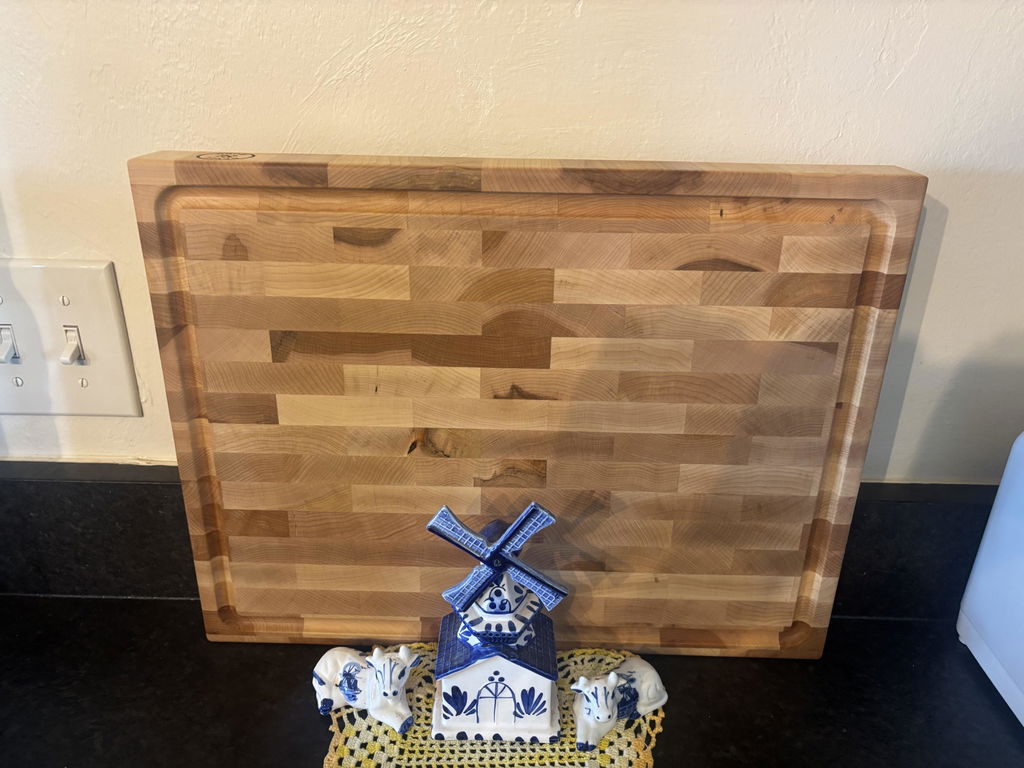
The best edge grain cutting board for most kitchens is hard maple, at least 1.25 inches thick, around 18 x 12 inches, with tight glue lines and a plain oil finish. From established makers that costs roughly $55 to $160 in 2026. Below is how to choose, what drives the price, and four edge grain maple boards worth a look.
A note on who is writing this: we make end grain maple boards, not edge grain, so none of the boards below are ours. We have picked them the way we would pick a board for a friend, and we link to our own honest reviews where we have them.
What is an edge grain cutting board?
It is a board made from long strips of wood glued side by side, with the narrow edges of the strips facing up as the cutting surface. It sits between face grain (one wide plank) and end grain (fiber ends facing up) on weight, price and knife feel. If you are new to the terms, start with our end grain vs edge grain comparison and edge grain vs face grain.
How do you choose an edge grain cutting board?
1. Species: hard maple first
Hard maple (Acer saccharum) rates about 1,450 lbf on the Janka scale and has a closed, tight grain (The Wood Database). It is also the species health codes based on the FDA Food Code name for cutting boards (Minn. R. 4626.0490). Walnut and cherry are softer and darker. Look for the species by name, not just "hardwood." See hard maple vs soft maple.
2. Thickness: 1.25 inches or more for daily chopping
Thin edge grain boards are light but flex and slide more. For a daily board, 1.25 to 1.5 inches is the sweet spot. Around 2 inches is butcher territory. Our thickness guide goes deeper.
3. Size: about 18 x 12 inches for most kitchens
Big enough to push chopped food aside and keep working, small enough to fit in a sink. Go 20 x 15 or larger if you break down roasts. See what size cutting board you actually need.
4. Strip orientation and glue lines
Look at the ends. Growth rings running mostly up and down mean the board will move less across its width. We explain why in vertical grain vs flat grain strips. Glue lines should be thin and continuous.

5. Features you actually use
Reversible faces, finger grips and a juice groove are all useful, but each one is a trade-off. A groove takes cutting space, and grips reduce the usable face. See are reversible cutting boards worth it?
6. Finish
Food-grade mineral oil or an oil and beeswax blend. No lacquer or polyurethane on a cutting surface.
How much should an edge grain cutting board cost?
| Price range | What you usually get |
|---|---|
| Under $50 | Thin boards (about 1 inch), smaller sizes, often unnamed species or bamboo |
| $50 to $100 | Named hard maple, 1.25 to 1.5 inches, established maker, smaller to mid sizes |
| $100 to $160 | Larger 20 x 15 and 24 x 18 sizes, or premium brands and finishes |
| $160 and up | Very thick (2 inches plus) butcher-style boards or large sizes |
Edge grain costs less than end grain at the same size because it takes one glue-up instead of two, with less waste and faster flattening. We break that down in how edge grain cutting boards are made and why end grain costs more.
Which edge grain maple cutting boards are worth a look?
Specs and prices below are from each maker's own website, checked on September 27, 2026. Prices change, so confirm before you buy.
John Boos R-Board Series: the all-round pick
- Wood and build: North American maple, edge grain, reversible, recessed finger grips
- Sizes: 18 x 12, 20 x 15 and 24 x 18 inches, all 1.5 inches thick
- Price: from $94.95 for 18 x 12 (range listed as $94.95 to $154.95)
- Worth knowing: Boos lists the series as NSF certified and made in the USA
Source: John Boos R-Board Series. Our full take is in John Boos maple cutting boards: an honest review from a competitor.
John Boos RA-Board Series: the heavy-duty pick
- Build: edge grain maple, 2.25 inches thick, reversible
- Price: listed from $133.95 to $326.95 depending on size
- Worth knowing: NSF certified per Boos. Heavy, so it tends to live on the counter.
Source: John Boos edge grain collection.
John Boos Chop-N-Slice Series: the budget pick
- Build: edge grain maple, 1.25 inches thick, reversible
- Price: listed from $52.95 to $88.95 depending on size
- Worth knowing: a good second board for bread or produce, or a first maple board on a budget
Source: John Boos edge grain collection.
J.K. Adams Professional Edge Grain Maple Board: the size-range pick
- Build: edge grain maple, professional series
- Sizes and prices: 14 x 10 inches $105, 18 x 12 inches $155, 24 x 18 inches $259
- Worth knowing: J.K. Adams is a long-running Vermont company and offers personalization on these boards
Source: J.K. Adams Professional Cutting Boards. Our review: J.K. Adams cutting boards, honest review.
Should you buy edge grain or end grain?
Buy edge grain if you want a lighter board you will move to the sink, a lower price, or a second board for bread, produce or raw meat. Buy end grain if the board lives on the counter and knife feel matters most, especially with harder Japanese knives. See the best cutting board for Japanese knives and our best end grain cutting board guide.

Frequently asked questions
Is edge grain good for a cutting board?
Yes. Edge grain hard maple is durable, stable and easy on knives compared with glass, stone, bamboo or hard plastic. It shows knife marks sooner than end grain.
How long does an edge grain cutting board last?
With hand washing, drying on edge and regular oiling, many years. A worn surface can be sanded flat again. See how long wooden cutting boards last.
What is the best size for an edge grain cutting board?
About 18 x 12 inches suits most home kitchens. Go larger for carving and smaller for bread or a bar board.
Is edge grain cheaper than end grain?
Usually, at the same size and wood. End grain needs a second glue-up and more labor to flatten.
Last reviewed September 2026 by James at Bevel & Bond. Competitor specs and prices are from the makers' websites on September 27, 2026 and may change.
Decided knife feel matters most? Our end grain maple cutting board is 17 x 13 x 1.75 inches of US-grown hard maple, made in Oregon, $129.99 with a 5-year limited warranty. Whatever board you choose, keep it conditioned with Board Balm.