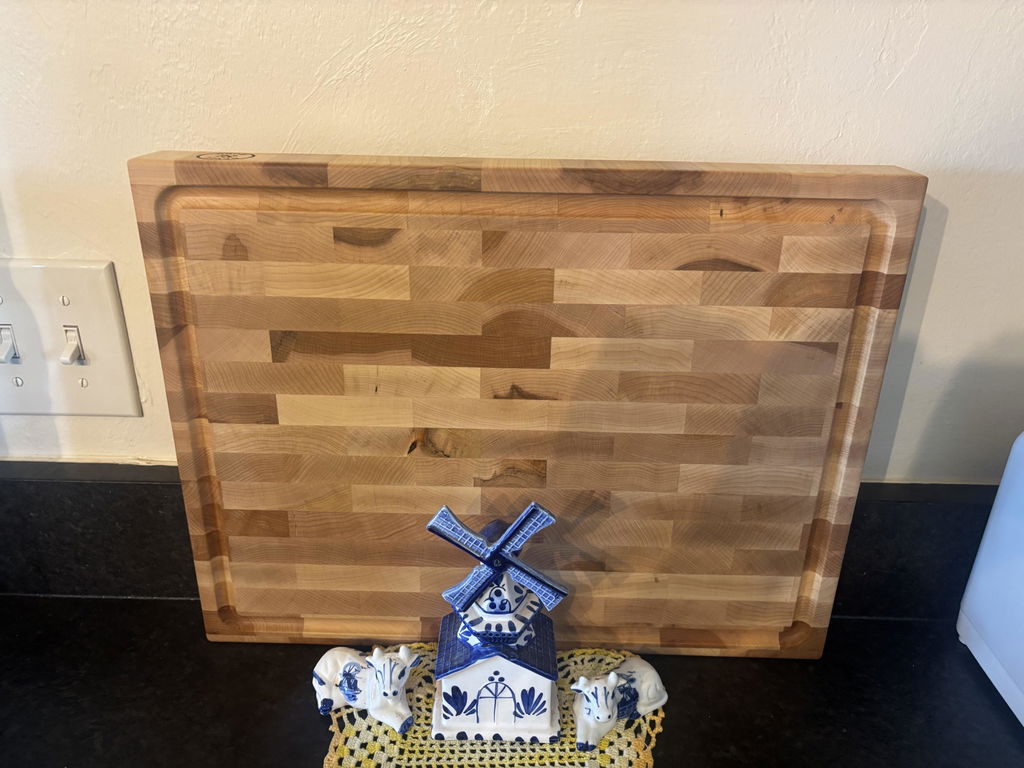
The short answer: for a genuine end-grain board at a real board size, the field is small. Bevel & Bond's maple end grain cutting board is $139.99 for 17 × 13 × 1.75″. The Boardsmith and Brooklyn Butcher Blocks build comparable boards at roughly double that. John Boos is the famous name, but most of its popular boards are edge grain, not end grain.
Before any of that, though, the part almost no buying guide will tell you.
Most end-grain boards worth owning land near 17x13, and there's a practical reason for that.
America's Test Kitchen tested end grain and did not pick it
In its heavy-duty cutting board testing, America's Test Kitchen measured how much oil each board absorbed during a maintenance session. End-grain boards averaged 26.5 grams, with the worst absorbing 47.3 grams. Edge-grain boards averaged 6.6 grams, and their winner took just 3.3 grams.

ATK also reported that "the only board that cracked was an end-grain model." Their top pick was an edge-grain teak board, not an end-grain one.
Serious Eats, testing separately, made an end-grain maple board its top pick. Two credible outfits, opposite conclusions. That disagreement is real and you should know it exists.
What the disagreement actually tells you
The oil finding is not in dispute — end grain drinks more oil, because you are presenting the open ends of the wood fibres to the surface. That is the same property that makes it gentle on knives. It cuts both ways, literally.
So the honest framing is a trade, not a winner:

| End grain | Edge grain | |
|---|---|---|
| Knife edges | Gentler — the blade parts the fibres | Good, but the blade crosses the fibres |
| Knife marks | Fibres close back, marks fade | Marks stay and accumulate |
| Oil per session (ATK) | 26.5 g avg, 47.3 g worst | 6.6 g avg, 3.3 g best |
| Maintenance | More frequent, more oil | More forgiving |
| Price | Higher — more pieces, more steps | Lower for the same wood and size |
| Weight | Heavy; usually stays put | Lighter, easier to carry |
Buy end grain if you care about knife edges and don't mind oiling. Buy edge grain if you want less upkeep and a lower price. Neither answer is wrong. The full side-by-side is in our end grain vs edge grain guide.
The end-grain boards actually worth comparing
Every figure below was read on the maker's own website on 19 August 2026.

| Board | Size | Thickness | Wood | Price | Warranty |
|---|---|---|---|---|---|
| Ironwood Charleston Chef's | 14 × 14″ | 1.25″ | Acacia | $81.99 | None published |
| Bevel & Bond | 17 × 13″ | 1.75″ | Hard maple | $139.99 | 5 years |
| The Boardsmith | 18 × 12″ | 2″ | Maple | $185 – $200 (reg. $230) | 60 days |
| The Boardsmith | 18 × 12″ | 2″ | Walnut | $225 – $250 (reg. $280) | 60 days |
| Brooklyn Butcher Blocks | 12 × 18″ | 1.75″ | Maple | $230 | None published* |
| Brooklyn Butcher Blocks | 16 × 20″ | 1.75″ | Maple | $350 | None published* |
| Brooklyn Butcher Blocks | 18 × 24″ | 1.75″ | Maple | $550 | None published* |
*At the time reviewed, we did not locate a separate Brooklyn warranty page; its refund policy stated a full refund within 90 days "no questions asked" and free repairs on any board under two years old. In practice that is stronger cover than several published warranties.
Cost per square inch — the like-for-like test
Price alone flatters whoever sells the smallest board. Cutting surface is the fairer measure.
The comparison that matters most is the middle one. The Boardsmith's 18 × 12 is 216 square inches. Ours is 17 × 13, which is 221. Same species, same construction, five square inches apart — and at their sale price we are roughly two-thirds the cost, at their regular price about half.
Brooklyn's 12 × 18 is also 216 square inches, at $230.
The Boardsmith is sold out
Worth knowing before you shop: on 19 August 2026, every item on The Boardsmith's site showed "Sold out" — every board, every size, every wood.
That is not a criticism. John Loftis has run the shop since 2005 with a small team, and the boards are made to order in batches. It does mean that if you want a board this month, availability is a real factor and not just a spec.

We mention it with the date attached because it will change, and a guide that states it as permanent would be wrong within weeks.
Where John Boos fits
John Boos is the oldest name here — founded 1887, still in Effingham, Illinois — and it is the name most people reach for first. But it belongs in this guide as context rather than as a price comparison, for two reasons.
Most popular Boos boards are edge grain, not end grain. The R-Board series, probably its best-known line, is 1½″ edge-grain Northern Hard Rock Maple in 18×12, 20×15 and 24×18. Excellent boards — a different construction from everything in the table above.
Its butcher blocks are furniture, not boards. Boos butcher blocks run from $761.00 for the 24×24″ Maple Cucina Laforza up to $6,133.00 for a 48×24×4″ Walnut Gathering Block with shelf and baskets. End-grain tops of 4″, 5″, 6″, 10″ and 16″. These stand on legs. Comparing a $139.99 board to them would be dishonest.
Boos cutting boards themselves run $29.95 to $326.95 across the range, so at $139.99 we sit inside their span rather than under it. Where we differ is construction and thickness, not price.
Boos also carries NSF and NHLA certification, which most home-focused brands don't bother with — a genuine quality signal, and one we don't have.
What to actually check before buying

- Is it really end grain? Look for the checkerboard of small squares, not long parallel strips. Product pages often don't say, and photographs can mislead.
- Thickness. 1.5″ is the sensible floor for end grain; below about 1.25″ the construction loses the mass that makes it work.
- Warranty, and what it excludes. Terms here range from 60 days to five years, and we did not locate published warranty terms for two makers at the time checked.
- Availability. Small workshops sell out. Check before you fall in love with a board.
- Whether you will actually oil it. This is the ATK finding made personal. End grain wants more oil, more often. If that won't happen, buy edge grain and be happier.

Common questions
What is the best end-grain cutting board?
For hard maple at a real board size, the shortlist is Bevel & Bond at $139.99 for 17 × 13 × 1.75″, The Boardsmith at $185–$200 for 18 × 12 × 2″, and Brooklyn Butcher Blocks at $230 for 12 × 18 × 1.75″. All three are American-made end grain; the difference is price, thickness and availability.
Comparing maple boards only? See our scored guide to hard maple boards.
Are end-grain cutting boards better than edge grain?
Not universally. End grain is gentler on knife edges and hides cut marks. Edge grain costs less, weighs less and needs less oil — America's Test Kitchen measured end-grain boards absorbing 26.5 grams of oil per session against 6.6 grams for edge grain, and picked an edge-grain board as its winner.
Why are end-grain cutting boards so expensive?
The joinery is labour-intensive. The board is assembled from many small blocks stood on end, glued, flattened and finished, which uses more hardwood and more steps than gluing long strips edge to edge. That is why comparable end-grain boards from small American workshops sit between $185 and $550.
How thick should an end-grain cutting board be?
At least 1.5 inches. End grain relies on mass for stability, and a thin end-grain board loses the advantage that makes the construction worth paying for. The boards in this guide run 1.25″ to 2″.
Do end-grain boards crack?
They can. America's Test Kitchen reported that the only board that cracked in its testing was an end-grain model. Cracking is usually a moisture problem — one face drying faster than the other — so drying both sides and oiling regularly matters more on end grain than on any other construction.
The takeaway
End grain is a trade, not an upgrade. You get a surface that is kinder to knives and hides its scars, and you accept more oiling and a higher price. America's Test Kitchen weighed that trade and came down the other way; Serious Eats came down on ours. Both are defensible.

If you have decided you want end grain, the American-made field is narrow and the price gaps are large. At 221 square inches for $139.99 with free U.S. shipping, our end grain maple cutting board costs roughly 30 to 40 percent less than a comparable Boardsmith or Brooklyn board. If you would rather have their two-inch thickness or their larger formats, buy those — they are excellent, and we would rather you had the right board than ours.
Prices, dimensions and warranty terms read at each maker's own website on 19 August 2026. Testing figures from America's Test Kitchen's heavy-duty cutting board review. Where a maker does not publish a figure, we have said so rather than estimating it.
Honest reviews of every major cutting board brand
We make end-grain hard maple boards ourselves, so we review the competition the way a buyer would want: what each maker does well, where to look more closely, a like-for-like spec table, and who the board actually fits. No brand is dismissed. Several are recommended outright for the right cook.
- John Boos maple cutting boards review
- The Boardsmith cutting boards review
- Michigan Maple Block cutting boards review
- Brooklyn Butcher Blocks cutting boards review
- Virginia Boys Kitchens cutting boards review
- Teakhaus cutting boards review
- Larchwood Canada cutting boards review
- Sonder LA cutting boards review