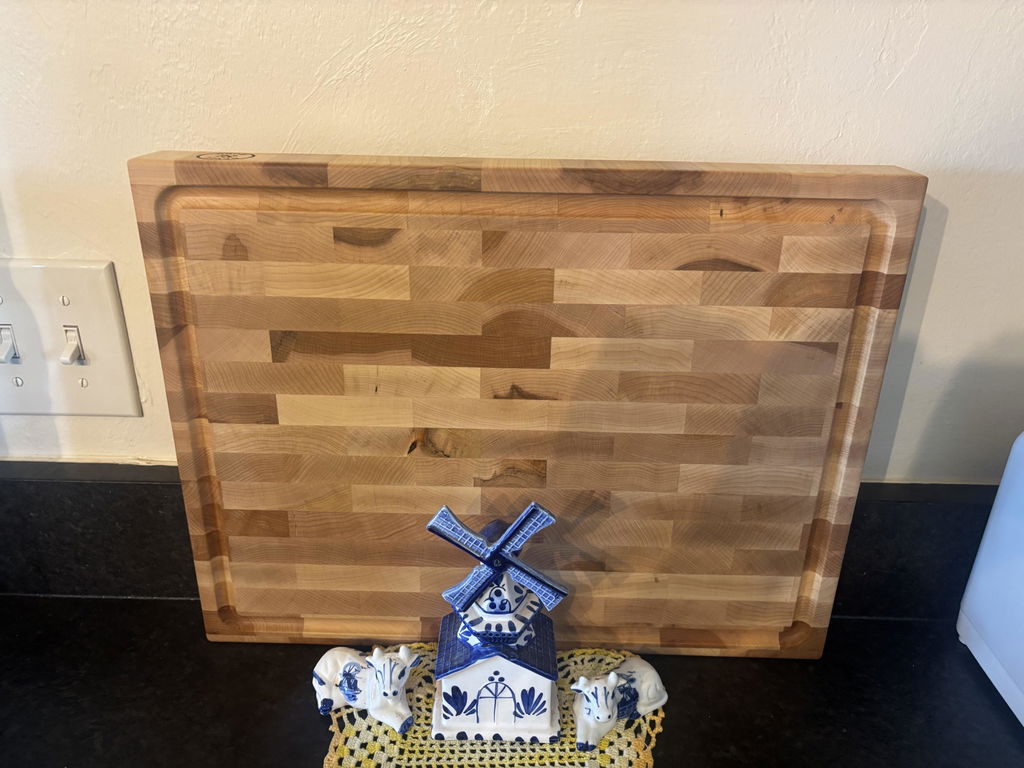
End grain is easier on knives because the wood fibers stand upright, so the blade slips between them instead of cutting across them. Picture a tight bundle of drinking straws standing on end. A knife edge parts them, drops slightly into the gap, and the surface scars less over the cut when you lift the blade.
On an edge-grain board, the same knife lands on the long sides of those fibers and has to sever them. That takes more force, scars the surface permanently, and grinds microscopic material off your edge every time.
What actually happens to the blade on each surface?
On end grain, the edge meets thousands of hollow fiber ends that compress and separate. There's very little lateral resistance, so the cutting edge isn't being scraped sideways across a hard surface.

On edge grain or face grain, the blade meets continuous fiber walls running perpendicular to the cut. It has to shear through them, and that shearing is what rolls and dulls a fine edge over months of use.
Why is end grain called hard-wearing?
Because the surface scars less than flat grain. Wood fibers have natural elasticity, and when they're oriented vertically they behave a bit like bristles on a brush, parting under pressure and returning to position afterward.
It isn't magic and it isn't unlimited. Deep cuts and repeated chopping in one spot will eventually leave visible marks, especially if the board is dry. A well-oiled board recovers noticeably better than a thirsty one, because moisture keeps the fibers flexible.
End grain vs. edge grain: what the knife experiences
| Factor | End grain | Edge grain |
|---|---|---|
| Blade meets | Fiber ends | Fiber walls |
| Cutting action | Meets fiber ends | Cuts across fibers |
| Surface marking | Marks stay shallow | Cut is permanent |
| Force required | Lower | Higher |
| Visible knife marks | Slow to appear | Appear sooner |
| Edge retention | Better | Good |
This table is only about what the blade feels. For the full build-versus-build comparison including cost, care, and which to buy, see end-grain vs. edge-grain.
How much longer does a knife edge actually last?
Here's the honest answer: no one has produced a clean, reproducible number, and anyone quoting an exact percentage is guessing. What's consistent is the direction, not the magnitude.
Cooks who switch from plastic or bamboo to end-grain hardwood generally report sharpening less often. The bigger variables are still your knife steel, your technique, and how often you actually hone. A board can't rescue an edge you never maintain.
Does hardness matter as much as grain direction?
Both matter, and they pull against each other. A harder wood resists denting and lasts longer, but a very hard surface is less forgiving to a blade. Hard maple sits at 1,450 lbf on the Janka scale, which is dense enough to wear well without being punishing.
Here are the same numbers the chart shows, so you don't have to squint at it. Janka measures the force needed to press a steel ball halfway into the wood, in pounds-force.
| Wood | Janka (lbf) | What the knife feels |
|---|---|---|
| Cherry (American) | 950 | Gentlest of the four. Dents sooner. |
| Walnut (black) | 1,010 | Easy on an edge, softer surface. |
| Teak | 1,070 | Silica in the grain dulls edges faster than the number suggests. |
| Red oak | 1,220 | Open pores trap moisture. Not a board wood. |
| Beech | 1,300 | Close to maple, and cheaper. |
| Hard maple (sugar maple) | 1,450 | The balance point. Dense enough to last, forgiving enough to spare an edge. |
| Hickory | 1,820 | Hard-wearing, but noticeably harder on a blade. |
Figures from The Wood Database, measured at 12% moisture content. Checked August 2026.

Woods much harder than that, like hickory at around 1,820 lbf, start trading knife-friendliness for durability. Our Janka scale guide covers where the useful window sits.
Why does glass or stone destroy an edge?
Because neither gives at all. Wood fibers compress under the blade and absorb some of the impact. Glass, granite, and ceramic are harder than your knife steel, so the edge is what deforms instead. A single session on a glass board can undo a careful sharpening.
This is the clearest case in the whole category, and we go through it in maple vs. glass. If your knives matter to you, glass boards belong under cheese, not under a chef's knife.
Does end grain dull knives at all?
Yes, every surface does. Cutting is abrasive by nature and an edge is only a few microns wide. End grain slows the process, it doesn't stop it. You'll still hone regularly and sharpen periodically.
Does board maintenance affect knife friendliness?
Significantly. A dried-out board becomes harder and less elastic, so the surface hardens and starts behaving more like a rigid one. Oiling every three to four weeks keeps that elasticity intact.
This is the part people miss. The durability depends on the wood being conditioned, not just on how it was cut. Our oiling guide and maintenance schedule cover the routine.
Is end grain worth it purely for knife protection?
If you own knives you've invested in and cook most days, yes. If you cook occasionally with a mid-range knife, the difference is real but small enough that a good edge-grain maple board is a sensible choice.
When was this article last reviewed?
This article was last reviewed in August 2026 by the Bevel & Bond workshop team.
The takeaway
End grain protects your edge because the blade parts upright fibers rather than severing horizontal ones, and those the surface scars less. Keep the board oiled and that mechanism keeps working for decades.
Our end-grain hard maple board is built on exactly that principle, 1.75 inches of Acer saccharum with the fibers standing where your knife wants them.