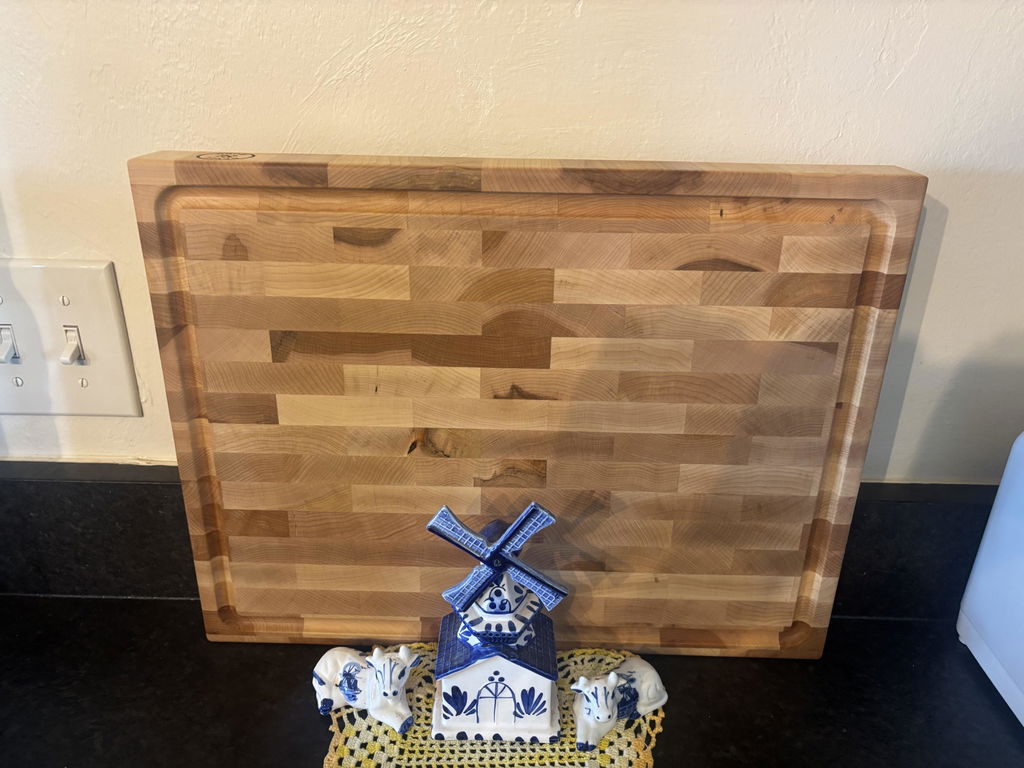
The short answer: a juice groove is worth it if you carve cooked meat. It is not worth it if you mostly chop vegetables, because the groove costs you usable width and the flat reverse face. If you buy one, buy it on a board at least 1.5 inches thick — a groove routed into a thin board removes wood the board cannot spare.
This guide merges three things we had written separately: what a juice groove actually does, how thick a grooved board needs to be, and which grooved boards are worth the money. Every price and dimension below was read on the maker's own website on 19 August 2026.
What a juice groove actually is
A juice groove is a shallow channel routed around the cutting surface, roughly a quarter of an inch deep, that catches liquid running off a roast before it reaches your counter.
That is the whole job. It is not a design flourish and it is not a quality signal — plenty of excellent boards have no groove at all. It solves one problem: resting and carving cooked meat without making a mess.
Groove or flat — which one you actually need
| Board with a juice groove | Flat board | |
|---|---|---|
| Best at | Carving roasts, steak, poultry, juicy fruit | Daily chopping, bread, herbs, vegetables |
| Usable surface | Loses roughly an inch of width to the channel | Full surface, edge to edge |
| Reverse face | Usually unusable, or a second groove | Both faces work |
| Cleaning | The channel needs brushing out | Wipe and dry |
| Weight | Heavier, because it needs the thickness | Can be light |
If you cook meat most weeks, the groove earns its place. If you are prepping vegetables on a weeknight, it is in the way. Plenty of kitchens are best served by owning both, and using the flat one for ninety per cent of the work.
Why thickness decides whether a groove works
Here is the part most buying guides skip. The channel is cut out of the board's thickness, so the thinner the board, the less solid wood is left underneath the deepest point of the groove.

At three-quarters of an inch, a groove takes a third of the board's depth. What is left is thin enough to flex, and thin boards cup when one face dries faster than the other. At 1.75 inches you still have an inch and a half of solid wood under the channel.
This is why we build at 1.75 inches rather than the more common 1.5. It is a quarter inch of difference on paper and a real one in the hand — the extra mass is also what stops a board sliding while you carve.
Grooved boards worth comparing
Six boards that actually offer a juice groove, with what each one costs and what you get. Read at each maker's own site on 19 August 2026.
| Board | Size | Thickness | Wood | Price |
|---|---|---|---|---|
| Teakhaus carving range | Various | ~1.5″ | FSC teak | $47 – $160 |
| Virginia Boys juice-groove board | 17 × 11″ | 0.75″ | Black walnut | $85 (list $100) |
| Ironwood Charleston with Channel | — | 1.25″ (chef's board) | Acacia | $102.99 |
| John Boos BBQ board | 18 × 12″ | 1.5″ | Hard rock maple, edge grain | $108.95 |
| Bevel & Bond | 17 × 13″ | 1.75″ | Hard maple, end grain | $139.99 |
| John Boos CB series | Various | 1.5″+ | Hard rock maple | $129.95 – $162.95 |
Two things worth pointing out, neither of which flatters us particularly.
Teakhaus starts at $47, which is less than half what we charge. If a grooved board for occasional carving is all you want, that is a sensible buy — teak is tough and forgiving. What you trade is knife friendliness: teak contains silica, the same mineral used in sandpaper, and it dulls edges faster than maple does over years of use.
The Virginia Boys board is American walnut at $85, and it is a genuinely nice board. But it is three-quarters of an inch thick with a groove cut into it, which is the exact combination the chart above argues against.
What a groove costs you
Three real downsides, stated plainly, because most guides pretend they don't exist.
- You lose usable width. The channel and its margin eat roughly an inch across the board. A 17-inch board with a groove gives you about as much working surface as a 16-inch board without one.
- The reverse face is usually dead. On a single-groove board the back is either unusable for carving or simply flat — you can't have the groove and a full second work surface on the same board.
- It needs cleaning out. Fat and juice sit in the channel. A brush and hot soapy water handles it, but it is a step you don't have with a flat board.
Common questions
Do you need a juice groove on a cutting board?
Only if you carve cooked meat. For vegetable prep, bread and general chopping, a flat board is better — you get the full surface and both faces. If you roast most weekends, the groove saves your counter every time.
How deep should a juice groove be?
About a quarter of an inch. Deeper than that and you are removing structural wood for very little extra capacity; shallower and liquid escapes over the lip when you tilt the board.
How thick should a cutting board with a juice groove be?
At least 1.5 inches, and 1.75 is better. The groove is cut out of the board's depth, so a 0.75-inch board keeps only half an inch of solid wood beneath the channel. That is thin enough to flex and cup.
Can you use both sides of a board with a juice groove?
Usually not in the way people hope. Most grooved boards are grooved on one face only, so the reverse is flat — useful for chopping, but you cannot carve on it without losing the drip catch.
Is a juice groove hard to clean?
No, but it is an extra step. Brush the channel out with hot soapy water, rinse, and dry it standing on edge so the groove drains rather than holding water.
The takeaway
Buy a grooved board if you carve meat, and buy it thick enough that the groove doesn't hollow it out. Buy a flat board if you mostly chop. If you only want one board and you cook a mix of both, a thick grooved board with a usable flat reverse is the compromise most kitchens end up wanting.
If you want end-grain hard maple at 1.75 inches with the groove already cut properly, that's our maple cutting board with a juice groove. If a $47 teak board covers what you actually do in your kitchen, buy that instead — you'll get more use out of the right board than the expensive one.
Prices and dimensions read at each maker's own website on 19 August 2026. Where a maker doesn't publish a figure, we've left it blank rather than estimating it.