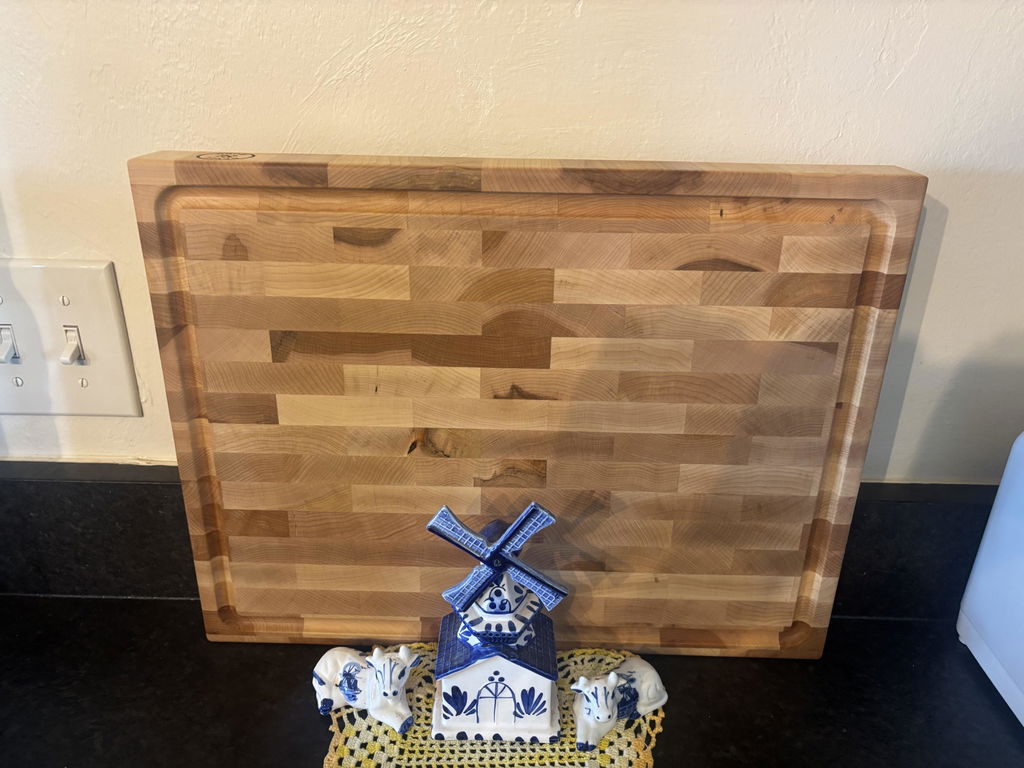
Buy a hard maple board between 12x9 and 15x11 inches, 1.25 to 1.75 inches thick, and store it standing on edge in a slot. Big enough to actually cut on, small enough to live somewhere in a tight kitchen. That is the whole answer.
I have sold boards to people in 400-square-foot apartments and to people with kitchen islands the size of a dining table. The apartment folks make the same mistake every time: they buy a board so small the onion rolls off the edge, or they buy a slab so big it lives in a closet and never gets used. A small kitchen does not mean a tiny board. It means a board sized to your counter and a plan for where it goes when you are done.
Quick size guide for tight kitchens
| Board size | Best for | Fits typical counter? |
|---|---|---|
| 12x9 in | One-person prep, small produce, cheese | Yes, even galley kitchens |
| 15x11 in | Everyday cooking for one or two | Yes, most apartments |
| 17x13 in | Real cooking, a whole chicken, batch nights | If you have 18 in of open counter |
| Over 18 in | Entertaining and big roasts | No, wrong tool for the room |
What size cutting board fits a small kitchen?
A board between 12x9 and 15x11 inches. That range gives you enough surface to break down an onion, a bell pepper, and a chicken breast without ingredients sliding onto the counter, and it still fits next to a sink and a stovetop in a galley layout. Go below 12x9 and you spend the whole time herding food back to the middle.
If your counter has a genuine 17 to 18 inches of clear run, our flagship 17x13 board is the largest I would put in a small kitchen. It is the upper limit, not the compromise. Below that, size down. For the full breakdown of surface area versus counter space, read our guide on what size cutting board you actually need.
Does thickness still matter in a small board?
Yes, and it matters more, not less. A thin board in a small kitchen slides, flexes, and clatters around while you work, which is exactly what you do not want when your counter is 24 inches wide. Stay in the 1.25 to 1.75 inch range so the board sits with authority and does not walk toward the edge.
Thickness also buys you stability without buying you floor space, since it adds weight straight down instead of surface area outward. A 15x11 board at 1.5 inches of hard maple has real heft. Put a damp towel under it and it will not move. Our full reasoning on this is in the cutting board thickness guide.
Can one board do prep and serving in a tight kitchen?
Yes, and in a small kitchen it should. When you do not have room for a rotation of specialty boards, one good hard maple board that goes from chopping to the table earns its counter space twice. Prep the vegetables, wipe it, then carry it out with cheese and crackers.
Hard maple looks the part for serving, which cheap plastic never will. A 15x11 board holds a respectable spread of charcuterie for two or three people. For how to set that up, see using a cutting board as a serving board.

Where do you store a cutting board when counter space is gone?
On edge, in a vertical slot. Standing a board upright between a cabinet divider, a pull-out rack, or alongside your baking sheets takes a two-inch footprint instead of covering a chunk of counter. It also lets both faces breathe, which keeps the wood from trapping moisture and cupping.
Never store a wood board flat under a stack of other things, and never leave it lying in a puddle by the sink. Both invite warping. A thick, flat, well-oiled maple board can be stored vertically when stable and when airflow reaches both sides.
Should you get a board that fits over the sink?
If your counter is truly maxed out, yes, a board sized to bridge your sink basin doubles your working surface without adding a square inch of permanent footprint. Measure the sink opening first, then buy a board an inch longer on each side so it rests on the lip without slipping in.
This trick turns dead space into prep space, and it puts your scraps right over the drain or a compost bowl. The catch is stability: only do this with a board thick and heavy enough to sit still. A 1.5 inch maple board works. A thin bamboo sheet will rock and dump your dinner into the sink.
What is the smallest board you can actually cook on?
12x9 inches is the floor for real cooking. Below that you are working on a coaster, and every stroke of the knife pushes food off the edge. At 12x9 you can dice an onion, slice a tomato, and cut chicken with room to push the pieces aside as you go.
The mistake I see most is buying a 9x6 board because it looked cute and cheap, then fighting it every single night. Small kitchen or not, the board has to hold the food you are cutting. Buy the biggest board your counter and storage will honestly take, then stop.
Working in a tight kitchen? Our end-grain hard maple cutting board is 17x13x1.75 inches, the largest board I would put in a small kitchen, and it goes straight from prep to the table. Produced in the USA from hard maple and backed by a five-year limited warranty covering qualifying manufacturing defects under normal household use, and it ships in a premium black gift box; Board Balm is available separately. If your counter is smaller, browse the full collection for a size that fits your run of counter.
Is end-grain or edge-grain better for a small kitchen?
End-grain, if you can fit the thickness. End-grain maple is heavier and stays flatter, so it sits rock-steady on a narrow counter and is gentler on your knife edge because the fibers stand vertical. It costs more upfront and it is thicker, so measure your storage slot first. In a small kitchen where one board does everything, the durability is worth it.
Can a small maple board handle daily use?
Yes. Hard maple has a Janka hardness around 1,450 lbf, which is dense enough to resist many signs of routine knife use when properly maintained. Size has nothing to do with durability, only surface area. A well-made 15x11 maple board oiled every few weeks will outlast a decade of plastic boards you would have thrown away.
How do you clean a board without a big sink?
Hot water, a drop of dish soap, a quick scrub with the flat of a sponge, then stand it up to dry. You do not submerge a wood board and you do not need to. In a small kitchen this is a feature, since a quick wipe-and-stand beats hauling a giant slab to an undersized sink. Never put it in the dishwasher, which will crack and warp the wood fast.
Does a juice groove make sense on a small board?
Only if you carve a lot of meat or cut juicy fruit at the counter. A juice groove catches runoff, but it also eats into your usable flat area, and on a 12x9 board that trade stings. For a small everyday board I lean flat and reversible. If you roast often, the groove pays off. We break down the choice in juice groove versus flat board.
When was this article last reviewed?
This article was last reviewed in July 2026 by the Bevel & Bond workshop team. We revisit our buying guides as our boards, sizing, and care recommendations change, so the advice here reflects what we build and stand behind today.
Ready to fix your counter situation? Start with the end-grain hard maple cutting board, keep it fed with Board Balm, and store it on edge. One good board, sized right, beats a drawer full of plastic every time.