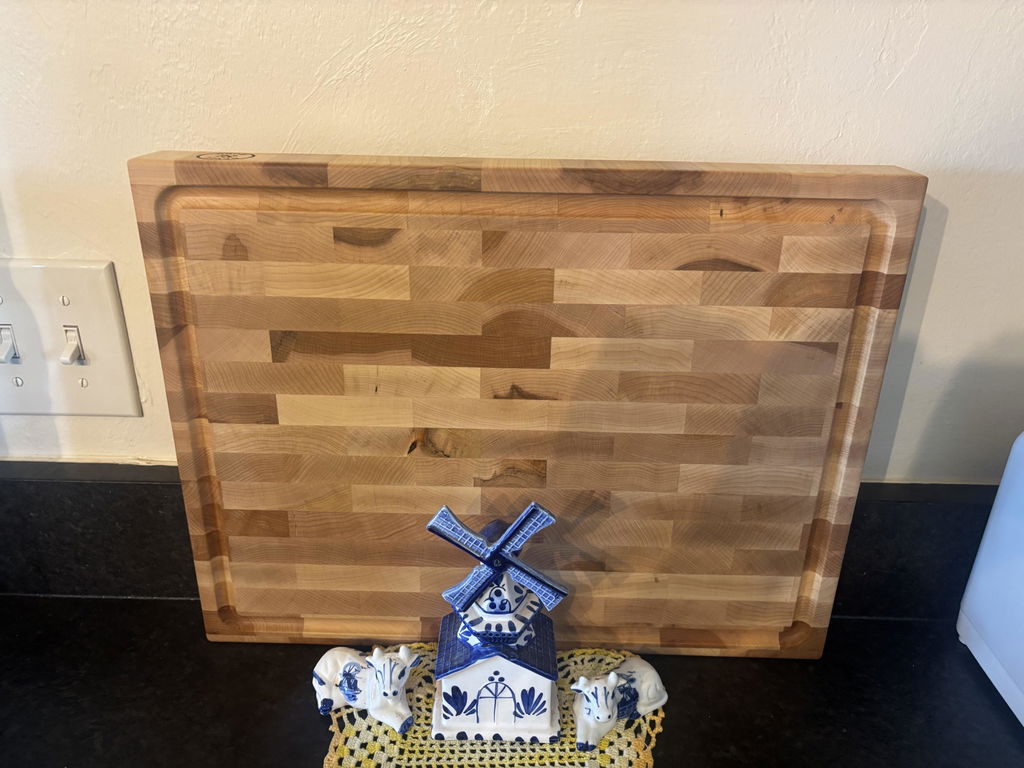
A reversible cutting board is worth it, not a gimmick, as long as it is thick enough to stay flat and both faces actually earn their keep. Two usable sides double your utility and even out the wear. A thin board with a groove on one face will cup on you inside a year, and that is where the gimmick reputation comes from.
Here is the situation most people are in. You want one board that pulls double duty: a flat face for chopping onions and a grooved face for carving a roast so the juice does not run onto the counter. That is a genuinely useful board. The problem is the market is full of 0.75-inch acacia boards marketed as reversible, and those are the ones that warp, rock on the counter, and get returned. The concept is sound. The execution is usually too thin.

Reversibility is one feature among several. How to choose a cutting board puts it in context.
What makes a cutting board reversible?
A reversible board is one with two fully usable faces, most often a flat side paired with a juice-groove side, or a prep side paired with a serving side. You flip it depending on the job. The best versions are a single slab thick enough that carving a groove into one face does not weaken the board or pull it out of flat.
The distinction that matters: a board with a groove on one side is not fully flat on that side. You lose about 0.25 inch of clear cutting field where the channel runs. That is fine for a roast and annoying for dicing a pile of shallots. This is exactly why two faces beat one. Keep the flat side for fine knife work, flip to the grooved side when there is liquid to catch.
Are reversible cutting boards actually worth it?
Yes, for most kitchens, because a second usable face doubles what one board can do without taking up a second board's worth of storage. You get a dedicated flat prep surface and a dedicated juice-catching surface in one slab. You also get to rotate faces, which spreads knife wear across both sides and keeps the board flatter for longer.
The trade-off is honest: a reversible board asks more of the wood. Working both faces means moisture hits both sides, so the board has to be thick and stable enough to take that without cupping. On a 1.75-inch end-grain maple slab, that is a non-issue. On a 0.75-inch big-box board, it is the whole issue.
| Board | Thickness | Stays flat worked both sides? | Verdict |
|---|---|---|---|
| Thin acacia reversible | 0.6 to 0.9 in | No, tends to cup | Where the gimmick reputation comes from |
| Mid edge-grain maple | 1.0 to 1.25 in | Mostly, with care | Acceptable everyday board |
| Thick end-grain maple | 1.75 in | Yes | The version worth buying |
Does the juice groove ruin the flat side?
No, because the groove lives on one face and the other face stays completely flat. That is the entire argument for a reversible board over a single-groove board. You are not forced to dice vegetables around a channel. You flip to the clean face and you have the whole surface.
If you are still deciding between a grooved board and a flat one, we broke that down in cutting boards with a juice groove. The short version is that a reversible board is the answer that refuses to choose, and for most home cooks that is the right call.
How thick does a reversible board need to be?
At least 1.5 inches, and 1.75 inches is the number I trust for a board worked on both faces. Thickness is what keeps a board flat when both sides get wet, washed, and cut on. Carve a groove into a thin board and you have removed material from a slab that did not have much to spare.
Thickness also buys you decades of resurfacing life and a board heavy enough that it does not slide while you work. We go deep on this in the cutting board thickness guide, but for a reversible board specifically, do not go under 1.5 inches. That is the line between a tool and a warped souvenir.

Can you use each side for a different job?
Yes, and this is the smartest way to run a reversible board: assign each face a job and stick to it. Keep the flat side for produce, bread, and ready-to-eat food. Reserve the grooved side for carving roasts and resting meat where liquid needs somewhere to go.
Do not use one face for raw chicken and the other for salad and call it food-safe. Flipping a board does not separate raw meat from produce the way two boards do; a board that gets raw poultry on it needs a full wash before either face touches ready-to-eat food. For real cross-contamination control you still want a second board, which we cover in separate cutting boards for meat and vegetables.
When is a reversible board a gimmick?
When it is too thin to stay flat, or when the second face is decorative rather than functional. If the "second side" is a shallow etched pattern you cannot cut on, you paid for a picture, not a face. And if the whole board is under an inch thick, working both sides is how you warp it.
The other gimmick tell is a soft, pretty wood chosen for grain figure over hardness. Acacia photographs beautifully and dulls knives faster than hard maple. A reversible board only pays off if the wood underneath is hard, stable, and thick. Get that right and the two faces are a real advantage, not marketing.
Our end-grain hard maple cutting board is 17x13x1.75 inches, designed for greater stability when used and maintained correctly, made in the USA with food-safe PVA glue and backed by a five-year limited warranty covering qualifying manufacturing defects under normal household use. It ships in a premium black gift box; Board Balm is available separately.
Can you put raw meat on one side and vegetables on the other?
Not safely without a full wash in between. Flipping the board does not create a barrier; juices and bacteria transfer through handling, and the same knife often touches both faces. Use the two faces for flat prep versus carving, and keep a genuinely separate board for raw poultry and meat.
Do reversible boards warp more than single-sided boards?
Only if they are thin. A 1.75-inch end-grain maple slab gives you plenty of wood on both faces, as long as both are washed and dried evenly. A 0.75-inch board worked on both sides absorbs and releases water unevenly and cups. Thickness, not the reversible design itself, decides whether a board warps.
How do you clean and dry a reversible board?
Wash both faces by hand with warm water and a little dish soap, never the dishwasher, then stand the board on edge to dry so air reaches both sides evenly. Drying flat on a counter traps moisture against the down face and invites cupping. Re-oil with a board wax when the surface looks dry, about once a month with regular use.
Is end-grain available as a reversible board?
Yes, and end-grain is the construction I would pick for a reversible board. End-grain maple is easier on knife edges and shows cut marks less, so both faces stay smoother longer. Paired with 1.75-inch construction, the board is designed for years of daily use with proper care. Actual lifespan varies. See best wood for cutting boards for why hard maple leads the pack.
Which side should you serve on?
Serve on the flat face and carve on the grooved face. The flat side gives you a clean, uninterrupted surface for a cheese spread or sliced bread, while the grooved side does its job under a roast. If you want a board dedicated purely to presentation, a separate serving board is worth owning, but a good reversible board covers most hosting.
When was this article last reviewed?
This article was last reviewed in July 2026 by the Bevel & Bond workshop team. We update our buying guides as we build and test boards, so the recommendations here reflect what we would tell a customer standing in the shop today.
Start with our end-grain hard maple cutting board or browse the full Bevel & Bond collection. Keep it conditioned for decades with Board Balm.