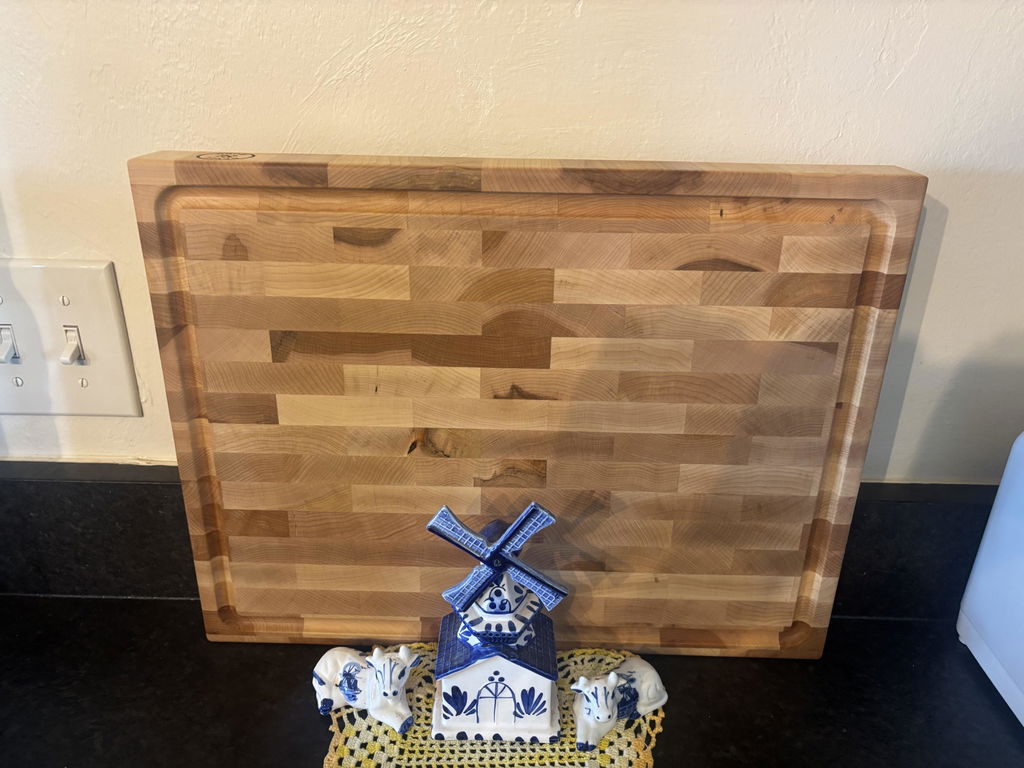
The short version: the best board for carving meat is a heavy hardwood board with a deep juice groove and non-slip feet — roughly 10 lbs, at least 1.5" thick, big enough to hold the roast with room to work. Buy a separate dishwasher-safe plastic board for raw prep. Two boards, two jobs, and you stop making one board do both badly.
How we ranked these. Carving is a narrow job with a clear spec, so the ranking is juice-groove capacity first, then weight, then non-slip feet, then working area. A board that cannot hold the juices off a roast does not make the list regardless of how well it is built.
The best carving boards of 2026, ranked
We checked every price and spec below at each maker's own site in the first week of September 2026. Where a maker doesn't publish a number, we say so rather than guess. This is the same short list we'd hand a friend looking for the best cutting board for carving meat: one pick for most people, and seven others that are the right answer for a specific kitchen.
| Rank | Board | Wood / construction | Size & thickness | Juice groove | Weight | Price | Made in | Warranty |
|---|---|---|---|---|---|---|---|---|
| 1 | Bevel & Bond End-Grain Maple | Hard maple, end grain | 17" × 13" × 1.75" | Yes, included, plus non-slip feet | 10+ lb | $139.99 | USA (Oregon) | 5 years |
| 2 | JK Adams Maple Reversible Pour Spout Carving Board | Maple, edge grain, reversible | 20" × 14" × 1" (24" × 16" available) | Yes, both sides, with pour spout; poultry well on one side | Not published; check current listing | $135 (24" × 16": $155) | USA (Vermont) | Lifetime guarantee |
| 3 | Teakhaus Traditional Carving Board w/ Juice Canal (L) 108 | Teak, edge grain, reversible | 24" × 18" × 1.5" | Yes, one side; hand grips | 15 lb | $160 | Check current listing | Check current listing |
| 4 | John Boos Maple AuJus Cutting Board | Hard rock maple, edge grain, reversible | 20" × 15" × 1.5" (24" × 18" available) | Yes, sloped, one side | 12 lb | $154.95 | USA | 1 year |
| 5 | The Boardsmith Maple End Grain (Butcher / Big Block) | Hard maple, end grain | 12" × 18" × 2" up to 18" × 24" × 2" | Optional, +$25–$35; feet sold separately | 9–10 lb (Butcher); 23–24 lb (Big Block) | $245–$450 before options | USA (Texas) | 60 days |
| 6 | Larch Wood Canada Medium Carvers' Board | Larch, end grain | 17.75" × 13.5" × 1.6" (24" × 15" × 2" Large available) | Yes, deep moat, plus rubber feet | 8 lb (Large: 15.7 lb) | CA$412.50 (Large: CA$562.50) | Canada (Nova Scotia) | 10-year limited |
| 7 | Ironwood Gourmet Kansas City Carving Board | Acacia | 22" × 15" × 1.5" | Yes, sloped channels into a pool | About 7.8 lb (3,538 g) | $157.49 list; often discounted, check current listing | Check current listing | Check current listing |
| 8 | OXO Good Grips Carving & Cutting Board (best for raw prep) | Plastic, double-sided | About 21" × 15" × 0.35"; check current listing | Yes, grooved meat side; non-slip edges | Just over 3 lb | Check current listing | Check current listing | Check current listing |
1. Bevel & Bond End-Grain Maple Cutting Board — best overall under $150
This is our board, so weigh that as you read. It's 17" × 13" × 1.75" end-grain hard maple, 10+ lbs, with a deep perimeter juice groove and non-slip feet included in the $139.99 price rather than sold as add-ons. It's made in Oregon and carries a 5-year written warranty. It made the list because of the eight boards here, nothing else combines end grain, 10 lbs of mass, a groove and feet under $150; the nearest end-grain competitors start at roughly double once you add the groove. The honest downside is size: 221 square inches is under America's Test Kitchen's 300-square-inch target, so a 20-lb turkey gets tight. It's for the cook who carves chicken, pork loin, tri-tip, brisket flats and the occasional prime rib, and wants one heavy board that also goes to the table.
2. JK Adams Maple Reversible Pour Spout Carving Board — best for a whole turkey
The JK Adams pour spout board is 20" × 14" × 1" maple, made in Vermont, $135, with a lifetime guarantee. One side has a shallow well that cradles a bird or roast; the reverse is flat; both sides have a juice groove and a pour spout so you can tip the drippings into a gravy pan. A 24" × 16" version is $155. America's Test Kitchen recommends it, and gave its top spot to JK Adams' sibling reversible carving board. The downside is thickness: at 1" it's lighter than the boards above and below it, and JK Adams doesn't publish a weight or feet, so plan on a damp towel underneath. If Thanksgiving is the main event, this is the board we'd buy instead of ours.
3. Teakhaus Traditional Carving Board w/ Juice Canal (L) 108 — best big board for the money
The Teakhaus 108 is 24" × 18" × 1.5" edge-grain FSC-certified teak, 15 lbs, reversible with a juice canal on one side and hand grips, for $160. That's 432 square inches of hardwood for less than most 18" × 24" maple boards cost. Teakhaus's edge-grain XL has been ATK's overall cutting board winner for years, and it needs less oil than maple. Two downsides: ATK notes that teak's silica content can wear blades faster than other woods, and there are no feet, so the 15-lb board relies on its own mass. Teakhaus doesn't state country of manufacture or warranty on the product page, so check before ordering. For anyone who roasts big and has the counter space, this is the value pick.
4. John Boos Maple AuJus Cutting Board — the reversible workhorse
Boos's AuJus board is 20" × 15" × 1.5" Northern hard rock maple, 12 lbs, $154.95, with a sloped juice groove on one side and a flat surface on the other, finger grips, and NSF certification. A 24" × 18" size is offered. It made the list because it hits ATK's 20" × 15" minimum in American hard maple at a fair price, from a maker that has been building blocks since 1887. The downsides are the ones we cover in our full Boos review: edge grain shows knife marks sooner than end grain, there are no feet, and the warranty is one year. It's for the cook who wants a classic, restaurant-supply maple board with a groove and doesn't mind oiling it.
5. The Boardsmith Maple End Grain — best custom end grain, if you'll pay for it
The Boardsmith's maple end grain comes in three sizes: Butcher (12" × 18" × 2", 9–10 lbs, $245), Carolina Cut (16" × 22" × 2", $360) and Big Block (18" × 24" × 2", 23–24 lbs, $450). A juice groove is +$25–$35; finger grooves are +$15 and feet are sold separately, and boards are made to order in Frisco, Texas, in about one to two weeks. It's here because the 2" end-grain surface is as knife-friendly as carving boards get, and the Big Block will hold anything you can fit in an oven. The downsides are price, a 60-day warranty, and a 12" width on the Butcher that's tight for a long roast. Our Boardsmith review goes deeper. It's for the buyer who wants an heirloom-grade block built to spec.
6. Larch Wood Canada Medium Carvers' Board — the end-grain alternative to maple
Larch Wood's Medium Carvers' Board is 17.75" × 13.5" × 1.6" end-grain larch, 8 lbs, with a deep juice moat and bottom-mounted rubber feet, made in Cape Breton, Nova Scotia, for CA$412.50. The Large is 24" × 15" × 2", 15.7 lbs, CA$562.50. It made the list because it is one of very few end-grain carving boards that ships with both a groove and feet, and larch's tight grain gives it a distinctive look. The downsides are price after exchange and shipping to the US, a softer wood than hard maple, and a guarantee whose terms you should read on their site. Our Larch Wood review covers the rest. It's for the buyer who wants end grain and feet in something other than maple.
7. Ironwood Gourmet Kansas City Carving Board — budget pick with caveats
The Kansas City board is 22" × 15" × 1.5" acacia, about 7.8 lbs, with channels that slope to a collecting pool and neoprene-coated feet. Ironwood lists it at $157.49, but it is routinely sold well below that at big-box retailers, so check current pricing. It's on the list because it's the most widely available large carving board with feet and real groove capacity, and it looks good on a table. The honest downside is durability: in ATK's carving board test it "scarred badly during testing, and those channels made the small work surface unpleasant to cut on." Country of manufacture and warranty aren't stated on the product page. It's for the once-a-year carver who wants a presentable board without spending $150.
8. OXO Good Grips Carving & Cutting Board — best for raw prep, not for carving
The OXO carving board is double-sided plastic: a grooved side for meat, a smooth side for vegetables, side grips, and non-slip edges. It's dishwasher safe, which is the entire point. ATK measured its board at roughly 15" × 20", 0.35" thick and just over 3 lbs, and named it their lightweight pick. OXO's own page doesn't list price or dimensions, so check the current listing. It's on this list as the second half of the two-board system below, not as a carving board: at 3 lbs it moves under a slicing knife and it won't come to the table. It's for the raw work — breaking down chicken, trimming brisket — that you should never do on the wood board.
How to choose a carving board
Five things decide it. First, groove capacity: a rested prime rib gives up half a cup of liquid and a turkey more, so the groove needs to be cut deep, not decorative. Second, mass: at 8–10 lbs a board stops sliding under a long knife on its own; under that, you're relying on feet or a towel. Third, non-slip feet, which also lift the board so the underside dries instead of sitting in juice. Fourth, working area: for a whole turkey or packer brisket you want at least 16" × 12" of flat surface inside the groove, and ATK's 20" × 15" is safer still. Fifth, wood species and knife-friendliness: hard maple at 1,450 Janka resists dents, end grain is kindest to an edge, and teak's silica is the one hardwood caveat worth knowing.
Carving is one job. If you want one board that handles everything, see the best chef cutting board picks.
Carving is a different job than chopping
Most cutting board advice treats meat as one category. It isn't.
Raw prep is messy, wet and contaminated. You're breaking down chicken thighs, trimming silverskin, portioning steaks. The board needs to get properly clean afterward, ideally in hot water and a machine.
Carving is the opposite. The meat is cooked, it's been resting, and it's releasing a lot of hot liquid. Nothing on the board is a contamination risk anymore. What you need instead is a board that holds still, holds juice and looks good enough to bring to the table.
Those are two different tools. Which is genuinely good news, because it means you don't have to solve the hard problem — cleaning wood after raw poultry — to get a great carving board.

What a carving board actually needs
A juice groove with real capacity
This is the whole feature. A rested prime rib can release half a cup of liquid, and a turkey more. A shallow decorative channel fills up and then sends the rest onto your counter, which is a specific kind of Thanksgiving disappointment.
Look for a perimeter groove cut deep, and check whether it's included in the price. It often isn't — The Boardsmith charges $25–$35 to add a perimeter juice groove to their end-grain maple boards (checked 19 August 2026), on top of a board that starts at $245.
If you're weighing whether you want the groove at all, we broke it down in the guide to boards with a juice groove.
Enough mass to stay put
Carving a roast means pulling a long knife toward you under real pressure while your other hand steadies a hot, slippery, awkwardly shaped object. A board that skates is a board that will eventually cost you a knuckle.
Around 10 lbs is the point where a board stops needing help. Under about 5 lbs, you're relying on the feet and the friction of a damp towel underneath — which works, but it's one more thing to remember. Our full fix list is in how to stop a cutting board from sliding.
Non-slip feet, not just a heavy board
Feet do two jobs. They break the friction problem, and they lift the board off the counter so air can reach the underside — which matters a lot when the board is sitting in a puddle of pan juices for twenty minutes.
Feet are frequently an upcharge or a separate accessory. Check the listing rather than assuming.
Size that matches the biggest thing you cook
America's Test Kitchen recommends a board of at least 15" × 20" — 300 square inches. That's a sensible target for a turkey.
Be realistic about what you actually cook, though. A 17" × 13" board is 221 square inches, which handles a chicken, a pork loin, a tri-tip or a rack of ribs comfortably, and gets tight with a 20-lb bird. Bigger boards also weigh more, cost more and are harder to store, so the right answer depends on your Novembers.
Hardwood, and preferably end grain
Hard maple (Acer saccharum) sits at 1,450 on the Janka hardness scale — harder than walnut at 1,010 or teak at 1,070. That density is what keeps a carving board from denting when you set a heavy roast down on it.
End grain construction scars less and shows knife marks less than edge grain over years of use. It also drinks more oil and costs more, which we lay out honestly in end grain vs edge grain.
The board we'd point you to
Our 17" × 13" × 1.75" end-grain hard maple board was designed around exactly this spec. It's 10+ lbs, the deep juice groove and the non-slip feet are included rather than added, and it carries a 5-year written warranty — which is longer than what John Boos publishes (one year) or The Boardsmith publishes (60 days), both checked on 19 August 2026. It's made in Oregon by a small wood shop, and it's $139.99 with free U.S. shipping.
The honest limit: 221 square inches is under ATK's 300-square-inch recommendation. If a 20-lb turkey is an annual event in your house, buy something in the 18" × 24" range instead. Teakhaus makes an end-grain teak carving board at 24" × 18" × 1.5" with a juice canal and hand grips for $195, and it's a genuinely good board.
You can read what owners say on our reviews page.

Now buy a plastic board for the raw work
Here's where we argue against ourselves a little.

The USDA's Food Safety and Inspection Service says consumers may use either wood or a nonporous surface for raw meat and poultry. It also says, plainly, that nonporous surfaces are easier to clean than wood. And it recommends keeping a separate board for raw meat, poultry and seafood.
That's the practical case. A plastic board goes in the dishwasher on a hot cycle and comes out done. A wood board doesn't — every maker in this category, us included, says hand wash only, because dishwasher heat and standing water are what crack wood boards.
FSIS technically permits solid wood in the dishwasher. Every manufacturer's care sheet disagrees, and the manufacturers are the ones replacing the board. More on that tension in can you put a wooden cutting board in the dishwasher.
The research on wood is real and we're not walking it back. Dean Cliver's UC Davis work found bacteria drawn into wood fibers died off rather than surviving on the surface, and knife-scarred plastic was harder to sanitize than knife-scarred wood.
What that research doesn't do is make wood the easier surface to clean after you've spatchcocked a chicken on it. Both things are true. We compared them side by side in maple vs plastic.
Plastic boards worth naming
San Jamar Saf-T-Grip, 12" × 18" × 0.5" — the one professional kitchens actually use. The manufacturer describes it as warp-resistant, able to withstand the high temperatures of commercial dishwashers, and made from a co-polymer blend formulated to decrease knife dulling. Grip edges on both ends keep it planted. No price is published on the manufacturer's site; it's sold through foodservice suppliers.
Material MK Free Board — $52 — the better-looking option for a home kitchen. 17.5" × 12" × 0.25", dishwasher-safe bioplastic made from biopolymers and natural clay minerals, with a juice groove and lifetime coverage per Material's own page. No feet, so put a damp towel under it.
OXO Good Grips Carving & Cutting Board — widely available, double-sided with a grooved meat side, drip catcher with pour corners, non-slip feet, dishwasher safe. We couldn't verify its current price or dimensions because oxo.com blocked our request on 19 August 2026, so we're not going to quote numbers we didn't read.
Whichever you pick, replace it when the grooves get hard to clean. FSIS is explicit about that, and a scarred plastic board is the one genuinely risky surface in this whole conversation.
The two-board system, in practice
| Job | Board | Why |
|---|---|---|
| Breaking down raw chicken, trimming brisket, portioning steak | Dishwasher-safe plastic | Hot machine wash, replaceable, no oiling |
| Resting and carving cooked roasts, turkey, prime rib | End-grain hard maple with juice groove and feet | Holds juice, holds still, goes to the table |
| Vegetables, bread, cheese | Either | Flip the maple board or use a second plastic board |
That's roughly $170 for both if you pair our board with the Material board — less than one 2" end-grain board from most of the premium makers, and it solves the cleaning problem instead of arguing with it. More on splitting boards by task in separate cutting boards for meat and vegetables.

After you carve
Scrape the board, wash it with hot soapy water, rinse and dry both sides. Stand it on edge rather than laying it flat so air reaches the underside.
Don't soak it, don't leave it in the sink and don't put it away damp. Oil it about monthly. That's the entire maintenance routine, and it's what turns a carving board into something your kids inherit rather than something you replace.
If raw meat did touch the wood board, here's how to sanitize it properly.
Frequently asked questions
Do I really need a juice groove? For carving cooked meat, yes. It's the difference between juices staying on the board and juices finding the seam behind your stove.
Can one board do carving and raw prep? It can. It's just harder to clean and you'll be more careful about it. If you'd rather buy one board, see the best cutting board for meat for that version of the answer.
Is a carving board different from a cutting board? Mostly it's a cutting board with a juice groove and enough weight to stay put.
What about boards with spikes? They hold a bird steady, and they also put permanent holes in your board and get in the way of everything else. A heavy board with feet does most of the same work without the commitment.
What is the best wood for a carving board? Hard maple is the safest answer: it sits at 1,450 on the Janka scale, so it resists dents from a heavy roast, and it's closed-grain and easy on knives. Walnut and cherry carve well but dent more easily. Teak resists moisture and needs less oil, though its silica content can wear an edge faster. End grain in any of these species is the most knife-friendly surface.
Do you need a juice groove on a carving board? For cooked meat, yes. A rested roast or bird releases well over half a cup of liquid, and a flat board sends it onto the counter. Look for a groove cut deep enough to hold it, and check whether it's included in the price or an add-on. For raw prep you can skip it; that job belongs on a dishwasher-safe board anyway.
The takeaway
A carving board has one job and a short spec list: deep juice groove, real mass, non-slip feet, hardwood surface, sized to the biggest thing you roast.
Buy that in wood, buy a plastic board for the raw work, and you've solved both problems properly instead of compromising on one board. If you want the wood half of that pair with the groove, the feet and a 5-year warranty included at $139.99, the Bevel & Bond End-Grain Maple Cutting Board is built for it.
Last reviewed September 2026. Prices and specs verified at each maker's site at time of review.
Honest reviews of every major cutting board brand
We make end-grain hard maple boards ourselves, so we review the competition the way a buyer would want: what each maker does well, where to look more closely, a like-for-like spec table, and who the board actually fits. No brand is dismissed. Several are recommended outright for the right cook.
- John Boos maple cutting boards review
- The Boardsmith cutting boards review
- Michigan Maple Block cutting boards review
- Brooklyn Butcher Blocks cutting boards review
- Virginia Boys Kitchens cutting boards review
- Teakhaus cutting boards review
- Larch Wood Canada cutting boards review
- Sonder LA cutting boards review