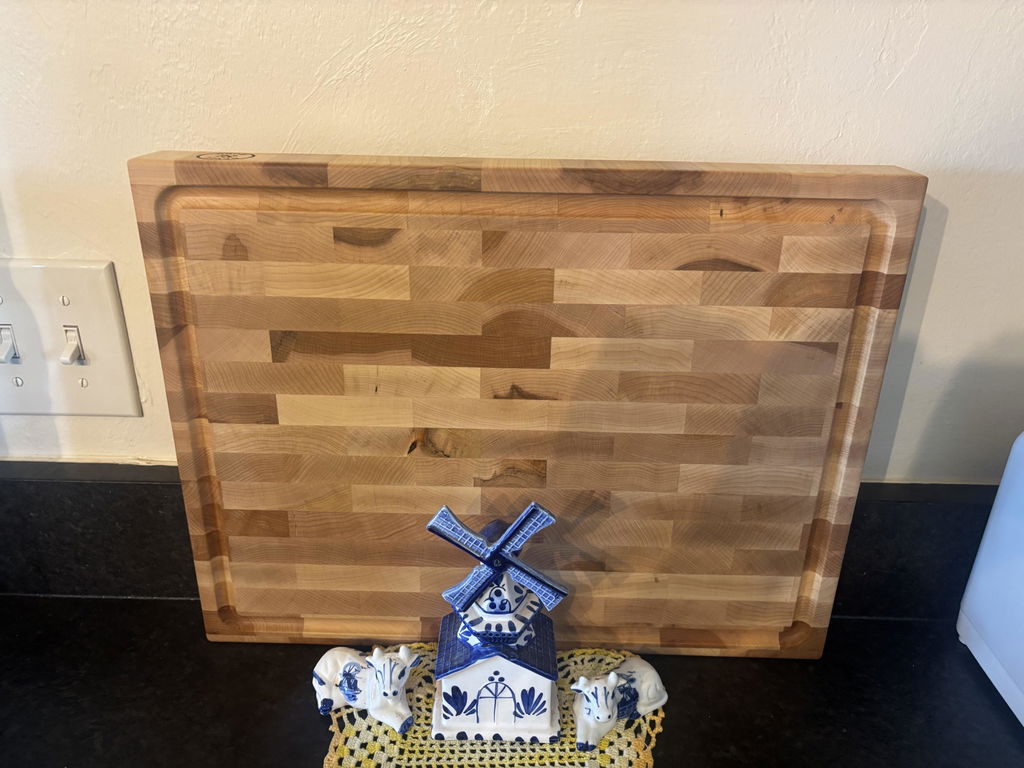
Walnut earns its place for looks and knife feel, not for toughness. American black walnut sits at 1,010 lbf on the Janka scale — softer than hard maple — so it gives under the blade and treats a fine edge kindly. That same softness means it shows knife marks sooner, which its dark grain then hides well. Buy walnut for a board that serves as well as it preps. For a pure daily workhorse, see walnut vs. maple. To see where walnut lands against all twelve common species, check the full best-wood ranking.
Walnut is gentle on edges, but hinoki goes further if edge retention outranks everything else for you.
What walnut is good at, and what it isn't
| Walnut | |
|---|---|
| Janka hardness | 1,010 lbf (Juglans nigra) |
| On your knife edge | Very gentle — among the kindest hardwoods |
| Knife marks | Show sooner than maple, but hide in the dark grain |
| Color | Chocolate brown with honey streaks; deepens with age |
| Stain visibility | Low — dark surface forgives beets and berries |
| Serving use | Excellent — charcuterie, bread, carved meats |
| Heavy daily chopping | Capable, but maple holds up better |
| Price | 15–25% above maple for the same build |
Few materials match walnut for a premium cutting board. It's durable, beautiful, and gentle on knives — making it a favorite among professional chefs and home cooks alike.
In this guide, we'll explore the key benefits of walnut cutting boards and why they've become a signature of Bevel & Bond craftsmanship, trusted by culinary experts who value both form and function.
1. Elegant, Timeless Appearance

Walnut's deep, rich tones range from chocolate brown to warm honey streaks, creating a striking look that complements any kitchen — modern or rustic.
-
Unique grain patterns: No two boards are ever identical.
-
Develops a patina: Walnut grows more beautiful over time.
-
Doubles as serveware: Ideal for charcuterie, bread, or roasted meats.
With a walnut board, you're not just prepping food — you're showcasing craftsmanship.
2. Knife-Friendly Surface

Walnut strikes a well-judged balance between hardness and softness at 1,010 lbf on the Janka scale:
-
Hard enough to resist deep gouges.
-
Soft enough to protect your knife's edge.
That balance suits everyday chopping, slicing, and carving without dulling your blades. Chefs like walnut boards for their smooth “give” and long-term consistency. Where walnut sits against every other board wood is laid out in our guide to the Janka scale.
3. Naturally Hygienic
Walnut can provide a practical food-preparation surface when it is cleaned promptly, dried thoroughly, and maintained. Laboratory research has compared bacterial recovery from wood and plastic, but no cutting board should be treated as self-sanitizing.
Deep knife grooves on any board can become harder to clean and are a reason to resurface or replace the board. Walnut’s fibers close slightly after cutting, keeping the working surface cleaner for longer. We go through the full comparison in maple vs. plastic.
4. Easy to Maintain

With regular care, a walnut board can retain an attractive finish over time.
Follow this simple routine:
-
Wash by hand with mild soap and warm water.
-
Dry immediately — never soak or dishwasher.
-
Condition with Bevel & Bond Board Balm every 3–4 weeks.
This conditions the surface, helps reduce dryness, and enhances the natural glow. The step-by-step method is in our guide to oiling a cutting board.
5. Durable and Long-Lasting

American black walnut is a stable hardwood used for cutting boards, but movement, cracking, and surface wear still depend on construction, moisture exposure, use, and care. Because walnut is softer than hard maple, it may show wear sooner under heavy chopping.
That’s why professional kitchens rely on walnut for both beauty and reliability — usually alongside a harder maple cutting board for the roughest prep.
6. Sustainable, American-Sourced Hardwood

Bevel & Bond currently sells a US-grown hard maple end-grain board, not a walnut board. When comparing walnut products from other makers, verify species, sourcing, construction, and finish on the current product page.
When you invest in walnut, you’re choosing a material built for longevity — not disposability.
Final Thought
From its rich, timeless beauty to its gentle knife feel and natural strength, walnut is one of the finest woods you can put on a counter — especially when the board serves as well as it preps.
A properly maintained walnut cutting board can be an attractive, durable kitchen tool.
Explore the Bevel & Bond US-grown hard maple end-grain board. Board Balm is available separately for ongoing care.
Get Your Bevel & Bond Cutting Board Today!
Ready to invest in a cutting board that will stand the test of time? Visit our Shop today and choose from our US-grown hard maple end-grain cutting board, produced in the USA.
Why do chefs prefer walnut cutting boards?
Chefs like walnut because it is hard enough to last yet soft enough to spare a knife edge. American black walnut sits around Janka 1,010 lbf, a step below hard maple, so it has a pleasant give under the blade while still resisting deep gouges. It also looks the part on the pass, doubling as a serving board for meats and charcuterie.
Is a walnut cutting board good for your knives?
Yes, walnut is one of the more knife-friendly hardwoods you can buy. Its medium density lets the edge sink in slightly instead of hitting a hard, glassy surface, which keeps your blades sharper longer than bamboo or plastic. That gentle feel is a big reason cooks reach for walnut over harder or synthetic boards.
Are walnut cutting boards sanitary?
A well-kept walnut board can be sanitary when it is properly cleaned, dried, and maintained. Laboratory research has compared bacterial recovery from wood and plastic, but ordinary food-safety practices still control: clean promptly, dry fully, and resurface or retire a deeply damaged board. Hand wash, dry it right away, and keep it oiled.
How do you care for a walnut cutting board?
Hand wash with mild soap and warm water, dry it immediately, and condition it every 3 to 4 weeks. Never soak the board or run it through the dishwasher, since heat and standing water cause warping and cracks. A coat of food-grade mineral oil or Board Balm keeps the dark grain rich and the wood from drying out.
Is walnut or maple better for a cutting board?
It depends on what you want: walnut is softer and easier on knives with dramatic dark color, while hard maple is harder and more stain-resistant with a bright, neutral look. Walnut runs around Janka 1,010 lbf and maple around 1,450 lbf, so maple takes heavier abuse and walnut pampers your edge. Many cooks keep one of each. If you want the harder, more stain-resistant daily driver, choose an end-grain hard maple cutting board (and keep walnut for serving or knife-pampering prep). Our full walnut vs. maple comparison settles it either way.
When was this article last reviewed?
This guide was last reviewed in July 2026 by the Bevel & Bond workshop team.
Sources
- The Wood Database — Black Walnut (Juglans nigra), Janka hardness 1,010 lbf
- The Wood Database — Hard Maple (Acer saccharum), Janka hardness 1,450 lbf
- Cliver D.O., “Cutting boards in Salmonella cross-contamination,” Journal of AOAC International, 2006
Bring home a board built to last. Explore our handcrafted walnut and maple boards in the full collection, or keep yours rich with our Board Balm conditioner.
Keep reading
- Maple vs Walnut vs Cherry: The Complete Hardwood Cutting Board Guide
- Maple Cutting Boards: Benefits, Care Tips, and How Patina Makes Them Better Over Time
- Maple vs. Cherry Cutting Boards: Which Wood Belongs in Your Kitchen?
Ready to choose your board? Explore the Bevel & Bond End-Grain Maple Cutting Board, or browse all our cutting boards.