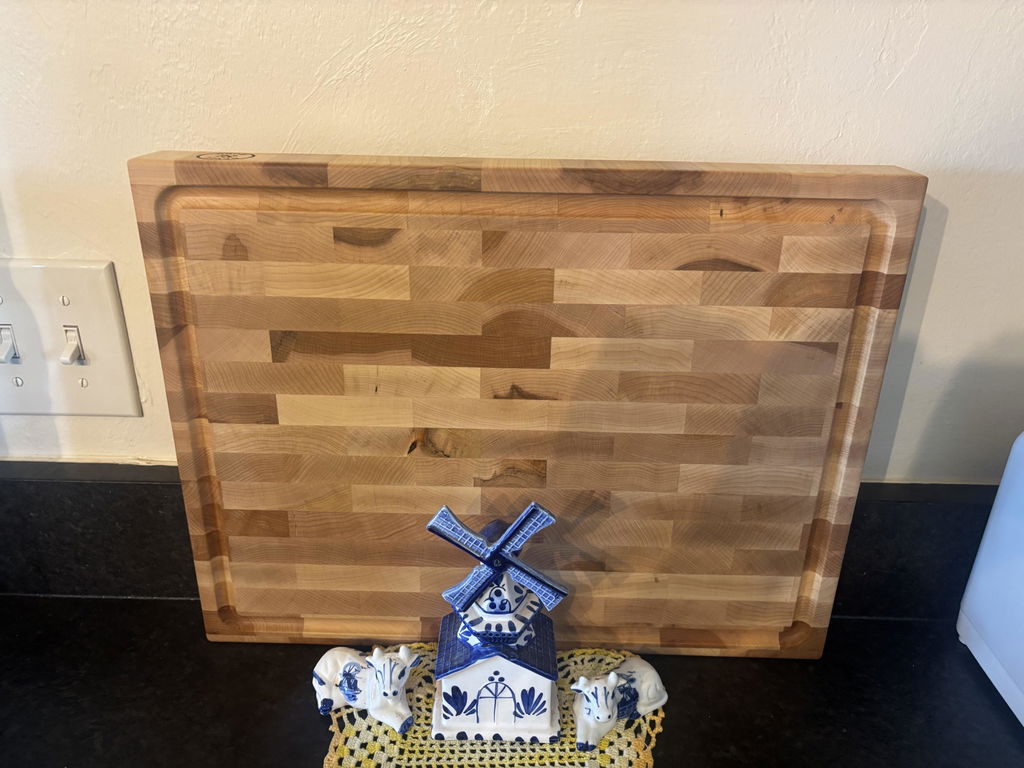
Yes, food-grade mineral oil is safe for cutting boards, and it's the standard the whole industry uses. It's inert, odorless, tasteless, and chemically stable, so it conditions the wood without ever going rancid or leaching anything harmful into your food. The one rule: use food-grade (also labeled USP or food-safe) mineral oil, not the hardware-store kind meant for machinery. Get that right and it's the simplest, safest board conditioner there is.
People hesitate because "mineral oil" sounds industrial, and it's true that mineral oil comes from refining petroleum. But the food-grade version is so thoroughly purified that it's used in pharmacies, on produce to keep it shiny, and as a base in cosmetics and baby products. The refinement is what matters, and food-grade mineral oil is about as inert and safe as a substance gets. Here's the full picture.
Serving boards need the same oiling routine despite far less knife work. We covered where they differ in charcuterie board vs cutting board.
Is mineral oil food-safe for cutting boards?
Yes, food-grade mineral oil is food-safe and the recommended conditioner for wood cutting boards. It's classified as safe for food contact, it's the same grade used as a gentle laxative and in food processing, and it doesn't support bacterial growth. Because it's inert, it won't react with food, won't spoil, and won't transfer taste or smell. That combination, food-safe plus never-spoils, is exactly what a cutting board finish needs, and it's why mineral oil is the default recommendation from board makers everywhere.
The key qualifier is the grade. There are industrial mineral oils sold for lubricating tools and machines that contain impurities and additives not meant for food contact. You want the food-grade version, which is cheap and sold specifically for kitchen and cutting board use. Read the label; if it says food-grade, USP, or food-safe, you're set.
What's the difference between food-grade and regular mineral oil?
Purity. Food-grade (USP) mineral oil is refined to remove impurities and meets standards for food contact, while industrial mineral oil is a less-refined lubricant that may contain additives unsafe to ingest. They can look identical in the bottle, so the label is your only guide. Never use the mineral oil from the hardware store's tool aisle on a cutting board, buy the one sold for butcher blocks and kitchen use.
| Type | Refined for food? | Safe for cutting boards? |
|---|---|---|
| Food-grade / USP mineral oil | Yes | Yes, recommended |
| Industrial / lubricant mineral oil | No | No, may contain additives |
| Baby oil (mineral oil + fragrance) | Partly | No, added fragrance |
Baby oil is mostly mineral oil but has added fragrance, so skip it too, you don't want perfume in your food. Plain, unscented, food-grade mineral oil is the target.
Is it safe if mineral oil gets on my food?
Yes, in the tiny amounts a conditioned board could transfer. Food-grade mineral oil is safe for incidental ingestion, it's literally sold as a digestive aid in larger doses, so the trace amount that might come off a properly wiped board is harmless. After you oil a board, you wipe off the excess and the rest is absorbed into the wood, so almost nothing transfers to food anyway. There's no safety concern with a correctly conditioned board.
This is a common worry and an understandable one, but it's unfounded for the food-grade product used correctly. The oil bonds into the wood fibers; it's not sitting on top waiting to coat your vegetables.

Want the food-safe protection of mineral oil plus a longer-lasting finish? A tin of Bevel & Bond Board Balm blends food-grade mineral oil with beeswax, so you get the same safe base with better water resistance.
Why is mineral oil better than cooking oils for a board?
Because it never goes rancid. Cooking oils, olive, coconut, vegetable, walnut, contain fatty acids that oxidize and spoil, leaving a board smelling sour and feeling sticky within weeks. Mineral oil has no fatty acids to oxidize, so it stays fresh indefinitely in the wood. That stability is the entire reason it's the standard: it protects the board without the spoilage that ruins boards conditioned with pantry oils. We cover the cooking-oil mistake in can you use olive or coconut oil on a cutting board.
How do you apply mineral oil to a cutting board?
Pour or rub a generous coat over every surface, let it soak in for a few hours or overnight, then wipe off the excess. The wood absorbs what it needs and you buff away the rest so the surface feels conditioned, not greasy. A new board wants this weekly for the first month, then monthly, or whenever water stops beading on the surface. Warm the oil slightly and it penetrates even better. Full walkthrough in our step-by-step guide to oiling a cutting board.
How often should you re-oil with mineral oil?
Once a week for a new board's first month, then about once a month, adjusting by the water-bead test. When you rinse the board and water beads up on the surface, the seal is intact; when it soaks in and leaves a dark patch, the oil has worn thin and it's time to reapply. Heavily used boards need it more often. More detail in how often you should oil a cutting board.
Which mineral oil should you buy for a cutting board?
Any bottle labelled food-grade, USP or food-safe mineral oil will do the job, and the cheap one works as well as the expensive one. There is no meaningful quality ladder here: USP is a purity standard, so a $7 bottle sold for butcher blocks and a $20 bottle in fancier packaging are the same refined product. What you are paying extra for is the label.
Three things worth checking before you buy:
- The grade is printed on the bottle. If it does not say food-grade, USP or food-safe anywhere, put it back.
- Nothing is added. No fragrance, no colour, no "conditioning" extras. Baby oil is mineral oil plus perfume, which is why it is not the right choice.
- The bottle is big enough. Oiling a board properly uses more than people expect, and a small bottle runs out mid-routine.
Pharmacy mineral oil sold as a laxative is the same USP grade and is perfectly usable, which is a useful fallback if the kitchen aisle is out.
How much mineral oil does a cutting board need?
More than feels right the first time. For a board the size of ours, 17 by 13 inches, expect to use a few tablespoons on the first conditioning and less on each one after that. The wood tells you when it has had enough: keep going until the surface stops drinking the oil in and starts holding a wet sheen, then leave it to absorb and buff off whatever is left.
A brand-new or freshly sanded board is thirsty and can take two or three rounds over a few days before it is properly saturated. A board on a regular routine needs far less. The mistake to avoid is not using too much, it is using too little and calling it done, which leaves the wood only partly conditioned.
Is mineral oil or a beeswax balm better?
Both are food-safe; the balm just lasts longer. Plain mineral oil penetrates and protects but wears off faster, so you reapply more often. A beeswax-and-mineral-oil board balm uses the same safe mineral oil base and adds beeswax, which leaves a harder, water-shedding surface that lasts longer between applications. Use mineral oil for cheap, frequent conditioning, or a balm for less-frequent, more durable protection. Full comparison in best cutting board oil.
Can you use too much mineral oil on a cutting board?
Not really, the wood only absorbs what it can hold, and you wipe off the rest. Applying oil often does no harm; the only mistake is leaving excess on the surface, which stays greasy until you buff it off. If a board feels oily to the touch, you left too much on top, so wipe it down and it's fine. You can't over-condition a board, only under-wipe it.
When was this article last reviewed?
This guide was last reviewed in September 2026 and reflects current food-safety guidance for cutting board conditioners.
Condition your board with food-grade mineral oil and natural beeswax. Pair your Bevel & Bond maple board with Board Balm, a food-grade mineral oil and beeswax blend.