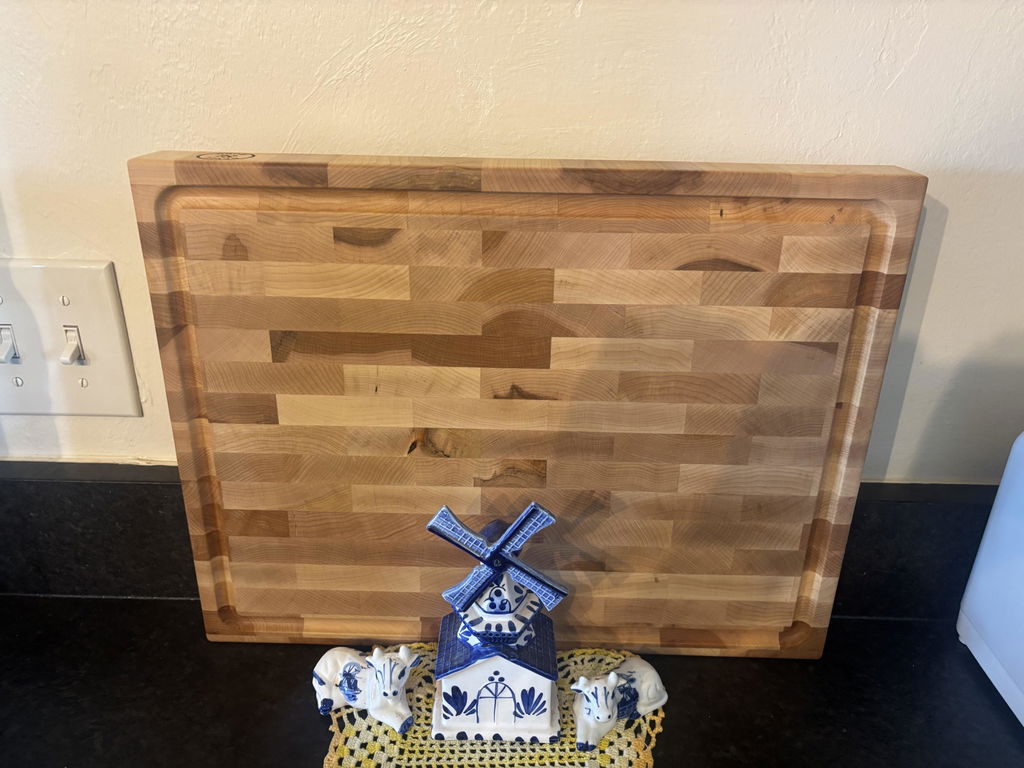
Short answer: the best 17 × 13 cutting board is a thick end-grain hard maple board, and the one we build is the Bevel & Bond End-Grain Maple Cutting Board at 1.75 inches, $139.99 with free U.S. shipping. But the honest framing matters more than the pick: 17 × 13 is 221 square inches, and it is not a large board. It's the size that fits.
How we ranked these. This is a ranking about fit, not size. Boards are judged on whether they clear a standard 24-inch counter, drop into a 33-inch sink, and stand in a dish rack, then on thickness and the warranty behind them.
That distinction is the whole point of this page. America's Test Kitchen recommends an all-purpose board of at least 20 by 15 inches — 300 square inches. A 17 × 13 gives you 221. You're trading about a quarter of the working area for a board that actually fits a 24-inch counter, drops into a standard sink, and stands upright in a dish rack.
If working area matters more to you than fit, buy the bigger board. If you've ever wrestled a slab into an undersized sink, keep reading.
Size is half the decision. Best cutting board material covers the other half.
What actually fits on a 17 × 13 cutting board
A spatchcocked chicken, a full mise en place of chopped vegetables, or a carved roast with room for the juices to pool. Those are the real jobs 221 square inches handles without complaint.
Flatten a 4 to 5 pound chicken and it lands inside the board's inner field with clearance on all sides, so your knife never rides the edge. Prep a stir fry and each pile — onion, pepper, garlic, ginger, broccoli — gets its own corner. Carve a pork loin and the juice groove catches the runoff.
What it won't do: hold a whole raw turkey sprawled for spatchcocking, or let you break down a primal without clearing as you go. That's what the extra 79 square inches on a 20 × 15 buys.

Does a 17 × 13 board fit standard counters, sinks and dish racks?
Yes, and this is the reason to buy one.
Standard base cabinets run 24 to 25 inches deep. Lay a 17-inch board long-ways and you keep roughly 7 to 8 inches behind it for your knife, your oil, your scrap bowl. Lay a 20-inch board there and that working room mostly disappears.
A 17 × 13 also fits inside most 33-inch and larger sink basins, so you can wash it without turning it sideways and flooding the counter. And it stands upright in the large slot of a dish rack, which is how a wood board should dry — on edge, both faces exposed to air.
A 20 × 15 slab doesn't fit a rack. It lies flat on a towel, traps moisture against one face, and that uneven drying is exactly how boards cup. The board that fits your drying setup is the board that stays flat.
How 17 × 13 compares to the other common sizes
| Board | Footprint | Area | Thickness | Weight | Wood / grain | Price | Warranty |
|---|---|---|---|---|---|---|---|
| Bevel & Bond End-Grain Maple | 17" × 13" | 221 sq in | 1.75" | 10+ lbs | Hard maple, end grain | $139.99 | 5 years |
| Sonder LA Alfred | 17" × 13" | 221 sq in | 1.5" | 7.5 lbs | Black walnut, end grain | $179 | 1 year limited |
| John Boos R-Board | 20" × 15" | 300 sq in | 1.5" | ~12 lbs | Hard rock maple, edge grain | $124.95 | 1 year limited |
| John Boos R-Board | 18" × 12" | 216 sq in | 1.5" | ~10 lbs | Hard rock maple, edge grain | $94.95 | 1 year limited |
| Virginia Boys Medium Maple | 17" × 11" | 187 sq in | 0.75" | 3.8 lbs | Maple, grain not stated | $85 | 120-day money back |
All prices, specs and warranties checked at each brand's own website on August 19, 2026.
Three honest reads of that table. The John Boos 20 × 15 is the better buy if you have the counter and the sink for it — more area, less money than ours, from a company that's been making boards in Effingham, Illinois since 1887. The Sonder Alfred is a genuinely nice 17 × 13 end-grain board; it's walnut rather than maple, which is 1,010 lbf on the Janka scale against maple's 1,450, softer and darker, and it's $39 more than ours. The Virginia Boys at 0.75 inches is the one we'd steer you away from for daily work, though their 120-day money-back window is the most generous return policy in this group.
For the full size breakdown, read what size cutting board you actually need and the cutting board thickness guide.

Why thickness matters so much at this footprint
Thickness is what keeps a 17-inch span flat. The wider the board, the more leverage seasonal wood movement has to pull it into a cup, and mass is what fights that.
Add a quarter inch over the standard 1.5-inch build and you gain real rigidity across the span, plus the depth to hold a proper juice groove that a 0.75-inch board can't. Our board runs over 10 pounds, and that weight plants it on the counter so it doesn't skate when you lean into a hard squash.
We won't call any wood board warp-proof, because misuse still warps wood. Soak one overnight or oil one face only and it will cup. At 1.75 inches thick, end-grain maple is designed for stability, though wood movement still depends on use, washing, drying, and storage.
Looking for the 17 × 13 that gets this right? The Bevel & Bond End-Grain Maple Cutting Board is US-grown hard maple, 1.75 inches thick, with a juice groove, side handles and non-slip feet, hand-finished with Board Balm and shipped in a black gift box. $139.99, backed for five years. Shop the full collection.
Is end-grain or edge-grain better at 17 × 13?
End-grain, if you cook most days and care about your knives. End-grain stands the wood fibers vertical, so the surface scars less and shows knife marks less than an edge-grain face. That's a gentler landing for an edge.
Edge-grain is less expensive and fine as a backup board. But at the size where you do your real cutting, end-grain is the surface that stays presentable longest. Our board is a double glue-up of hard maple, Acer saccharum, bonded with food-safe PVA, which is what lets end-grain survive daily use without splitting.
For meat work, our guide on the best cutting board for meat covers why the juice groove and end-grain pairing matters.

When 17 × 13 is the wrong size
Two cases, and neither of them is us being modest.
Your counter is deep and you batch-cook. If you break down primals, can 40 pounds of tomatoes, or cook for eight most weekends, the 20 × 15 John Boos gives you the staging room and costs less than our board. Buy that one.
Your kitchen is genuinely tight. If your counter run is under about 18 inches of clear space, or your storage is a narrow slot, a 17 × 13 will crowd you. That's a different question with a different answer, and we wrote it up separately in our guide to the best cutting board for a small kitchen, which covers 12 × 9 and 15 × 11 sizing, on-edge storage, and over-the-sink boards. Start there instead of here.
For everyone in between — a normal counter, a normal sink, cooking a few nights a week — 17 × 13 is the size that doesn't make you compromise on fit.
Frequently asked questions
Is a 17 × 13 cutting board big enough? For most home cooking, yes. It holds a spatchcocked chicken, a full vegetable prep, or a carved roast. It is not a large board by review-site standards — 221 square inches sits below the 300 square inches America's Test Kitchen recommends for an all-purpose board — so if you regularly prep for a crowd, size up to a 20 × 15.
Is a 17 × 13 board too heavy for everyday use? No. At just over 10 pounds our board is heavy enough to stay planted while you cut, and light enough to lift to the sink one-handed using the side handles. A board that slides while you work is a hazard, and a board you dread carrying is one that gets left dirty.
Can a 17 × 13 board handle a whole turkey? For carving, yes. A 17 × 13 with a juice groove holds a carved bird and catches the drippings, which is the Thanksgiving job people buy this size for. It won't hold a raw 20-pound turkey sprawled flat for spatchcocking, but very few home boards will.
Does a 17 × 13 maple board dull knives? No. Hard maple at 1,450 lbf on the Janka scale is firm without being brittle, and an end-grain surface is easier on an edge than bamboo, acacia or a hard plastic board. It also shows knife marks less than an edge-grain face.
Does a 17 × 13 board fit in a standard sink? Usually. It fits inside most 33-inch and larger basins. It also stands on edge in the large slot of a typical dish rack, which is the drying position that keeps a wood board flat.
How much should a good 17 × 13 cutting board cost? Between roughly $85 and $180, depending on species, thickness and construction. The Sonder Alfred sits at $179 for 1.5 inches of walnut end grain. Ours is $139.99 for 1.75 inches of end-grain hard maple with a five-year warranty. Under about $90 at this footprint you're generally buying a thin board.
When was this article last reviewed? August 19, 2026. Pricing, specs and warranty terms for every board named above were checked at that brand's own website on that date.
Ready to buy the size that fits? The Bevel & Bond End-Grain Maple Cutting Board is 17 × 13 × 1.75 inches of US-grown hard maple, built in Oregon and backed for five years, at $139.99. Shop all boards to see it in the black gift box.