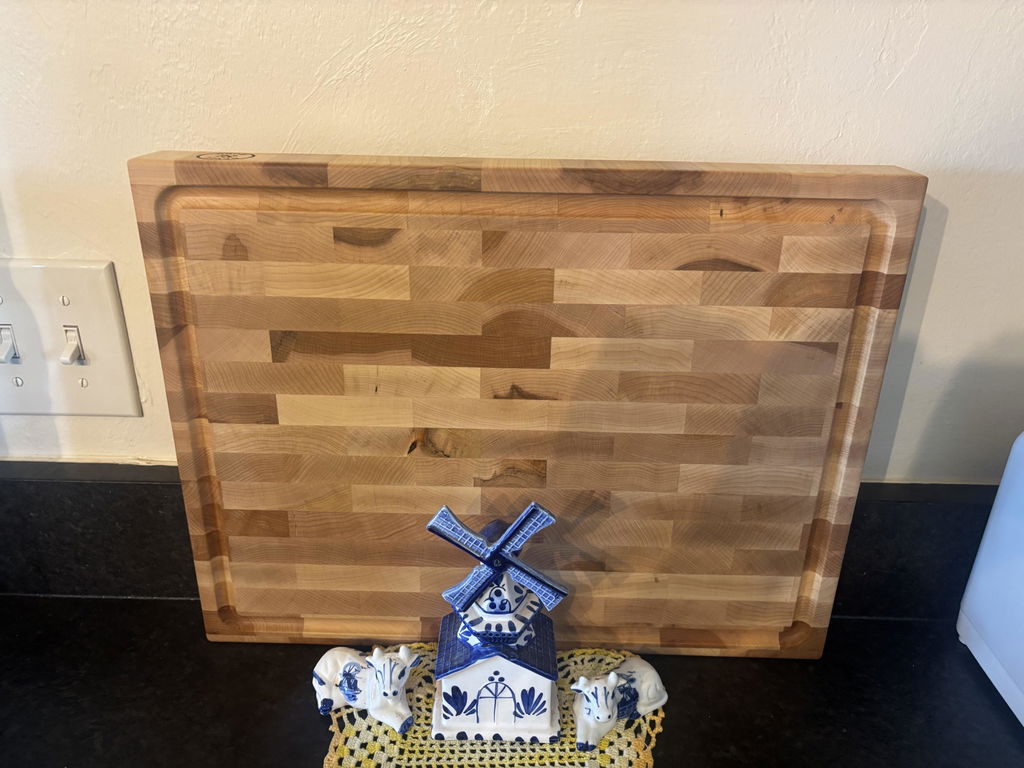
The best made-in-USA cutting board under $150 is a thick end-grain hard maple board with a named species and a warranty behind it. Our pick is the Bevel & Bond End-Grain Maple Cutting Board at $129.99. It combines a fully domestic supply chain, 1.75 inches of end-grain hard maple, and a written 5-year warranty for under $150.
How we ranked these. Every board here is made in the United States and sells for under $150 at the brand's own site. Within that, the ranking is thickness, then the published warranty term, then whether the wood species is actually named.
Search "American made cutting board" and you get a pile of listings that wave a flag on the label while the wood comes from overseas and the species is anyone's guess. Under $150, almost every option makes you give up something real: the domestic sourcing, the end-grain build, the actual hard maple, or a warranty that means the maker picks up the phone.
A set pushes you over budget fast — when maple cutting board sets are worth it.
How many boards are actually USA-made end-grain hard maple under $150?
Very few. Require all three at once — genuinely made in the USA, end-grain construction, and true hard maple — and the field under $150 collapses to a handful of names. Most drop out on price, on grain type, or on a species that turns out to be beech, soft maple, or birch wearing a "maple" sticker.
Edge-grain is where the budget crowd lives because it's less expensive to build. End-grain uses more lumber and more labor since the blocks stand vertically, so the knife meets the ends of the fibers rather than riding across them. That construction is what makes an end-grain board hard-wearing and easier on a knife edge, and it's the first thing that gets cut to hit a low price.

How do you verify a real made-in-USA cutting board claim?
Look for three things: a named wood species, a stated domestic supply chain, and a warranty. A board that lists Acer saccharum (sugar maple) instead of generic "maple" tells you the maker knows exactly what they cut. A maker who stands behind the board for years trusts the material.
"Assembled in USA" and "designed in USA" aren't the same as made in USA. Those phrases usually mean the wood, the milling, or the finishing happened somewhere else. Watch for the softer variant too — John Boos, a genuinely American manufacturer, labels its boards "Made in the USA with domestic and imported materials," which is honest and worth reading closely.
The Bevel & Bond board runs American lumber, American labor, and American finishing end to end. If a listing won't name the species or the origin of the wood, treat the silence as your answer.
Which USA cutting boards under $150 actually deliver?
Here's the field, with every figure checked at the brand's own website on August 19, 2026.
| Board | Made in USA? | Wood / grain | Size | Thickness | Warranty | Price |
|---|---|---|---|---|---|---|
| Bevel & Bond End-Grain Maple | Yes, fully domestic (Oregon) | Hard maple, end grain | 17" × 13" | 1.75" | 5 years, written | $129.99 |
| John Boos R-Board | "Made in the USA with domestic and imported materials" | Northern hard rock maple, edge grain | 18" × 12" | 1.5" | 1 year limited | $94.95 |
| John Boos R-Board | Same | Northern hard rock maple, edge grain | 20" × 15" | 1.5" | 1 year limited | $124.95 |
| Virginia Boys Companion | Yes (Virginia) | Walnut, end grain | 9" × 12" | 1.5" | 120-day money back | $125 |
| Virginia Boys Medium Maple | Yes (Virginia) | Maple, grain not stated | 17" × 11" | 0.75" | 120-day money back | $85 |
| Sonder LA Alfred | Yes, handcrafted in USA | Black walnut, end grain | 17" × 13" | 1.5" | 1 year limited | $179 — over budget |
John Boos has been making boards in Effingham, Illinois since 1887, and they're a genuinely good option — their scale and their track record are real. The differences here are thickness and warranty: their standard board is 1.5 inches where ours is 1.75, and their published warranty runs one year against our five. Their 20 × 15 also gives you 300 square inches for $124.95, which is more working area than our 221 square inches for less money. If area is what you want, buy theirs.
Sonder builds a nice end-grain walnut board and prices it at $179, over the line this guide is about. Virginia Boys' Companion is a real end-grain walnut board under budget, but at 9 × 12 it's a side board, not a main one. Their 17 × 11 maple comes in at $85 and 0.75 inches, less than half the Bevel & Bond thickness, and thin boards cup and warp first.

Premium Options Under $150
This section answers the question people used to land on our separate premium-boards guide with. That page now points here, so the answer lives here.
"Premium" gets used as a synonym for "expensive," which is not useful when you're spending your own money. So let's define it in specs you can check on a product page before you buy:
- The species is named. Hard maple, black walnut, cherry — not "hardwood," not "maple" with no qualifier. Hard maple runs 1,450 lbf on the Janka scale, walnut 1,010, cherry 950.
- The grain orientation is stated. End grain, edge grain, or face grain. If it isn't stated, it's usually face or edge.
- It's at least 1.5 inches thick. Thickness is the spec that separates a decades board from a season board.
- The adhesive is named. A premium board should tell you it uses a food-safe adhesive compliant for food contact.
- There's a written warranty or return promise you can read before buying.
A board that clears all five under $150 is doing something unusual. Here's who manages it.
Premium picks that fit under $150
Best overall under $150 — Bevel & Bond End-Grain Hard Maple, $129.99. Named species (Acer saccharum), end grain, 1.75 inches, food-safe PVA, five-year written warranty, built in Oregon. It clears all five bars, and it's the only board we found under $150 that pairs end-grain hard maple with a warranty longer than a year.
Best working area under $150 — John Boos R-Board 20 × 15, $124.95. Northern hard rock maple, NSF certified, edge grain, 1.5 inches, one-year limited warranty. It misses on grain orientation, but it gives you 300 square inches, which is the size America's Test Kitchen recommends for an all-purpose board. If you cook for a crowd, this beats our board on the spec that matters most to you.
Best end-grain walnut under $150 — Virginia Boys Companion, $125. Genuine end-grain American black walnut, 1.5 inches, 6 pounds, made in Virginia, with a 120-day money-back window. The catch is size: 9 × 12 is a companion board, which is exactly what they call it. Buy it as a second board or a gift, not as your only board.
Best value under $100 — John Boos R-Board 18 × 12, $94.95. Same maple, same NSF certification, same one-year warranty, 216 square inches. Under $100 this is hard to argue with.
Premium boards that miss the $150 line, and by how much
Worth knowing, because if your budget can stretch, two of these are excellent.
| Board | Wood / grain | Thickness | Price | Over budget by |
|---|---|---|---|---|
| Sonder LA Alfred | Black walnut, end grain | 1.5" | $179 | $29 |
| Virginia Boys Medium End Grain | Walnut, end grain | 1.5" | $175 | $25 |
| John Boos MCS1 chopping block | Maple, end grain | 3" | $188.95 | $38.95 |
| The Boardsmith Maple End Grain | Maple, end grain | 2" | from $230 | $80+ |
| Brooklyn Butcher Blocks | Maple, end grain | 1.75" | $230 | $80 |
The Boardsmith builds made-to-order boards in a 7,500 square foot shop in Frisco, Texas, and two inches of end-grain maple is more board than anyone in the under-$150 group offers. Their published guarantee, though, runs 60 days from receipt. Brooklyn Butcher Blocks sources roughly 90% of its material within 400 miles of the shop, which is an unusually specific claim, but we couldn't find a published warranty term anywhere on their site.
The short version: under $150 you can get premium construction, but you have to pick which premium spec you care about most — end grain, working area, or wood species. Above about $175 you stop choosing and start collecting.
Why does sub-$150 usually force a compromise?
Because building a genuinely domestic end-grain hard maple board costs money, and most brands protect their margin by cutting one corner: the wood species, the grain orientation, the thickness, or the warranty.
Hard maple runs a Janka hardness around 1,450 lbf, hard enough to shrug off daily knife work without wearing an edge the way acacia does inside 18 months. End-grain doubles the labor of edge-grain, and a 1.75-inch build uses more board feet than a 1.5-inch slab.
Stack those costs and a domestic maker has to choose between pricing past $150 or quietly swapping in soft maple and a thinner profile. Bevel & Bond holds all of it under $150 and finishes each board by hand with Board Balm.

Looking for a genuinely American end-grain board?
The Bevel & Bond End-Grain Maple Cutting Board is 17" × 13" × 1.75", over 10 pounds of North American hard maple, with a juice groove, deep finger grips, rubber feet, and a black gift box. It ships with a 5-year warranty and founder Jeff answering the email. See the full lineup on the shop all page.
Does thickness matter more than price at this budget?
Yes. Thickness is the single spec that separates a board you maintain for long-term use from one that cups within a season. At 1.75 inches, the Bevel & Bond board carries a quarter inch more than the standard 1.5-inch competitor and more than double the 0.75-inch budget boards.
More thickness means more stability against the moisture swings that make thin boards warp, and heft that stays put during brisket prep instead of skating across the counter. Paying $129.99 for 1.75 inches of domestic hard maple beats $85 for 0.75 inch of anything, because the thin board is the one you replace. Do the math on cost per year, not cost at checkout.
What should you ask before buying a USA cutting board under $150?
Ask four questions. What species is the wood? Where was it milled and finished? Is it end-grain or edge-grain? How long is the warranty?
The answers tell you if this is a decades board or a season board. A maker who dodges any of them is telling you something.
If country of origin drives your decision, our piece on American-made cutting boards covers why a fully domestic hardwood supply chain is worth paying for.
Is a $100 maple board worth it over a $30 one?
Yes, if you cook more than twice a week. A $30 board is usually thin softwood, bamboo, or plastic that wears knife edges and warps, and you buy three of them in the time one hard maple board lasts.
Can you put a Bevel & Bond board in the dishwasher?
No. No solid wood cutting board belongs in a dishwasher, where heat and standing water crack and warp the wood. Hand wash with warm soapy water, dry it upright, and re-oil with Board Balm when the surface looks dry, roughly once a month.
Is end-grain better than edge-grain for a home kitchen?
Yes, for daily knife work. End-grain stands the wood fibers vertical, so the surface scars less and shows knife marks less than an edge-grain face, and it's gentler on an edge. Edge-grain costs less and is fine for light use, but end-grain is the surface most serious cooks reach for.
What size cutting board do most home cooks need?
A 17" × 13" board fits most counters and handles most jobs, from a full spread of vegetables to carving a roast. It's 221 square inches, which is below the 300 square inches review kitchens recommend for an all-purpose board — you're trading some working area for a board that fits a standard counter, sink and dish rack. If you routinely cook for a crowd, size up to a 20 × 15.
Who actually makes the Bevel & Bond board?
A full-service wood shop in Oregon builds every board — milling the rough stock, cutting and orienting the blocks, the double glue-up, flattening, and the final hand-finish with Board Balm, all under one roof. No stage happens overseas.
That matters for quality. End-grain construction means hundreds of individual blocks milled to consistent dimensions and glued under even pressure, and when the whole process runs in one shop you can call, problems get caught at the bench instead of in your kitchen. It's also why a 5-year warranty is an easy promise to keep.
Where does the maple itself come from?
From American forests. Every board is hard maple — Acer saccharum, the sugar maple — grown and harvested in the United States. It isn't imported, and it isn't "North American" as a way of dodging the question.
The species name is the tell. "Maple" on a listing can mean soft maple, birch, or beech, which are different woods with different hardness. Naming Acer saccharum is a claim you can check, and at roughly 1,450 lbf on the Janka scale it's the wood butcher blocks have trusted for over a century.
Is the glue holding it together food safe?
Yes. The blocks are bonded with a food-safe PVA adhesive that's non-toxic and selected for food-contact woodworking and used according to the adhesive manufacturer's directions. That detail matters more than most buyers realize — an end-grain board is hundreds of glue joints, and you chop on all of them.
When was this article last reviewed?
August 19, 2026. Every competitor price, spec, origin claim and warranty in this guide was checked at that brand's own website on that date. We revisit our buying guides as products and prices change.
Ready to buy the board you keep for many years with proper care?
For a genuinely made-in-USA end-grain hard maple board under $150, the Bevel & Bond End-Grain Maple Cutting Board is the pick: $129.99, 1.75 inches of Acer saccharum, a 5-year warranty, and founder-led service.
For more on where premium boards earn their price, see whether expensive cutting boards are worth it, or browse the full collection. And once it's on your counter, our step-by-step oiling guide is the five-minute habit that keeps it flat and beautiful for many years with proper care.