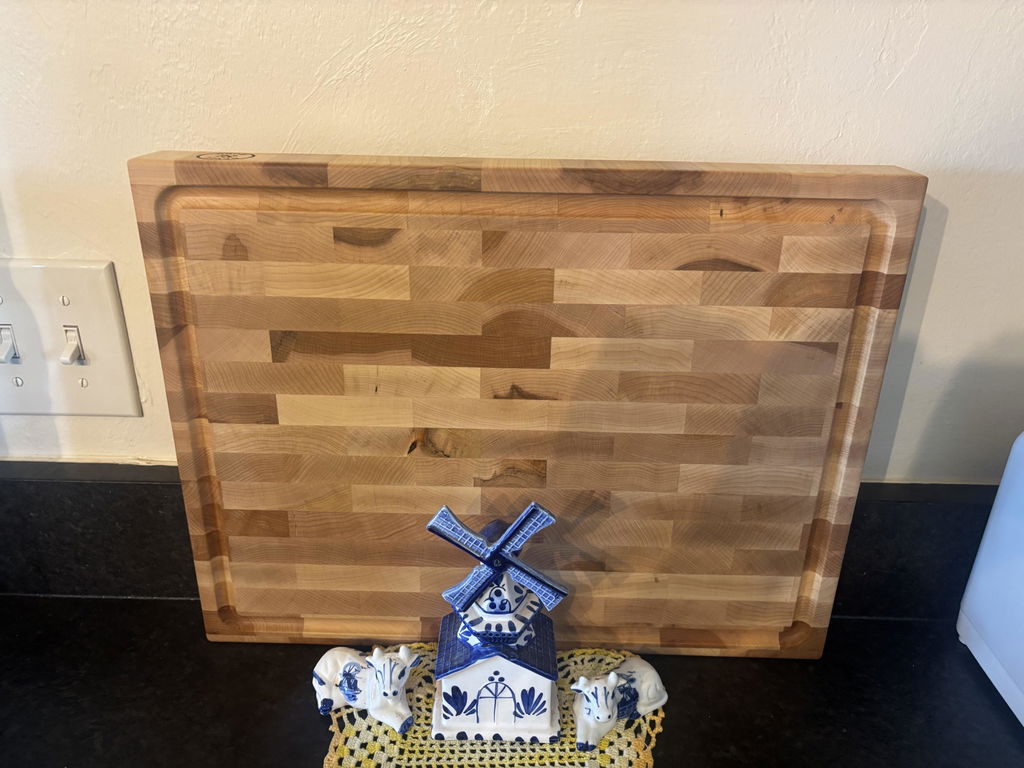
The real difference isn't romance, it's wood selection and joint preparation. A small workshop sorts boards individually, rejects the pieces with knots or unstable grain, and mills each joint until it's square. A high-volume line runs whatever the pallet delivered, at speed.
Both approaches can produce a good board. But they fail differently, and it's worth knowing which failure you're buying.

What does handmade actually change?
Three things: which pieces of wood make the cut, how carefully the joints are milled, and how flat the board is when it ships.
Wood is not a uniform material. Two boards from the same tree can behave differently depending on where they sat in the log and how they dried. Someone sorting by hand catches the unstable pieces. A production line usually doesn't.
Where mass production genuinely wins
Price, consistency of dimensions, and availability. A factory board arrives at a predictable size, at a lower cost, and it's in stock. Those are real advantages and it would be dishonest to wave them off.
If you need a serviceable board tomorrow for under $40, mass production is the answer, and there's no shame in that. Not every kitchen task needs a board built for twenty years.
Side by side
| Factor | Handmade / small shop | Mass-produced |
|---|---|---|
| Wood selection | Sorted piece by piece | Batch-run |
| Species clarity | Usually named exactly | Often just "hardwood" |
| Joint prep | Milled square, clamped longer | Fast-cycle glue-up |
| Flatness on arrival | Checked individually | Variable |
| Thickness | Typically 1.25" to 2" | Often under 1" |
| Price | $90 to $300 | $20 to $70 |
| Warranty | Often multi-year | Return window only |
| Availability | Limited runs | Always in stock |
Does handmade mean better, automatically?
No. "Handmade" is a description of process, not a guarantee of skill. A careless small-shop board with rushed glue joints will separate just as fast as a factory one, and you'll have paid three times as much for the privilege.
Judge the board, not the label. Named species, stated thickness, tight seams, and a real warranty tell you more than any origin story. Our checklist is in how to tell if a maple cutting board is high quality.
Where do the two usually fail?
Some thin or poorly constructed mass-produced boards may fail at glue joints or warp, because the wood wasn't dried to a consistent moisture content and the glue-up was quick. Handmade boards, when they fail, usually fail from owner neglect rather than construction.
That second point matters. A well-built board's lifespan is decided mostly by whether it gets oiled. See why cutting boards warp.
Is "handcrafted" a meaningful term on a listing?
Not by itself. It has no legal definition in this category and gets applied to boards that were assembled by hand from machine-cut parts, which describes nearly everything.
More useful questions: what species, how thick, where was it made, and what's covered if it splits. Those have answers you can check.

Does small-batch mean the board needs different care?
No, the care is the same for any hardwood board: wash, dry standing on edge, oil every three to four weeks. What differs is how much a good board rewards that care.
A thick, well-sorted hard maple board that gets conditioned regularly with a mineral oil and beeswax blend like Board Balm can outlast several factory boards bought over the same span. The maintenance is identical; the payoff isn't.
Which should you buy?
Buy mass-produced if you want a low-cost utility board, need a spare for raw meat, or aren't sure yet how much you'll use it. Buy from a smaller maker if you cook often, own knives worth protecting, or want one board that stays on the counter for many years with proper care.
Plenty of kitchens sensibly have both.
When was this article last reviewed?
This article was last reviewed in August 2026 by the Bevel & Bond workshop team.
The takeaway
Handmade buys you wood selection, joint care, and flatness. Mass production buys you price and availability. Neither label guarantees anything on its own, so check species, thickness, joints, and warranty before you decide.
Our end-grain hard maple board is built the sorted-and-milled way, 1.75 inches thick with a 5-year warranty, and ships with a tin of Board Balm to keep it that way.