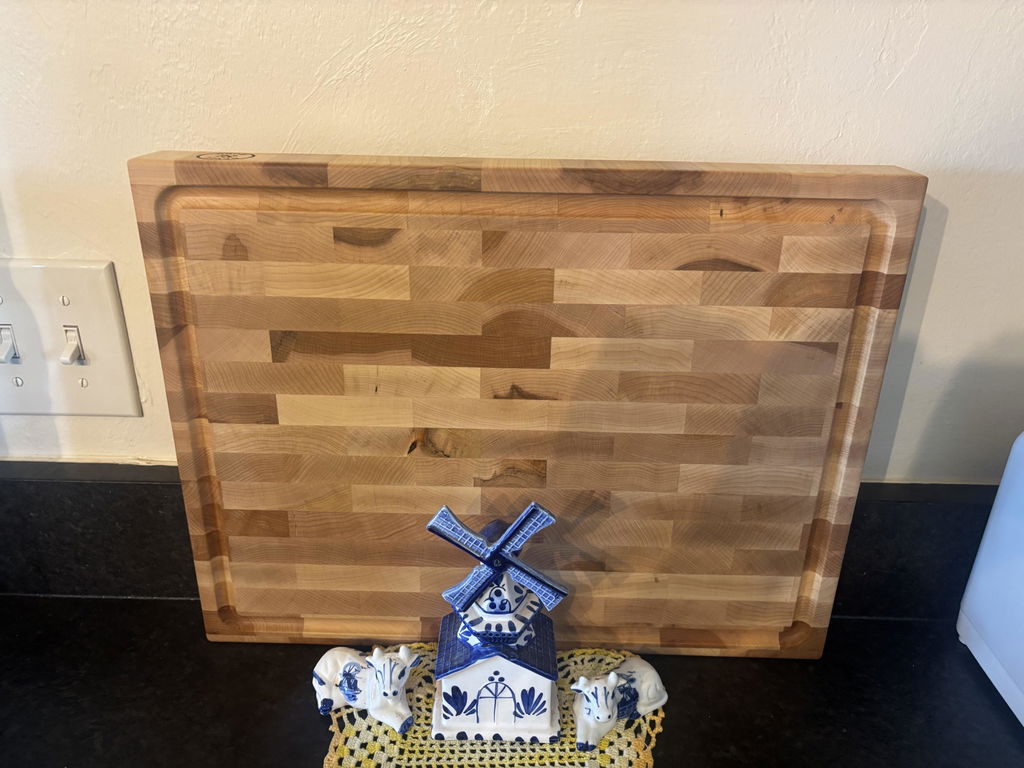
A well-made hardwood cutting board can provide many years of service with proper care. Actual lifespan depends on construction, frequency of use, cleaning, conditioning, storage, climate, and exposure to moisture or heat. Because you can sand and refinish wood back to a fresh surface again and again, a quality maple or walnut board can outlive the kitchen it was bought for. Compare that to a plastic board, which scars and needs replacing every one to three years, and the wood board is both the longer-lasting and, over time, the less expensive choice.
Lifespan is the number that changes how you should think about buying a board. People compare a 30-dollar plastic board to a 100-dollar wood one and see the wood as expensive, but that math ignores time. Spread the cost across the years each board actually survives and the picture flips. What follows is how long boards last, what shortens that, and how to extend a board's useful life.

Shape affects wear too — round boards get used unevenly. More in round vs rectangular.
How long does a wooden cutting board last?
A quality hardwood board may provide many years of service, while a thin or neglected board may require earlier replacement. These are general expectations, not guaranteed lifespans. The range is wide because lifespan depends almost entirely on two things: how well the board was built, and how it is cared for. A thick, end-grain hard maple board that gets oiled and dried properly can be refinished dozens of times over decades. A thin, glued-up bargain board left wet and dishwashered can crack in a season.
The key advantage wood has is renewability. A plastic board that scars is done, because the grooves are permanent and harbor bacteria — Cliver's peer-reviewed work on Salmonella cross-contamination found bacteria survived in those grooves after washing, while bacteria drawn into wood died off. A wood board that scars gets sanded flat and refinished back to new, as many times as its thickness allows. That is why wood is measured in decades and plastic in months. We compare the two directly in Maple vs. Plastic.
| Board type | Typical lifespan | Renewable? | Cost per year (rough) |
|---|---|---|---|
| Thick end-grain hardwood | Many years; varies by use and care | Yes, many refinishes | Very low |
| Edge-grain hardwood | Many years; varies by use and care | Yes | Low |
| Thin budget wood board | 2 to 5 years | Once or twice | Moderate |
| Bamboo | 3 to 5 years | Barely | Moderate |
| Plastic | 1 to 3 years | No | High over time |
What determines how long a cutting board lasts?
Four things: the wood species and hardness, the construction and thickness, the grain orientation, and the care it gets. A dense hardwood like hard maple at 1,450 lbf Janka resists wear far longer than a soft wood. A thick board has more material to refinish, so it survives more renewals. End-grain construction shows knife cuts less better than edge-grain. And regular oiling plus proper drying prevents the cracking and warping that end a board early.
The moisture side of that is not folklore. Wood swells and shrinks as it takes on and releases water, and uneven moisture between faces is what cups and cracks a board — the USDA Forest Products Laboratory's Wood Handbook documents that behavior in detail. Of the four factors, care is the one entirely in your hands, and it is decisive. A well-built board dies young if it lives in the dishwasher, and a modest board may provide a long service life with good habits. Thickness is the built-in factor that matters most, which we cover in cutting board thickness, because a thick board is stored lifespan.
How do you make a cutting board last longer?
Oil it every three to four weeks, hand wash and dry it on edge, keep it out of the dishwasher, and refinish it when the surface gets rough. Those four habits prevent the two things that kill boards: moisture damage (warping, cracking, mold) and surface wear (deep knife scarring). Oiling keeps the wood sealed and stable, drying prevents warping and mold, and periodic refinishing resets the surface.
The refinishing part is what most people never do and what unlocks the decades. When a board looks tired and scarred, a light sanding and re-oil brings it back to bare, fresh wood, effectively giving you a new board. Our refinishing guide and oiling guide cover the routines, and Board Balm keeps the seal between refinishes.
Do wooden cutting boards wear out?
Wood boards wear at the surface, but that surface is renewable, so they do not wear out the way plastic does. Years of knife work leave scarring and a worn finish, but a sanding removes the damaged layer and exposes fresh wood beneath. The board only reaches end of life when it has been refinished so many times it becomes too thin to be stable, or when a structural crack or deep mold makes it unsafe.
For a thick board, that end point is decades away and many refinishes down the road. For a thin board, you run out of material to sand faster. This is one more reason thickness matters, since a 1.75-inch board has far more sacrificial depth than a 0.75-inch one.

Want a board built to provide many years of service with proper care, not seasons?
The Bevel & Bond End-Grain Maple Cutting Board is built for the long end of that range: 1.75 inches of dense end-grain hard maple with deep refinishing life, backed by a five-year limited warranty covering qualifying manufacturing defects under normal household use. End-grain shows knife marks less, the thickness gives you decades of refinishes, and it ships conditioned so it starts protected. Buy it once and it can outlast every other tool in your kitchen.
When should you replace a wooden cutting board?
Replace a wood board when it has a crack running through it, deep mold you cannot fully remove, a surface so worn thin it flexes or feels unstable, or splits along the glue joints. Michigan State University Extension puts the food-safety line in the same place: replace a board once it has cracks, crevices, chips, or grooves where bacteria can hide. Those are structural or hygiene failures that refinishing cannot fix. A board that is merely scarred, stained, or dull is not worn out, it just needs a refinish. Do not confuse cosmetic tiredness with the end of a board's life.
The honest test: can the board be brought back to a clean, firm, flat surface with sanding and oil? If yes, keep it. If it is cracked through, structurally soft, or too thin to trust, retire it. Our guides on fixing a cracked board and cutting board mold cover the judgment calls.
Are wooden cutting boards worth the money given how long they last?
Yes, once you account for lifespan, a quality wood board usually costs less per year than repeatedly replacing plastic. Long-term value depends on actual service life, maintenance, repairability, and replacement criteria. Avoid assuming fixed costs or a universal lifespan for either wood or plastic. We run that math fully in Are Expensive Cutting Boards Worth It?.
Does an end-grain board last longer than an edge-grain board?
Generally yes, because end-grain construction shows knife cuts less, so its surface wears more slowly and refinishes less often. The vertical fibers of an end-grain board let the knife slip between them and scar less, meaning shallower, fewer permanent marks over time. Edge-grain boards are still durable and long-lived, they just show and hold knife marks a bit more. Both, when thick and well cared for, provide many years of service with proper care. The construction comparison is in End-Grain vs. Edge-Grain.
When was this article last reviewed?
This guide was last reviewed in July 2026. The lifespan ranges reflect how real hardwood boards age with typical home care, and the renewability point is what separates a 25-year board from a 2-year one.
Sources
- USDA Forest Service, Forest Products Laboratory — Wood Handbook: Wood as an Engineering Material (FPL-GTR-282, 2021), on moisture content and dimensional change
- The Wood Database — Hard Maple (Acer saccharum), Janka hardness 1,450 lbf
- Cliver D.O., "Cutting boards in Salmonella cross-contamination," Journal of AOAC International, 2006
- Michigan State University Extension — when to replace a cutting board
Buy once, keep it for many years with proper care
A good wood board is a long-term kitchen tool, not a disposable one, because you can refinish it back to new again and again. The formula is simple: buy thick, dense, end-grain hardwood, then oil it, dry it upright, keep it out of the dishwasher, and refinish it when it looks tired. Do that and the board outlasts the debate about whether it was worth it. The Bevel & Bond End-Grain Maple Cutting Board is built for the long end of that range and ships with Board Balm to keep it there.