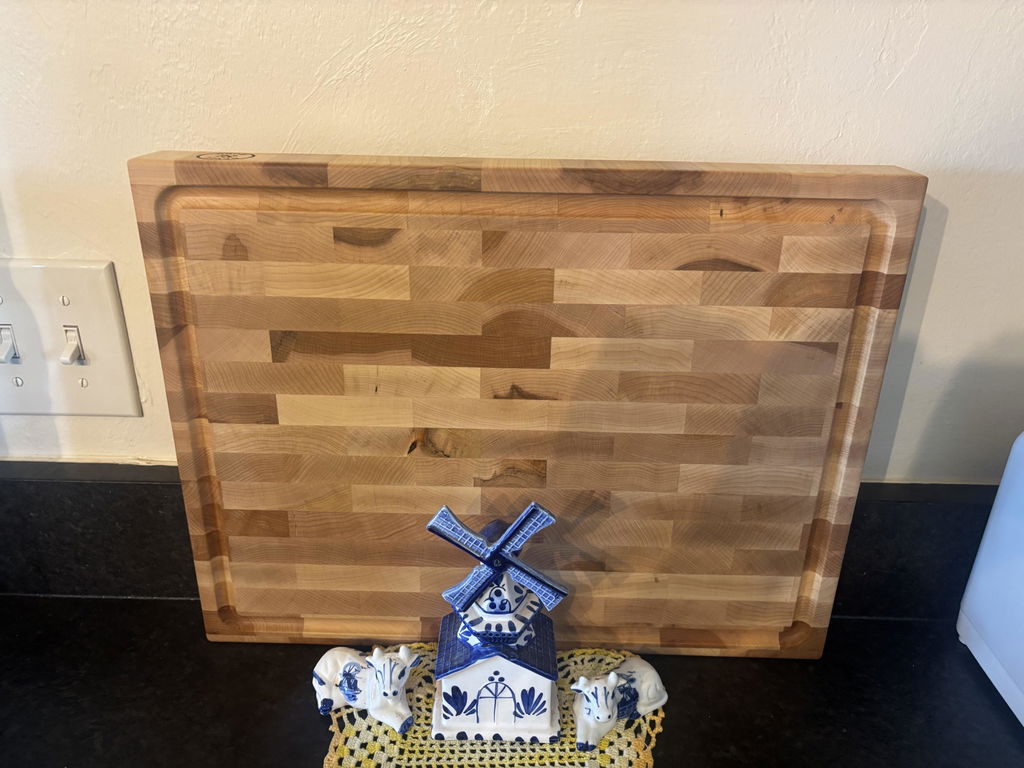
No single cutting-board material is automatically the healthiest in every situation. Hard maple finished with food-grade mineral oil is a durable option when it is properly cleaned, dried, maintained, and used in a way that prevents cross-contamination. Closed-grain hardwood avoids plastic shedding, while heavily scarred surfaces of any material can become harder to clean. Food safety depends primarily on cleaning, sanitizing when appropriate, drying, maintenance, and preventing cross-contamination. If you want the specific answer: US-grown hard maple (Acer saccharum), 1.5 to 2 inches thick, oil finish only, no varnish.
We sell end-grain hard maple boards, so we have a stake in this question. That is why this guide leans on published research and USDA guidance rather than our opinion, and says plainly where wood has trade-offs. Here is what the science says.
What is the healthiest cutting board material?
There is no single healthiest material for every kitchen. A sound hard maple board can be a practical option when it is properly cleaned, dried, maintained, and sanitized when appropriate. The USDA's food safety guidance approves hardwood alongside plastic, but the newer research separates them: plastic boards shed particles as knives wear them, and wood boards do not.
| Material | What to consider | Knife impact | Service life |
|---|---|---|---|
| Hard maple, walnut, cherry | Hand-wash, dry promptly, and maintain the surface | Generally knife-friendly | Varies with construction, use, and care |
| Bamboo | Construction and adhesive quality vary | Often harder on edges | Varies by product and care |
| Plastic (HDPE) | Dishwasher-compatible products are easy to sanitize; replace when deeply scored | Moderate | Depends on scoring and use |
| Rubber | Common in some professional settings; follow maker care instructions | Generally gentle | Varies by product and use |
| Glass, marble, titanium | Nonporous but slippery and very hard | Can damage knife edges quickly | Material may last, but suitability for cutting is poor |
A 2023 study in Environmental Science & Technology estimated that chopping on polyethylene boards can transfer tens of millions of microplastic particles into food per year. Wood's failure mode is a scratch you can sand out. Plastic's failure mode ends up in the salad.
Healthiest cutting board materials, ranked
- Hard maple or another closed-grain hardwood (walnut, cherry). Durable, knife-friendly, does not shed plastic, and can be sanded and refinished when it scars. Needs hand washing and oiling.
- Rubber. Gentle on knives and common in professional kitchens. Follow the maker's care instructions.
- Plastic (HDPE or polypropylene). Dishwasher-safe and easy to sanitize while new, but it sheds microplastic particles as knives wear it (Environmental Science & Technology, 2023), and the USDA advises replacing boards once they develop hard-to-clean grooves.
- Bamboo. Hard and inexpensive, but how healthy it is depends on the adhesive and finish, which labels rarely disclose.
- Glass, marble, stone and titanium. Non-porous and easy to wipe, but hard enough to damage knife edges quickly, so poor choices for everyday cutting.
Whatever the material, habits matter more than the ranking: a separate board for raw meat, prompt washing, sanitizing when appropriate, and drying on edge.
Typical replacement timeline, by material (our estimate)
Our own estimates for daily home use with basic care, not measured figures; actual life depends on construction, use and care. Maple assumes oiling every 3 to 4 weeks; plastic assumes replacement at first deep scarring per USDA guidance.
How do wood and plastic differ?
Wood does not shed plastic particles, but bacterial survival varies with surface condition, species, moisture, cleaning method, and study conditions. Laboratory research has reported differences in bacterial recovery from wood and used plastic surfaces, but neither material is self-sanitizing.
Plastic products that are dishwasher-compatible can be convenient to sanitize, while a maintained maple board can be resurfaced when worn. Replace or resurface any board when deep damage prevents effective cleaning.
Does a plastic board end up holding more bacteria than wood? Once it is scored, it can: knife grooves in plastic are hard for a brush or a sanitizer to reach, which is why the USDA says to replace any board once its grooves get hard to clean. For the everyday side of that choice, knife wear, cost and how long each one lasts, see maple vs plastic cutting boards.
What is the healthiest wood for a cutting board?
Hard maple, specifically Acer saccharum, sugar maple. It has a closed grain that resists absorbing moisture, a Janka hardness of 1,450 lbf (hard enough to resist deep scarring, soft enough to spare your knife edge), and no natural toxicity concerns. It is the wood professional butcher blocks have been built from for over a century, and that is not nostalgia, it is materials science that got there early.
Walnut (Janka 1,010) and cherry (995) are also excellent, slightly softer, both closed-grain. Open-grained woods and very soft woods can be more difficult to maintain as heavily used cutting surfaces because they may absorb moisture or develop deep scoring more readily. Exotic species can carry allergen and toxicity questions that maple simply does not have. Our full species rundown is in the hardwood cutting board guide.
If you are choosing the species first, our guide to the healthiest wood for cutting boards compares grain, natural antibacterial behavior and allergen risk wood by wood.
What is the least toxic cutting board?
A solid hardwood board with a plain oil finish and food-safe glue. Material safety depends on the complete product, including the species, adhesive, finish, manufacturing controls, condition, and intended use. Buyers should look for clear material and care disclosures. Check three things before buying any board: the finish (should be food-grade mineral oil or a beeswax blend, never a hard varnish), the adhesive (ours is a PVA adhesive selected for food-contact woodworking and used according to the manufacturer's directions), and the species (should be named exactly, "hardwood" with no species is a red flag, and species misrepresentation is common in this category).
Which cutting board is easiest to keep clean for raw meat?
Either wood or plastic is safe for raw meat if you wash it properly, and the USDA allows both. The honest version of this answer: what matters is having a separate board for raw meat, washing it with hot soapy water immediately, and drying it upright. The material matters less than the habit.
My own rule, and what I tell customers: run a dedicated board for raw poultry, keep your maple board for everything else, and never let any board sit wet. If you want the raw meat protocol step by step, it is in how to sanitize a cutting board after raw meat.
Is bamboo healthier than maple?
No. Bamboo gets marketed as the healthy option because it is a fast-growing grass, but a bamboo board is dozens of thin strips bonded with adhesive, and the quality of that adhesive is exactly what the label never tells you. Many bamboo boards are also harder than maple, and bamboo contains silica, so they tend to be tougher on knife edges. It costs less, and that is its complete list of advantages.
Looking for the board this article keeps describing? Our end-grain hard maple board is 17 x 13 x 1.75 inches of American Acer saccharum, food-safe PVA glue, finished in Board Balm, with a 5-year warranty. $139.99 with free U.S. shipping.
Which cutting board is easiest to keep clean?
A maintained hardwood board, day in and day out. Glass is technically the easiest surface to disinfect, and it is also the worst cutting board you can own because it wrecks knives and skids under pressure. Hygiene you cannot live with is not hygiene. Hard maple's closed grain, durable surface, and ability to be refinished make it a practical long-term option when properly cleaned and maintained.
Do wooden cutting boards hold bacteria?
Less than you have been told. Some laboratory studies have observed declining recoverable bacteria on certain wooden surfaces as they dry. Real-kitchen safety still requires washing, sanitizing when appropriate, thorough drying, and avoiding cross-contamination. The caveat that matters: this describes a board that gets washed and dried upright. A wet board in a sink is a petri dish regardless of material.
What those lab studies did and did not show, and how a home cook should read them, is laid out in are wooden cutting boards sanitary.
Is an end-grain board healthier than edge-grain?
Marginally, yes, and it is better for your knife by a wide margin. End-grain construction presents the wood fibers vertically, so a knife edge slips between fibers that scar less instead of severing them. The surface scars less, which means fewer permanent scars for anything to hide in, and your edge stays sharp weeks longer. The trade-off: end-grain costs more to build. It also outlasts two or three edge-grain boards, so do the math over a decade, not at checkout.

What oil keeps a cutting board food-safe?
Food-grade mineral oil, or a mineral oil and beeswax blend, applied every 3 to 4 weeks for a board in daily use. Never olive or vegetable oil, they go rancid inside the wood and the smell tells you about it for months. The full comparison is in our cutting board oil guide.
When should you replace a cutting board?
Replace plastic when it shows knife scarring you can feel with a fingernail. Replace wood when it has deep cracks that reach through the board or grooves too deep to sand out, which on a thick, well-kept maple board can take many years. One material is a subscription. The other is a purchase.
When was this article last reviewed?
August 2026. We review our health and safety articles against current USDA guidance and published research, and update them when the science moves.
The best board is one suited to the task and maintained using sound food-safety practices. See the Bevel & Bond end-grain maple board, built in the USA from named American hard maple, backed by a five-year limited warranty covering qualifying manufacturing defects under normal household use and a real person named Jeff who answers the email himself.