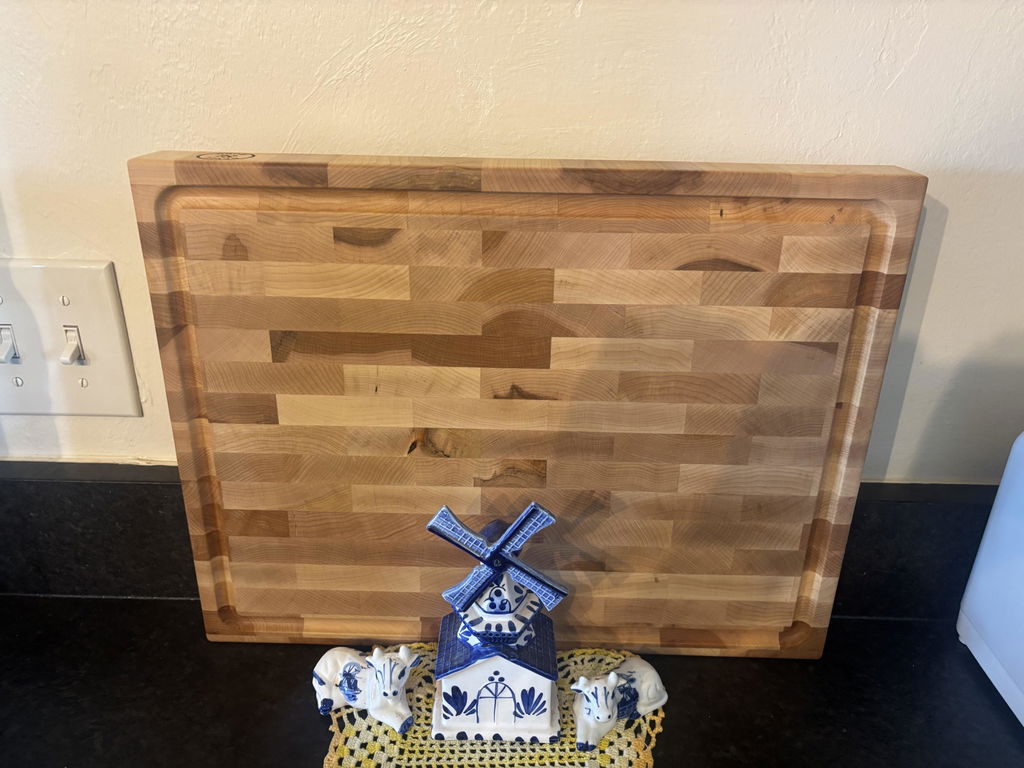
No, you shouldn't set a hot pan straight from the burner or oven onto a maple cutting board. Cast iron at 400°F or more will scorch the surface, drive moisture out of the wood, and can leave a permanent dark ring or a crack that opens weeks later. A warm plate is fine. A screaming skillet is not.
This question comes up constantly, and for good reason. A thick maple board looks exactly like the sturdiest trivet in the kitchen, and it's already sitting on the counter. Here's what heat actually does to the wood, and where the safe line sits.

What does heat do to a wooden cutting board?
Heat drives moisture out of wood fast and unevenly. The surface under the pan dries and shrinks while the wood a half inch below stays at normal moisture, and that difference creates internal stress.
Stress is what cracks boards. You may see nothing the day it happens, then find a hairline split along a glue joint a few weeks later. The scorch mark is cosmetic; the drying is the real damage.
At what temperature does a maple board start to suffer?
Meaningful damage starts around 200°F of sustained contact, and scorching becomes visible near 300°F. For reference, a pan pulled off a burner is commonly 350°F to 500°F, and cast iron holds that heat for a long time.
Brief contact with something warm, a plate at 150°F or a covered dish out of a low oven, won't hurt the wood. It's sustained contact with genuinely hot metal that does it. Time matters as much as temperature.
Hot items: what's safe and what isn't
| Item | Typical temperature | Safe on a maple board? |
|---|---|---|
| Warm dinner plate | 120 to 160°F | Yes |
| Bread fresh from the oven | 190 to 210°F | Yes, briefly |
| Roast resting out of the oven | 135 to 165°F | Yes |
| Baking dish straight from oven | 350 to 425°F | No |
| Cast iron off the burner | 400 to 600°F | No |
| Stockpot of boiling liquid | 212°F plus weight | No |
The pattern is simple: food is usually fine, cookware usually isn't. Your board was built to meet a knife, not a burner.
Can you use a cutting board as a trivet at all?
Yes, with a barrier. Put a folded towel, a cork pad, or a proper trivet between the board and anything that came off heat, and the board does the job it looks like it should do.
A thick end-grain board is genuinely good at this once protected, because the mass spreads what heat gets through rather than concentrating it. The barrier is doing the work, but the board makes a stable, attractive base for serving.

What if you already put a hot pan on your board?
Don't panic, and don't sand it right away. Let the board sit for a few days at room temperature so the moisture in the wood evens out, then look at it properly.
If there's a light scorch ring and no split, sand the area with 150-grit, work up to 220, and re-oil generously. A dark ring often lifts most of the way out. If a crack has opened along a joint, our guide to fixing a separated glue joint covers the repair, and how to fix a cracked cutting board handles splits in the wood itself.
Does heat damage void a cutting board warranty?
Usually, yes, and it's worth reading the terms before you find out. Most hardwood board warranties, including the Bevel & Bond 5-year warranty, cover manufacturing defects like warping or splitting under normal use, but exclude damage from misuse, and exposure to extreme heat is named misuse.
That isn't a technicality. A crack caused by a 500°F skillet is a heat crack, and it looks different from a defect to anyone who has seen both.
Is end grain more or less heat-resistant than edge grain?
End grain is slightly more vulnerable, because the exposed fiber ends behave like thousands of tiny straws that lose moisture more readily than a long-grain face. The difference is small in practice, and neither construction should meet a hot pan.
Where end grain wins is everything else: it takes shallower knife marks and stays smoother for years. We cover the full comparison in end-grain vs. edge-grain.
Can you put hot food directly on a maple board?
Yes. A rested steak, a roast chicken, a loaf out of the oven, all fine. Food carries far less heat than the metal it was cooked in, and it's usually in contact briefly. Carving straight on the board is one of the things a thick maple board is genuinely built for.
Wipe up juices when you're done rather than letting them sit, and re-oil if the surface looks dry afterward. Our maintenance schedule covers the routine.
Does a hot pan ruin the board permanently?
Often not. Light scorching sands out, and a well-built thick board has enough material to be resurfaced several times. Permanent damage means a split through a joint or a deep burn that goes below what you can safely sand away.
Why does heat make a board crack later instead of immediately?
Because wood moves slowly. The heat pulls moisture from a small area, that area shrinks against the wood around it, and the stress sits there until something gives, often weeks later during a dry stretch. A crack that appears in January frequently started with a pan in November.
When was this article last reviewed?
This article was last reviewed in July 2026 by the Bevel & Bond workshop team.
The takeaway
Hot food on the board, hot cookware on a trivet. That one habit prevents nearly all heat damage to a wooden board, and it costs you nothing but a folded towel.
If your board has seen a few hot pans and looks tired, a sanding and a fresh coat of Board Balm brings most of it back. And if you're shopping for a board thick enough to be resurfaced for years, our 1.75-inch end-grain hard maple board is built with that in mind.