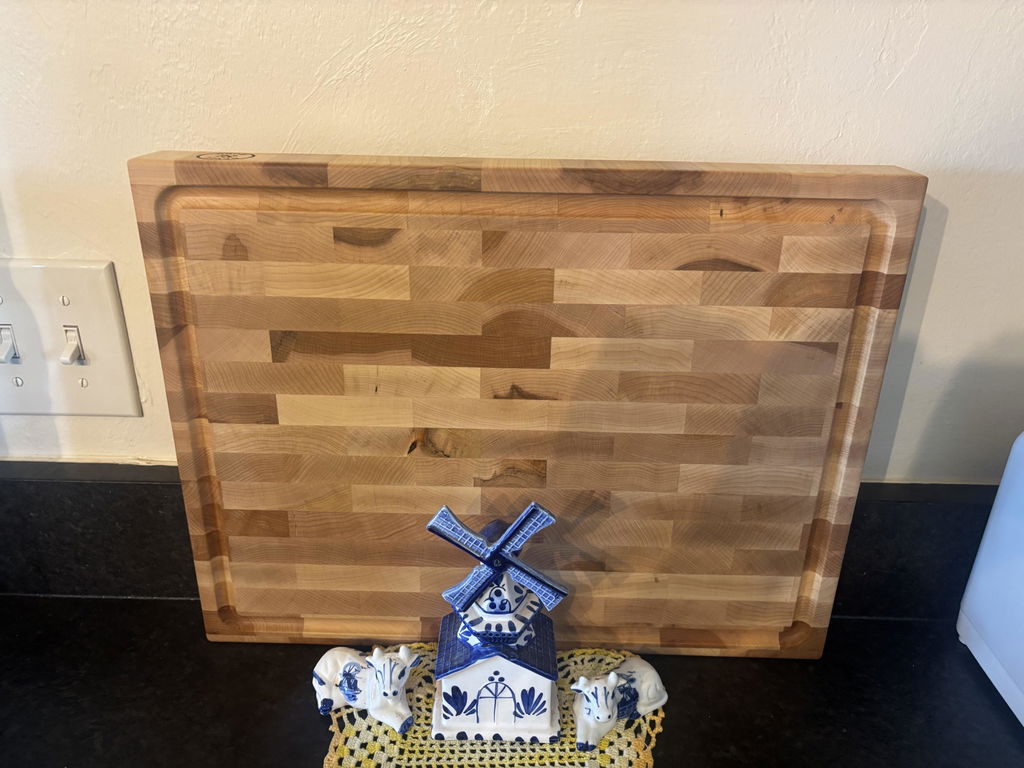
The 7 rule for butcher block is an oiling schedule. As it most commonly circulates: oil once a day for seven days, then once a week for seven months, then once a month from there.
It is a memory aid, not a law of wood science, and the versions in circulation disagree with each other in ways nobody seems to check. Below is the rule as published, where the variants fall apart, and the one test that beats any calendar.
What is the 7 rule for butcher block?
Oil once a day for seven days, once a week for seven months, once a month thereafter. That is the version published by Tasting Table and echoed across most of the home improvement sites that cover it.
The logic underneath is sound even if the numbers are arbitrary. New hardwood is thirsty, so it takes repeated coats before it stops absorbing. As the wood approaches saturation, each coat lasts longer, so the interval stretches. Daily, then weekly, then monthly is the right shape for that curve.
What does the schedule actually look like?
Roughly 44 applications across the first fourteen months, front-loaded into the first week. Laid out on a timeline, the front-loading is the whole point.

Why is it also called the rule of 7, and does the name change the schedule?
The names are interchangeable, the schedules underneath them are not. Rule of 7, 7 rule, and rule of sevens all point at the same idea, but the intervals attached to each phrasing vary by source.
The versions in circulation include "once a week for seven months," "once a week for seven weeks," and the older woodworking phrasing of once a day for a week, once a week for a month, once a month for a year. They differ by more than twenty applications. If you have seen two conflicting numbers and assumed you misread one, you did not.
Where did the 7 rule come from?
No original source. It appears on home improvement and lifestyle sites as received wisdom, with no maker, manufacturer, or research cited by any of them.
That absence is what allows the variants above to drift. Nobody is checking the arithmetic against a workshop, because there is no workshop behind the rule to check against.
Does the 7 rule actually hold up?
The shape holds up. The specific numbers do not, and following them literally will have you oiling a saturated board for months after it stopped absorbing anything.
Wood does not read calendars. A butcher block in a dry apartment with winter heating drinks oil far faster than the same block in a humid coastal kitchen, and a 3-inch countertop behaves differently from a 1.75-inch board. Thirty weekly applications is right for one and wasteful for the other.
Use the rule to get through the break-in period, then switch to the test in the next section. That is how a shop actually works, and it is why we send a care card rather than a calendar.
What test should you use instead of a calendar?
Put a few drops of water on the surface. If it beads, the board is sealed and needs nothing. If it darkens and soaks in within about thirty seconds, it is ready for oil.
This takes five seconds, works on any thickness, in any climate, at any age of board, and it cannot be wrong the way a fixed schedule can. Run it monthly and you will oil roughly two to three times a year once the board is broken in, which is what a mature block actually needs.

Prefer to skip week one entirely? Our board is hand-finished with Board Balm before it ships, so it arrives conditioned and ready to use. See the maple end grain chopping board
Does the 7 rule apply to cutting boards or only countertops?
It was written for countertops, and applying it unchanged to a cutting board overshoots. A butcher block countertop is 3 inches or more of unfinished hardwood with a large surface area, installed raw and sealed on site. A cutting board is thinner, smaller, and usually leaves the workshop already conditioned.
For a board, the honest version is: oil it when the water test says to, and expect that to mean every three to four weeks in the first year, then two or three times a year after. Our maintenance schedule lays out the full routine, and the oiling guide covers technique.
Are butcher blocks worth the money?
For a countertop, yes if you will maintain it and no if you will not. A butcher block counter runs roughly $40 to $100 per square foot installed, against $50 to $200 for quartz, and unlike quartz it can be sanded flat and refinished for decades.
The catch is honest: it stains, it scorches, it moves with humidity, and it needs the oiling routine above. People who resent that maintenance should buy quartz and be happier. People who like that a surface improves with attention should buy the block.
For a board rather than a counter, the math is easier. A well-built hard maple block runs $90 to $180 and lasts twenty years with a few minutes of care a month, which is the cheapest cost-per-year in the category.
Does the 7 rule change in winter?
Yes, and this is the schedule's biggest blind spot. Indoor heating drops humidity sharply, and a block that needed oil monthly in summer can need it every two weeks in January. Run the water test more often between December and March.
Can you over-oil a butcher block?
Not in any way that damages the wood. Excess oil simply sits on the surface and gets wiped off, which wastes product rather than harming the block. The real error is under-oiling, which is what causes the cracking the schedule exists to prevent.
Do you follow the 7 rule on a board that arrives pre-oiled?
No. A board finished at the workshop has already been through its saturation coats, so starting a daily regimen on top of that is oiling a board that is not asking for it. Run the water test at four weeks and go from there.
When was this article last reviewed?
This article was last reviewed in August 2026 by the Bevel & Bond workshop team.
A board that skips the break-in. American hard maple, end-grain, 17 by 13 by 1.75 inches, hand-finished with Board Balm and backed by a 5-year warranty. Shop the end grain maple cutting board or pick up a tin of Board Balm for the routine.