Howard Cutting Board Oil is plain food-grade mineral oil, and it is a good one at under $1 an ounce. It soaks into a dry board and stops it cracking. What it cannot do is seal the surface, so water gets back in faster. The best routine uses both: oil to soak in, then a wax balm like Board Balm to seal.
Full disclosure: we make a cutting board conditioner called Board Balm, so Howard is a competitor. We are going to tell you where Howard beats us anyway, because it does, on price and on how easy it is to find. Here is what is in each bottle and tin, what each one costs per ounce, and when to reach for which.
Howard oil vs Board Balm: key facts (checked September 26, 2026)
- Howard Cutting Board Oil: "100% Pure USP Food Grade Mineral Oil", 12 fl oz, $10.39 on Howard's site or $8.75 on Amazon ($0.73 to $0.87 per oz).
- Howard Butcher Block Conditioner: mineral oil with beeswax and carnauba wax, 12 fl oz, $9.98 to $11.69 ($0.83 to $0.97 per oz).
- Board Balm: 80% food-grade mineral oil and 20% beeswax, 6 oz tin, $14.95 ($2.49 per oz).
- Cheapest: Howard. Best seal from one product: a wax blend. Our routine: oil a new or dry board, then wax it.

What is Howard Cutting Board Oil?
It is mineral oil and nothing else. Howard's product page lists it as "100% Pure USP Food Grade Mineral Oil" in a 12 fl oz bottle, and Howard's own safety data sheet lists white mineral oil as the only ingredient (Howard Products).
Howard says the oil "exceeds the requirement set forth in the U.S. FDA regulations" for food contact and cites 21 CFR 172.878 and 178.3620(a), the FDA rules for white mineral oil. That is the right stuff. Mineral oil does not go rancid the way olive or vegetable oil does, which is why every serious board maker uses it. Our is mineral oil safe for cutting boards guide covers the safety question, and why not olive oil covers the rancid part.
One note: some Amazon copy says Howard's oil is "Made with Vitamin E". Howard's own page and safety data sheet do not mention it. Vitamin E is listed in Howard's Butcher Block Conditioner, not the plain oil.
What is Board Balm, and how is it different?
Board Balm is 80% food-grade mineral oil and 20% beeswax, in a 6 oz tin for $14.95. The mineral oil soaks in like Howard's does. The beeswax stays near the surface and fills the open pores, so water beads up instead of soaking in.
That is the whole difference. Oil conditions the wood from the inside. Wax seals the outside. Howard's plain oil does the first job only, which is why Howard itself suggests following its oil with its Butcher Block Conditioner, a mineral oil, beeswax and carnauba blend. Our what is Board Balm page has the full breakdown.
| Product | Ingredients | Size | Price | Per oz | Seals the surface? |
|---|---|---|---|---|---|
| Howard Cutting Board Oil | USP food-grade mineral oil | 12 fl oz | $8.75 (Amazon) to $10.39 (Howard) | $0.73 to $0.87 | No |
| Howard Butcher Block Conditioner | Mineral oil with vitamin E, beeswax, carnauba wax | 12 fl oz | $9.98 (Amazon) to $11.69 (Howard) | $0.83 to $0.97 | Yes |
| Board Balm | 80% food-grade mineral oil, 20% beeswax | 6 oz | $14.95 | $2.49 | Yes |
Which costs less per ounce?
Howard, by a lot. Howard's oil runs $0.73 to $0.87 per ounce and its Conditioner $0.83 to $0.97, against $2.49 for Board Balm. If price per ounce is your only test, buy Howard.
Two things narrow the gap in practice. A 12 oz bottle of oil lasts a long time, but so does a 6 oz tin of balm, because wax goes on in a thin layer and you wipe most of it off. And the sticker difference is a few dollars, not a few hundred.
Does oil alone protect a cutting board?
Not as well as oil plus wax. America's Test Kitchen tested a 3-to-1 mineral oil and beeswax "spoon butter" against oil alone, and after 20 wash cycles the oil-only pieces looked ashen, with dried, rough spots (ATK). The waxed pieces held up.

The reason is simple: oil soaks in and keeps working its way deeper, leaving the surface open to water again. Wax stays on top and keeps it out. The University of Maine Cooperative Extension recommends mineral oil or beeswax about once a month (UMaine Extension Bulletin 3108), and our maintenance schedule lays out the full routine.
Where does Howard win?
On price, availability and bulk. Howard is on Amazon for under $10, it sells gallon jugs for people oiling butcher-block counters, and it cites the exact FDA regulations its oil meets. If you are seasoning a brand-new board, or rehabbing a dry, grey one that drinks oil for days, a big cheap bottle of Howard's is the smart buy.
Consumer Reports tested Howard's oil against three other cutting board oils in November 2025 and found little difference among most of them (Consumer Reports). Plain mineral oil is plain mineral oil. You are paying for the bottle and the brand.
Already oiled? Now seal it.
See Board Balm: 6 oz of food-grade mineral oil and beeswax, 80/20, for $14.95.
Where does Board Balm win?
On sealing and simplicity. Two ingredients, a known ratio, and a single tin that both conditions and seals. Howard's Conditioner does the same job, and does it well, with a third ingredient (carnauba wax) and vitamin E. Board Balm is a two-ingredient balm that you rub in with a cloth and buff off.

We will be straight about value: if you compare Board Balm to Howard's Conditioner ounce for ounce, Howard is cheaper. We make Board Balm because we wanted one product we could hand-finish every board with and put in the box, and because we know exactly what is in it.
Should you use Howard oil and Board Balm together?
Yes, and that is our recommendation. Oil a new or dried-out board with a cheap mineral oil like Howard's until it stops soaking in, then seal it with a wax balm. After that, a thin coat of balm once a month keeps it there.
The routine takes about 15 minutes of work. Wash and dry the board fully. Flood it with oil and let it sit at least an hour; Howard says 3 to 4 coats for butcher block. Wipe off the excess. Rub in a thin layer of Board Balm, let it sit 20 minutes, then buff off what has not soaked in. Our how to season a new cutting board guide walks through it step by step.

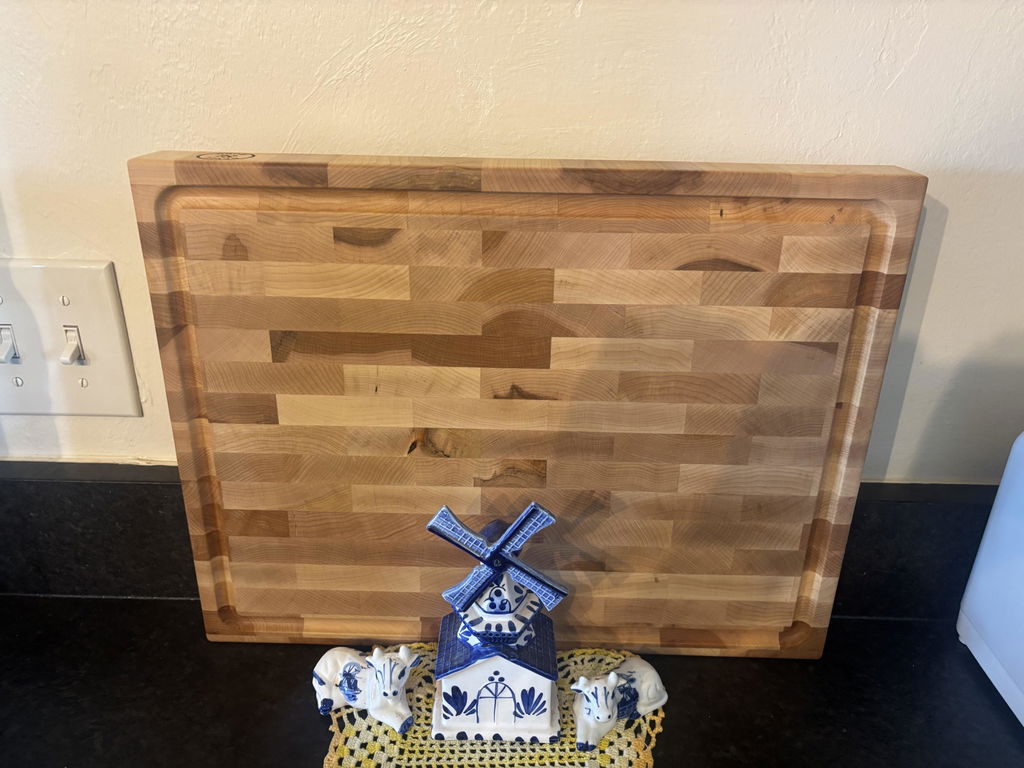
End-grain boards drink more oil than edge-grain boards, because the fibers run straight down into the block. An end grain maple cutting board like ours ships already conditioned with Board Balm, so you only need to maintain it.
Is Howard Cutting Board Oil food safe?
Yes. It is USP food-grade mineral oil, and Howard states it exceeds FDA requirements for direct and indirect food contact under 21 CFR 172.878 and 178.3620(a). It will not go rancid like vegetable or olive oil.
How often should you use Howard Cutting Board Oil?
Howard says to reapply whenever the wood looks or feels dry, without a set schedule. In practice, that is about once a month for a board in daily use, which matches the University of Maine Extension's advice. A new board needs several coats first.
What is the difference between Howard Cutting Board Oil and Butcher Block Conditioner?
The oil is pure mineral oil. The Conditioner is mineral oil with beeswax and carnauba wax, stabilized with vitamin E. The oil soaks in; the Conditioner soaks in and leaves a wax seal on top. Howard recommends using the oil first, then the Conditioner.
Is Board Balm the same as Howard Butcher Block Conditioner?
Close, not identical. Both mix mineral oil and wax. Board Balm is 80% mineral oil and 20% beeswax, with no carnauba. Howard's Conditioner adds carnauba and vitamin E and costs less per ounce.
Can you use Howard oil on a Bevel & Bond board?
Yes. Any food-grade mineral oil works on our boards, Howard's included. Follow it with a wax coat, from Board Balm or any mineral oil and beeswax blend, to seal the surface. Avoid olive, vegetable and coconut oil.
When was this article last reviewed?
This article was last reviewed and updated in September 2026. Howard product ingredients, sizes and prices were checked on Howard's site and Amazon on September 26, 2026, and Board Balm details on our product page the same day. Amazon prices change daily, so check before you buy.
What sources did we use for this review?
- Howard Cutting Board Oil product page and safety data sheet (rev. 09/12/2025)
- Howard Butcher Block Conditioner product page and safety data sheet
- Howard Products FAQ
- Howard Cutting Board Oil on Amazon and Butcher Block Conditioner on Amazon
- Bevel & Bond Board Balm product page
- America's Test Kitchen: caring for wood with spoon butter
- Consumer Reports: best cutting board oils (November 2025)
- University of Maine Cooperative Extension: Safe Cutting Boards (Bulletin 3108)
A board worth oiling, and the balm to finish it.
Shop Board Balm, see the end grain maple cutting board, or browse the full collection
Every board ships already conditioned with Board Balm.