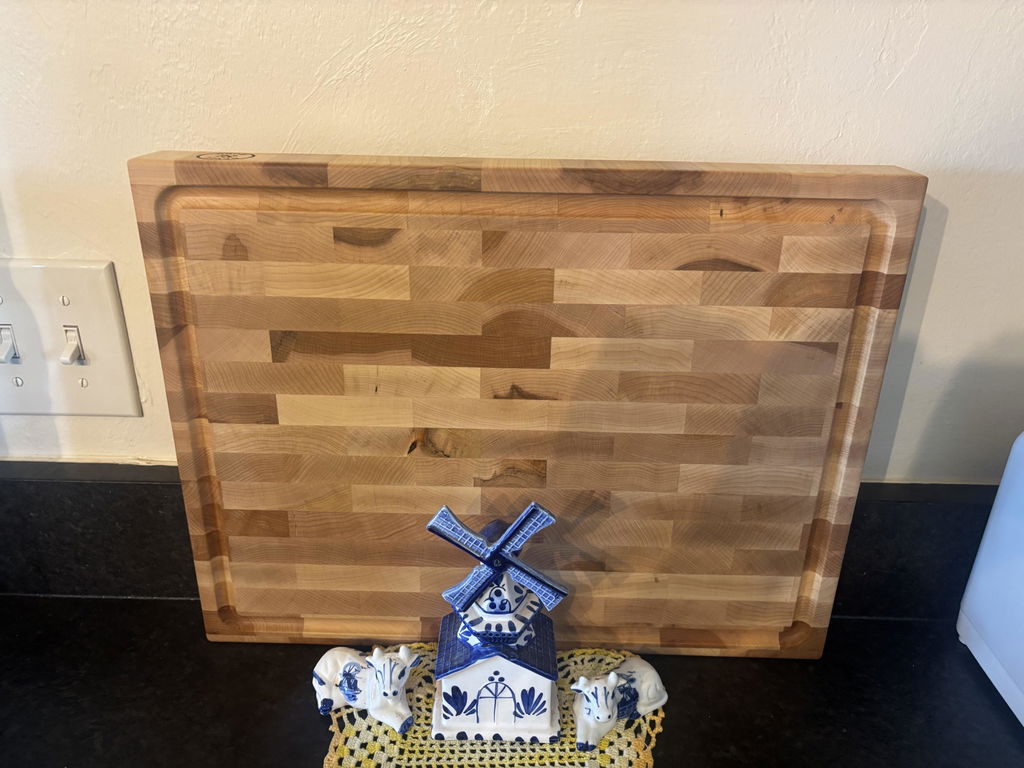
End-Grain Maple Cutting Board — Made in USA
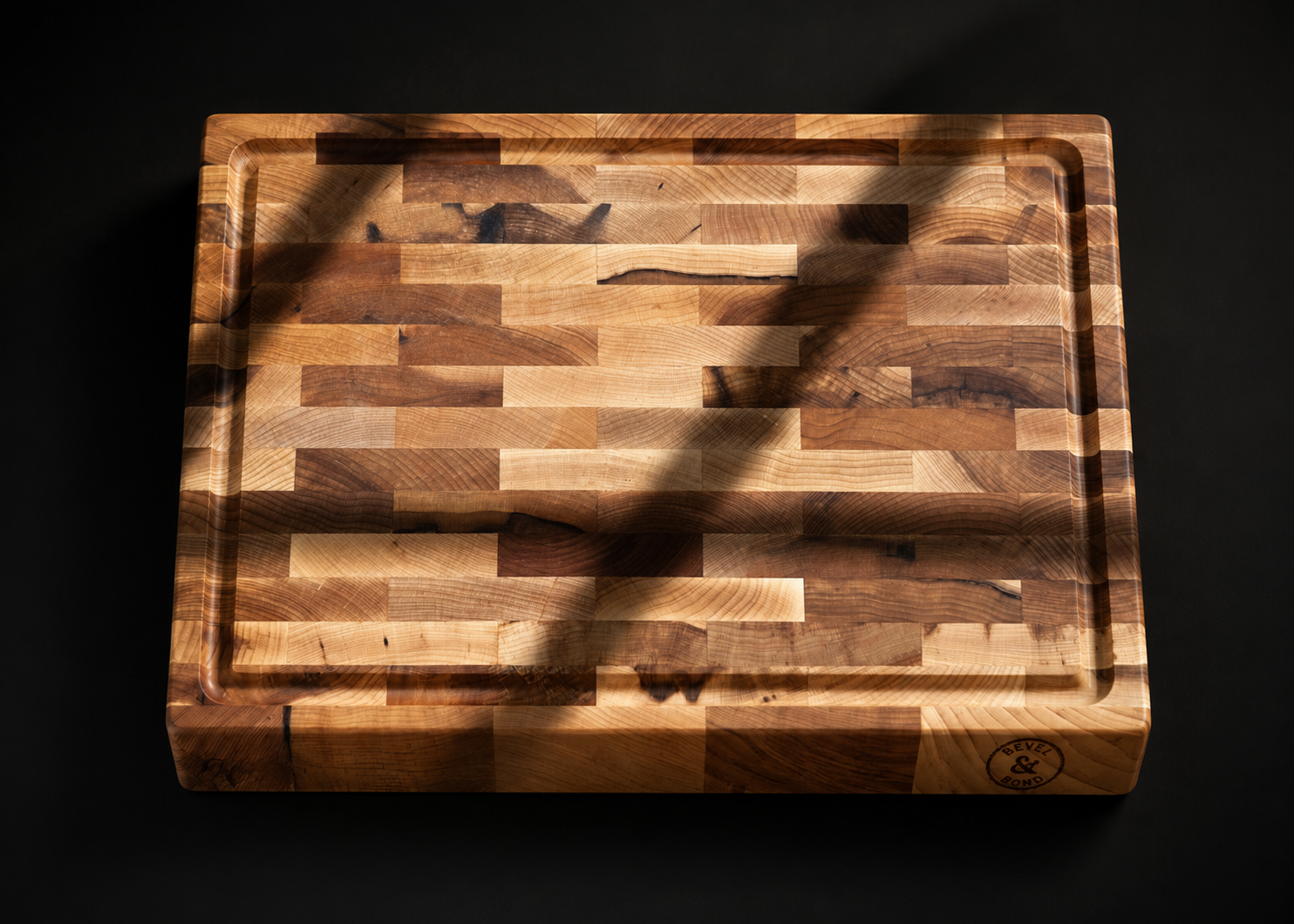
Every end-grain maple cutting board we make starts as select North American hard maple, cut on the end and joined block-by-block into a surface knives actually enjoy meeting. Because the grain runs vertical, the blade slips between the wood fibers instead of slicing across them, so your edge holds longer, and the board doesn't scar the way flat-grain boards do.
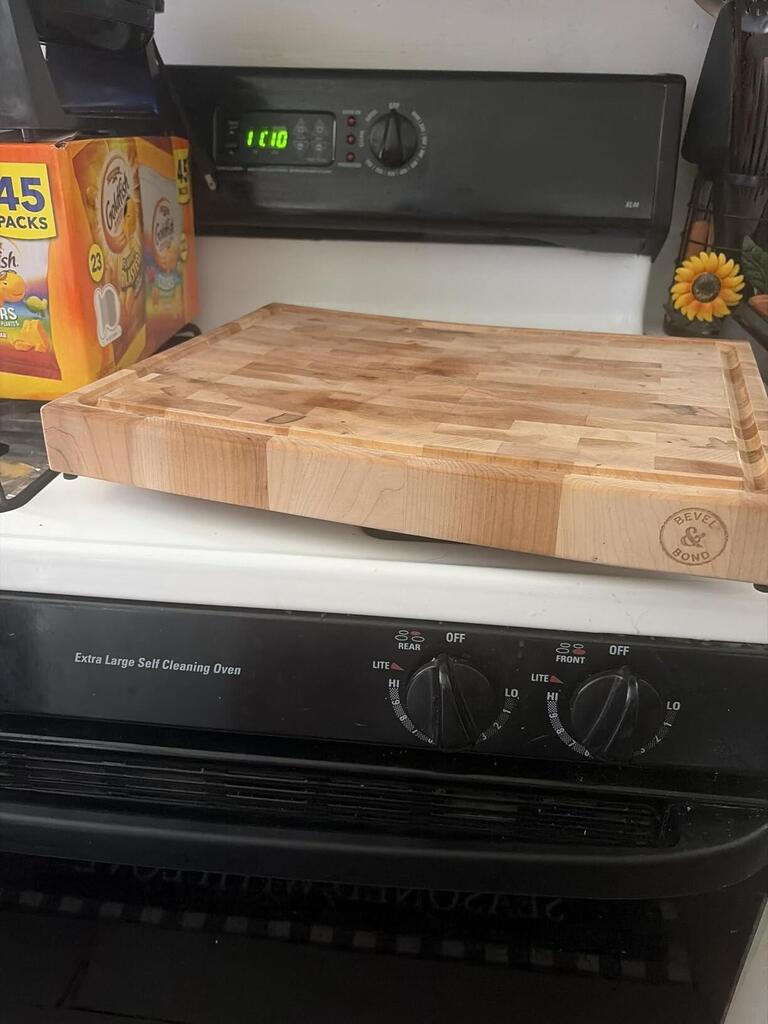
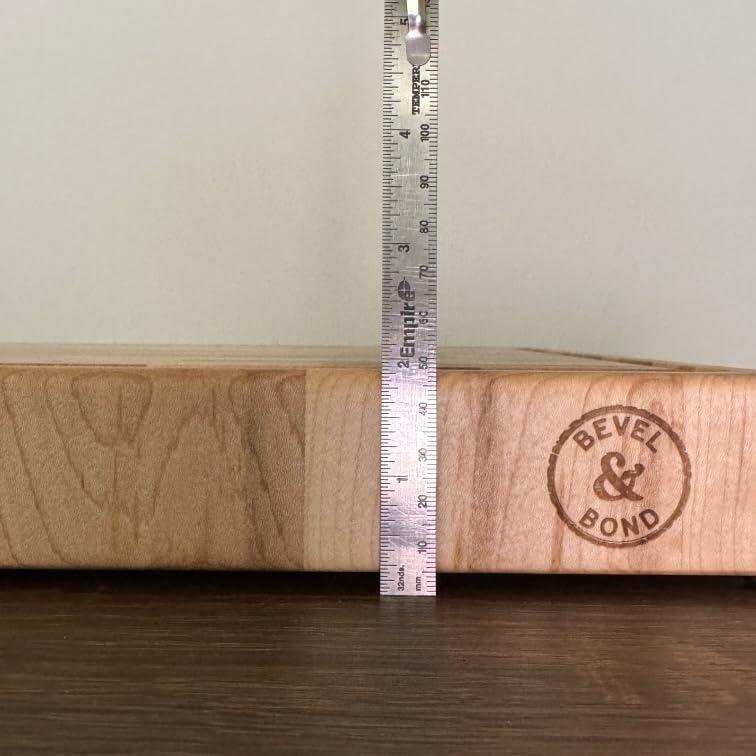
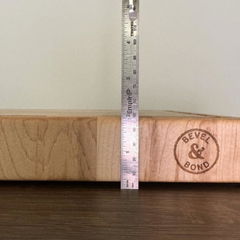
At 1.75 inches thick and over 10 pounds, it sits still while you work, feels balanced under a chef's knife, and looks the part on a kitchen counter or a Sunday spread. Produced in the USA, built to age well, and backed by a 5-year manufacturer guarantee.
Read what customers say in our verified customer reviews.
What Makes This a Hard Maple End Grain Cutting Board
The species is the part most listings leave out. This board is North American hard maple, Acer saccharum, the sugar maple. Soft maple is a different and less dense wood that often gets sold as plain “maple,” so we name ours. Hard maple measures roughly 1,450 lbf on the Janka scale, which lands it in a useful middle ground: hard enough to resist knife marks, soft enough to spare your edge. Its grain is closed and tight, with fewer open pores than oak or ash.
Construction carries the rest. Each block is cut on the end and joined in a double glue-up with food-safe PVA glue, then finished at 17 x 13 x 1.75 inches and over 10 pounds. That mass keeps the board still while you work, and the vertical fibers meet the blade end-on rather than across the grain.
Key Features
End-Grain Maple Construction
Knife-friendly surface that reduces blade wear and promotes long-term durability.
Extra-Thick Butcher Block Design
Substantial weight and balance for secure, professional-level prep.
Generous Working Size
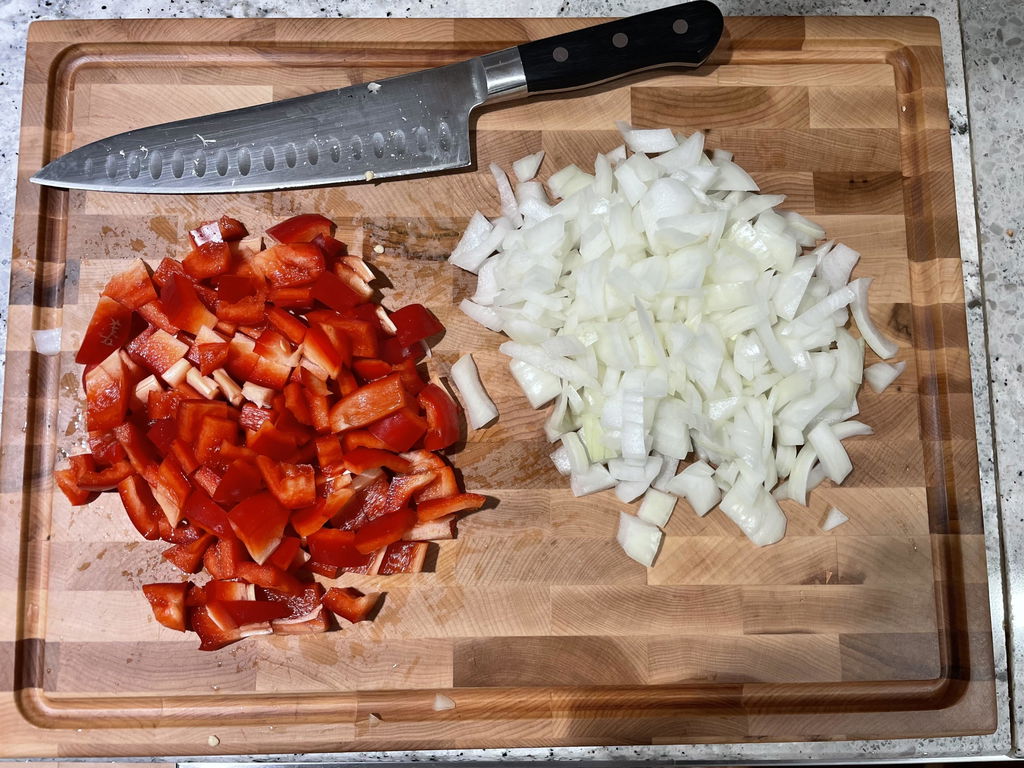
17″ × 13″ surface provides ample space for slicing, chopping, and serving.
Precision Juice Groove
Captures liquids from meats, fruits, and vegetables while preserving cutting space.
Non-Slip Feet
Keeps the board firmly in place and helps protect your countertops.
Hand-Finished in the USA
Crafted, inspected, and conditioned for lasting performance and beauty.
Premium Gift Box Included
Ready for gifting or elevated storage straight out of the box.
Frequently Asked Questions
Is an end grain maple cutting board better than edge grain?
For daily prep, yes, end grain is easier on knife edges and hides cut marks because the blade meets the fiber ends rather than crossing them. Edge grain is lighter and usually costs less, so it's a fine choice for light work or a secondary board. If you're chopping most days, end grain is the one that lasts. Here's how they compare side by side:
| Feature | End Grain | Edge Grain |
|---|---|---|
| Knife-friendliness | Best, blade meets the fiber ends | Good |
| Visible cut marks | Hides them | Shows them |
| Weight | Heavy (10+ lbs) | Lighter (5–7 lbs) |
| Best for | Daily prep, meat, serving | Light chopping, secondary board |
| Typical lifespan | 15–30 years with care | 8–15 years with care |

Full breakdown: end grain vs. edge grain cutting boards.
How thick should a maple cutting board be?
For serious kitchen use, look for at least 1.5 inches thick. Ours is 1.75 inches, thick enough to stay flat over years of use and heavy enough not to slide when you're breaking down a chicken or slicing brisket. Anything under 1 inch tends to warp. More on this in our cutting board thickness guide.
How do I clean an end grain maple cutting board?
Hand wash with mild soap and warm water, then dry it right away with a towel. Never submerge it, never put it in the dishwasher. Every few weeks, rub in a food-safe conditioner (our Board Balm works, so does mineral oil) to keep the wood from drying out. Step-by-step: how to clean a wooden cutting board.
Why maple over walnut, cherry, or teak?
Hard maple sits in the sweet spot on the Janka hardness scale, hard enough to resist knife marks, soft enough to protect your edge. Walnut is softer and darker (beautiful, but marks faster). Cherry is softer still. Teak has silica that dulls blades over time. Maple is the workhorse pros reach for, which is why it's what we build with.
What do professional kitchens use?
Hard maple end grain for butchery and carving, and color-coded plastic on the line where health codes require a dish machine. The construction we build is the one that lives at the butchery station. More in what professional chefs use for cutting boards.
Further Reading
If you're still deciding, these guides walk through the trade-offs: the best wood for cutting boards, maple vs. walnut vs. cherry, and end grain vs. edge grain.
Care & Maintenance
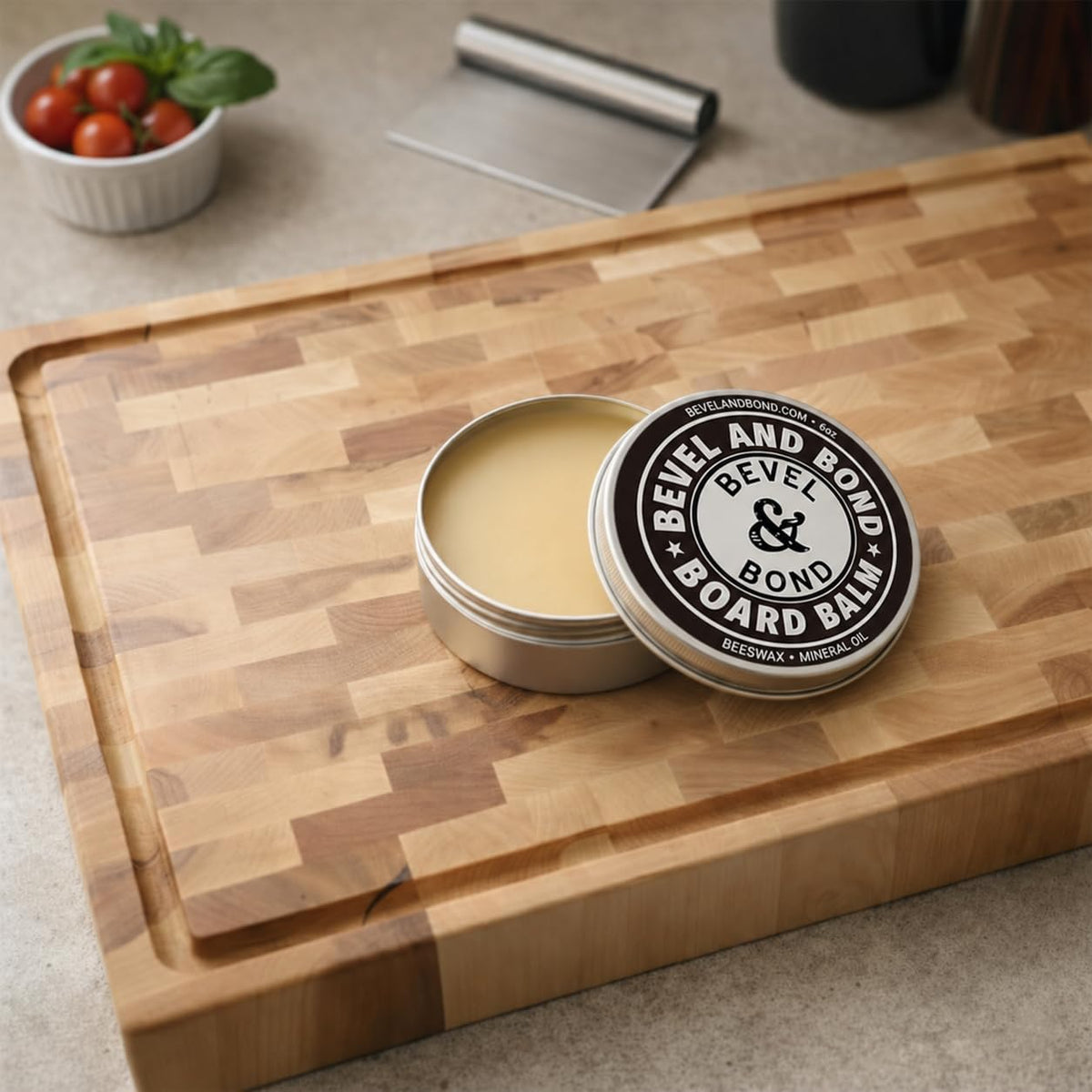
To maintain the board's finish and performance, hand wash with mild soap and dry immediately. Condition regularly with Bevel & Bond Board Balm, our signature blend designed to nourish the wood, enhance the natural grain, and help protect against drying or cracking over time.
With proper care, this board is made to age beautifully, developing character with every use.
Trusted & Crafted with Care
Crafted to last... if it does not, we will make it right.
Crafted from select North American hard maple, the Bevel & Bond Signature Maple Board is built for cooks who refuse to compromise on their tools.
The end-grain construction allows knives to glide between wood fibers rather than across them, helping preserve your blades while maintaining the integrity of the board over years of daily use.
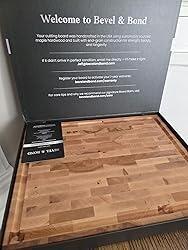
At 1.75″ thick and over 10 lbs, this board earns its place on the counter. It stays firmly grounded during prep, delivers professional-grade stability, and develops character with every meal prepared. It simply performs, meal after meal, year after year.
Every board is produced in the USA, finished with food-safe mineral oil, and packed in our premium black gift box. No seasoning required on arrival, it is ready to use from the moment it arrives.
Dimensions: 17″ × 13″ × 1.75″
Weight: 10 lbs +
Material: Select North American hard maple
Construction: End-grain butcher block
Finish: Food-safe mineral oil, hand-applied
Features: Precision juice groove · ergonomic side handle · non-slip rubber feet
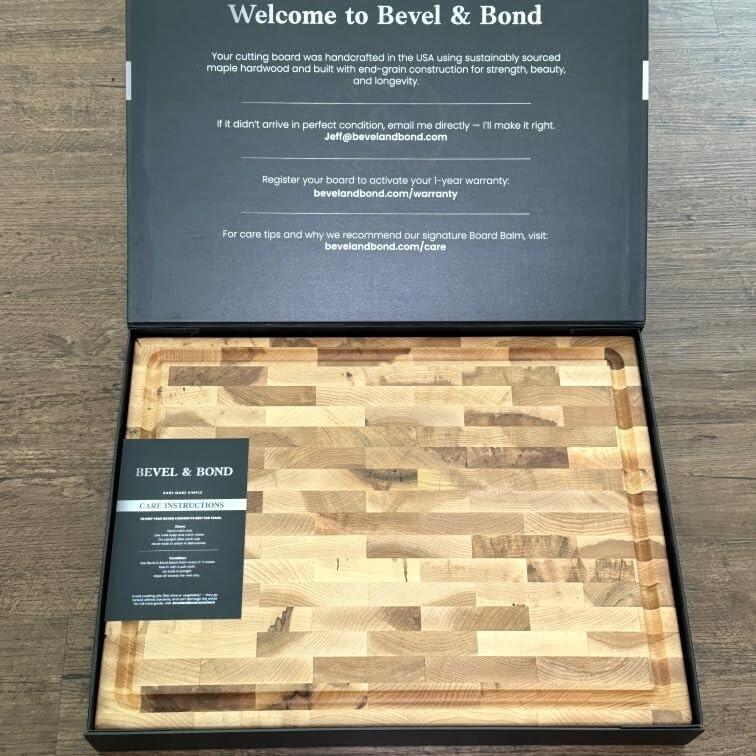
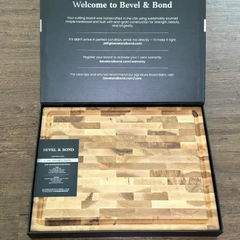
Packaging: Premium black magnetic gift box with welcome card and care instructions
Origin: Produced in the USA
Care: Hand wash only · Dry immediately · Do not soak · Do not dishwasher · Oil every 3–4 weeks
Daily care: Hand wash with mild soap and warm water. Dry immediately, never leave wet on the counter or soak in water.
Monthly conditioning: Apply a thin coat of food-safe mineral oil. Let absorb for 20 minutes, wipe the excess. Repeat every 3–4 weeks or whenever the wood looks dry.
What to avoid: Dishwasher · prolonged soaking · cooking or vegetable oils (they go rancid) · direct heat sources · air-drying vertically while wet.
Long-term: With proper care, this board will deepen in color and character over time. That is not wear, that is a board earning its history.
Shipping: $9.99 standard U.S. shipping
Standard U.S. shipping is $9.99.
Processing & delivery
Orders are processed within 1–2 business days. Standard delivery takes about 3 business days after processing. You will receive a tracking number by email once your order ships.
Estimated total time to delivery: 4–5 business days.
30-day returns
We stand behind every board we ship. If you are not completely satisfied with your purchase, you may return it within 30 days of delivery for a full refund.
To initiate a return, email us at Jeff@bevelandbond.com with your order number. We will send you a prepaid return label within 3 business days.
Returned items must be unused and in original condition. Boards showing signs of use are not eligible for return, but may be covered under our 5 year warranty if there is a defect.
Damaged or incorrect orders
If your board arrives damaged or you received the wrong item, email us at Jeff@bevelandbond.com with a photo and your order number. We will replace or refund your order immediately, no need to return the damaged item.
Questions?
Email Jeff@bevelandbond.com or visit bevelandbond.com/pages/contact. We respond to every inquiry personally.
What is covered
Every Bevel & Bond cutting board is backed by a 5-year warranty against manufacturing defects. This covers:
· Structural separation or splitting along glue lines
· Warping or cracking under normal use conditions
· Surface defects present at the time of delivery
· Any failure resulting from a defect in materials or craftsmanship
What is not covered
The warranty does not cover damage resulting from:
· Dishwasher use or prolonged soaking in water
· Use of cooking or vegetable oils for conditioning
· Exposure to direct heat sources (ovens, stovetops, grills)
· Normal wear, darkening, or surface marks from regular use
· Boards that have not been maintained with food-safe mineral oil
How to make a claim
Email Jeff@bevelandbond.com with:
· Your order number
· A photo showing the issue
· A brief description of what happened
We will review your claim within 3 business days and either send a replacement board or issue a full refund, your choice. We do not require you to return the defective board.
Register your board
To activate your warranty, register your board at bevelandbond.com/warranty. Registration is required to make a claim.
Warranty questions?
Email Jeff@bevelandbond.com directly. Every claim is handled personally, by the founder.
The greenest board is the one you never replace.
North American hard maple, cut end grain and glued up by a wood shop in Hubbard, Oregon. When the surface wears, it gets sanded flat and re-oiled rather than thrown away. Kept that way, a wood board lasts 15 to 30 years.
End-Grain Maple Cutting Board — Made in USA
Top Features: Crafted to Last
No shortcuts in the wood. No shortcuts in the build. Four deliberate decisions separate a board you will replace from one you will keep for decades.
Built for every meal.
From weeknight prep to weekend feast.
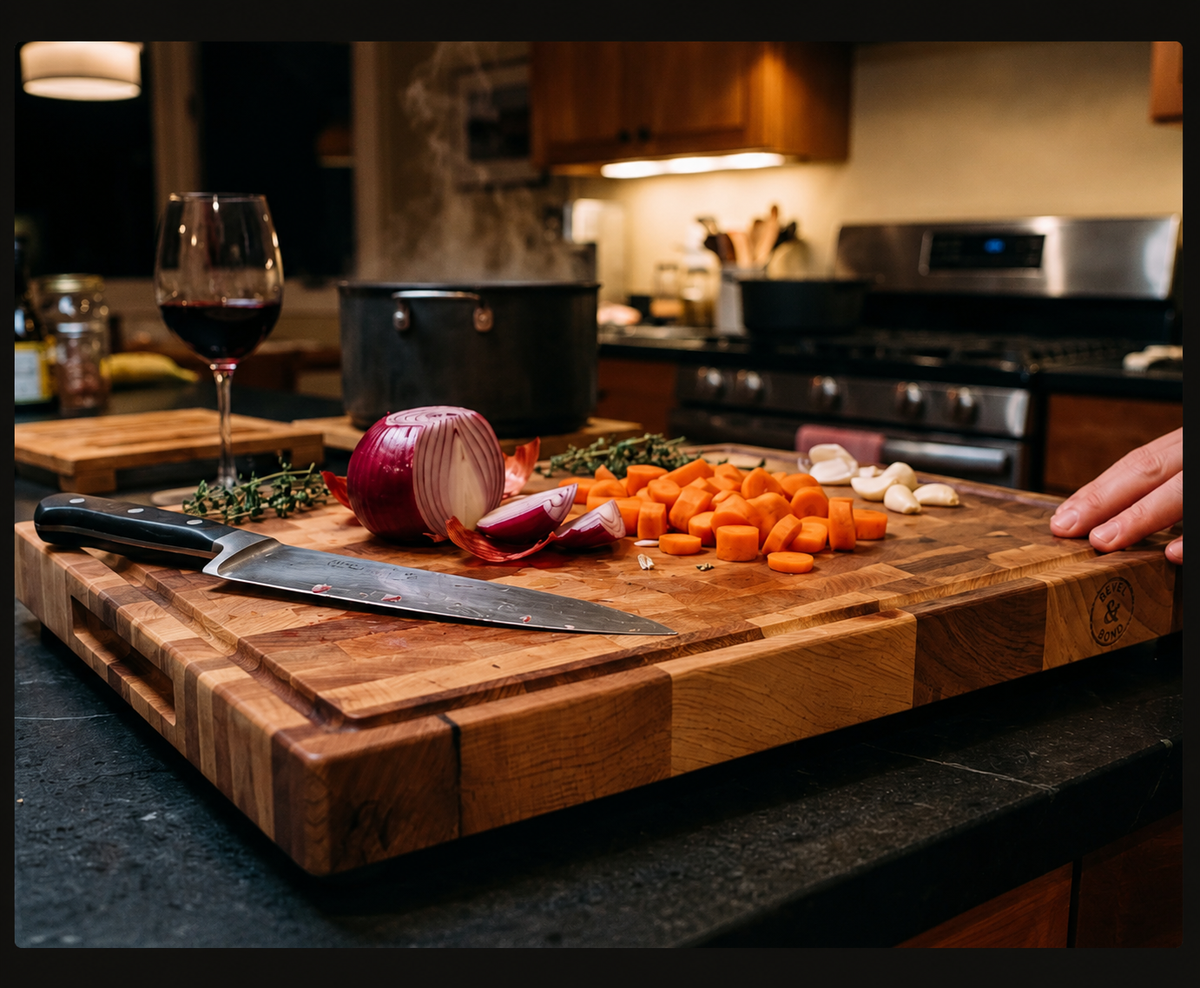
The Bevel & Bond Signature Maple Board is built to handle everything the kitchen demands: raw meat, fresh vegetables, warm bread, charcuterie spreads, and everyday prep.
The generous 17″ × 13″ surface gives you room to work comfortably, while the end grain maple construction remains gentle on your knives through years of daily use.
Built for the cook who uses their tools, not just displays them.
Actual end-grain surfaceWhy End-Grain
The surface professional kitchens choose.
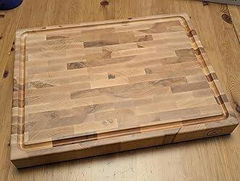
In an end-grain board the wood fibers stand upright, like a tight bundle of straws. Your knife settles between them instead of slicing across them, so the surface scars less and your edge survives.
Face-grain and bamboo do the opposite. They scar, they dull blades, they warp. Ours is solid North American hard maple, Acer saccharum, the species chefs standardized on.
- 1.75″ Thick
- 10+ Pounds
- 5 yr Warranty
- USA Handcrafted
- Species North American hard maple
- Dimensions 17″ x 13″ x 1.75″
- Construction End-grain, juice groove, non-slip feet
Wood species, not boards
Which wood makes the best cutting board? Eight species, compared
This table compares wood species. The board-to-board comparison, on thickness and warranty, is a separate section on this page.
Cutting board woods are ranked here on two properties: Janka hardness, the force in pounds (lbf) needed to embed a steel ball halfway into the wood, and grain structure, which decides whether a cut surface closes back up or leaves open pores that hold moisture and food residue.
Our own Janka guide sets the useful window plainly: “The ideal range is 900 to 1,500 lbf. Below 900, the wood dents and scars too easily for daily chopping. Above roughly 1,500, the surface starts wearing knife edges faster.”
Every figure in the table below is taken from that article, Wood hardness for cutting boards: the Janka scale explained, published on this site.
| Wood species | Janka hardness (lbf) | Grain | Verdict as a cutting surface |
|---|---|---|---|
| Hard mapleThis boardAcer saccharum | 1,450 | Closed | Best all-around |
| WalnutJuglans nigra | 1,010 | Closed | Excellent, softer |
| CherryPrunus serotina | 950 | Closed | Good, lighter duty |
| TeakTectona grandis | 1,070 | Closed, oily | Good, dulls knives slightly |
| Red oakQuercus rubra | 1,220 | Open | Poor, too porous |
| Acacia | 1,700+ | Wild, interlocked | Fair, unstable and hard on knives |
| Bamboo | 1,400–1,600 | Fibrous, glue-laden | Poor, dulls knives fast |
| Hinoki cypress | ~400–500 | Softwood | Specialist, dents easily |
Harder is not better, and two of these are harder than maple
Two woods in this table are harder than hard maple, and we are not going to pretend otherwise. Acacia measures 1,700+ lbf and bamboo 1,400–1,600 lbf, at or above maple’s 1,450 lbf. On a cutting surface that works against you: past roughly 1,500 lbf the board stops yielding and the knife edge yields instead, which is why bamboo has a reputation for dulling blades fast. Acacia adds a second problem on top of hardness, a wild interlocked grain that moves and makes the board unstable.
Softer woods trade the other way. Cherry at 950 lbf and walnut at 1,010 lbf are gentler on an edge than maple is, and they dent and scar sooner under daily chopping. Hinoki cypress, a softwood at roughly 400–500 lbf, is valued in Japanese kitchens for exactly that gentleness, and it dents if you treat it like a chopping block.
Grain is a separate axis, not a footnote. Red oak sits inside the ideal hardness range at 1,220 lbf and is still a poor cutting board, because its open pores hold moisture and food residue. Teak is closed-grained and comfortably in range at 1,070 lbf, and its natural oils and silica still dull knives slightly.
So hard maple’s 1,450 lbf is not the top of the table, and it is not meant to be. It is the point just inside the upper limit of the ideal range where the surface is hard enough to resist denting and scarring, closed enough not to trap moisture, and still soft enough to let a blade settle in rather than skate off it. That is the whole case for maple. It is a trade-off, not a clean sweep.
Where this board sits: the Bevel & Bond board on this page is North American hard maple, Acer saccharum, 1,450 lbf, closed grain, built in end-grain construction at 1.75″ thick. $119.99.
Janka values, grain descriptions and verdicts on this page are taken from our own guide, Wood hardness for cutting boards: the Janka scale explained.
The Comparison
Thicker. Backed longer. Fairly priced.
A thicker board than most, a warranty none of them offer, at a price that is not trying to impress anyone. Here is how it compares.
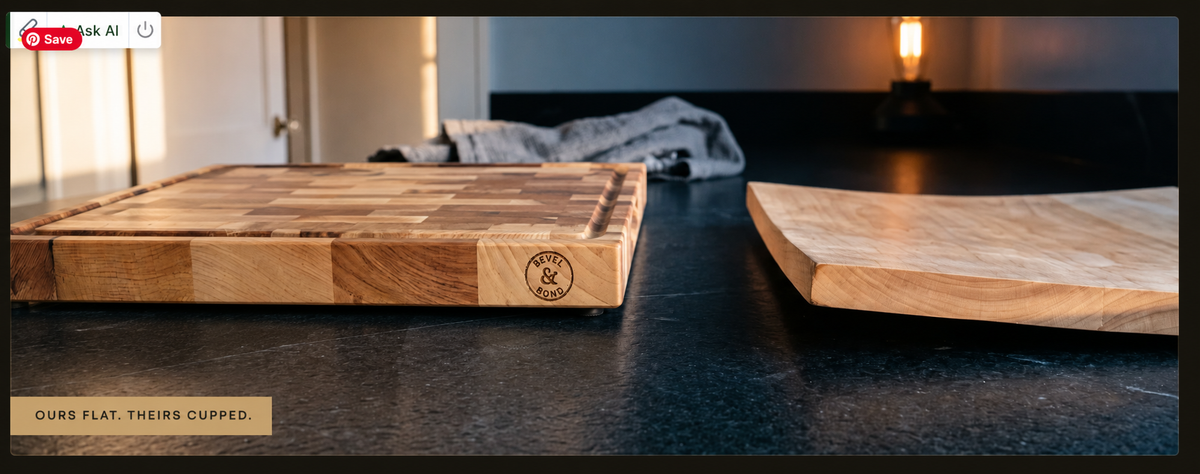
Ours flat. Theirs cupped.| Board | Thickness | Warranty | Notes |
|---|---|---|---|
| Typical budget board | 0.75″ | None | Thin, warps, dulls knives |
| Standard premium board | 1.5″ | None | Often pricier than ours |
| Bevel and BondOurs | 1.75″ | 5 years | Produced in USA, ready to use |
Figures reflect commonly sold boards in each category. We do not name competitors.
Before You Buy
Why this board, and why it costs what it costs.
The honest answers to what people ask us most before ordering.
Get Your BoardWhy buy this instead of a 30 dollar board?
A cheap board is a consumable. It scars, absorbs water, warps, and quietly ruins your knife edges, then you replace it in a year or two. This one is 1.75″ of solid end-grain hard maple, over 10 lbs, hand-finished and backed for five years. You buy it once.
Why end-grain instead of edge-grain or bamboo?
In end-grain the wood fibers stand upright, so your knife meets the fiber ends rather than crossing them. Edge-grain boards get sliced across the fiber, so they scar and stay scarred. Bamboo is harder than most steel knife edges, which is why it dulls knives fast.
Does 1.75″ really matter, or is 1.5″ fine?
It matters twice. Mass keeps the board still while you work. And thickness resists the cupping that thin boards develop as they take on and give off moisture. At over 10 lbs this one stays put and stays flat.
Why hard maple and not walnut, teak or acacia?
Hard maple sits in the sweet spot: dense enough to resist scarring, soft enough to spare your edge, tight-grained so it does not harbor moisture. Teak contains silica that dulls blades. Acacia and many imports vary wildly in density and glue quality.
Is it worth it if I only cook a few times a week?
Yes, for a different reason. Occasional cooks keep a board far longer, so warping and staining are what retire it, not wear. A board that stays flat and refinishes with a rub of oil still looks good in ten years.
What makes the 5-year warranty meaningful?
That most boards in this category come with nothing. If a manufacturing defect shows up within five years we repair or replace it, no runaround. We can promise that because Each board is produced to our specifications in the USA.
Will it actually protect my knives?
Yes, and people underestimate this. Every cut on a hard surface rolls the edge of your blade a little. End-grain maple lets the edge pass between fibers instead of hammering across them, so you sharpen less often.
What if I get it and do not love it?
Send it back within 30 days. Beyond that the five-year warranty covers manufacturing defects.