Meal prep is the hardest thing you'll ask a cutting board to do. Two hours of continuous knife work, pounds of vegetables, raw chicken somewhere in the middle, and a cleanup you want over with because you're already tired.
That workload changes what "best" means. For a Sunday batch session the board you'll actually reach for is light enough to move to the sink one-handed and safe to put in the dishwasher — not the heaviest, prettiest thing on the counter. This roundup ranks five named boards on weight, cleanup, surface area and published warranty, with prices and specs read from each brand's own site on 19 August 2026.
The honest winner is a light dishwasher-safe board. Ours isn't that board. It's the pick further down the list, for a different kind of cook.
How we ranked these
Four things, in this order:
- Cleanup. Can it go in the dishwasher? During batch prep you'll wash a board three or four times in one session.
- Weight. Anything over about 5 lb is a two-hand lift to the sink, wet, with slippery hands.
- Usable surface. Enough room to stage diced onion on one side while you keep cutting on the other.
- Published warranty. Read at the brand's own site, dated, not assumed.
Notably absent from that list: how it looks. If your board also has to go to the table, skip to the heavy-duty pick.
1. Epicurean Kitchen Series — the overall winner
- Price: $46.99 for the 17.5" × 13"; the range runs $15.99 to $46.99 across four sizes
- Dimensions: 17.5" × 13" × 1/4", 2.3 lb
- Material: Epicurean's composite; the product page lists "NSF Certified," "Dishwasher Safe" and "Made in USA"
- Verdict: the right shape of board for this job — big surface, 2.3 lb, and it goes in the machine between the chicken and the salad.
The warranty is the strongest on this list. Epicurean words it as "free from defects in material and workmanship for the lifetime of the product," excluding normal wear and tear and misuse. Epicurean Cutting Surfaces also appears in NSF's certified cutting board listings under NSF/ANSI 2, which is a meaningful signal for a board you'll use with raw protein.
The trade-off is real. At a quarter inch it flexes if your counter isn't flat, and it won't sit with the dead weight of a thick block. You're buying convenience, and for batch prep that's the correct thing to buy.
2. Dexas NSF Polysafe — the value pick, and the raw-protein board
- Price: $17.99 (14" × 17") or $22.99 (15" × 20")
- Dimensions: 14" × 17" and 15" × 20"
- Material: high-density poly; Dexas lists "Non-porous," "Non-absorbent," "Dishwasher safe" and NSF approval
- Verdict: the least expensive way to get a big dishwasher-safe surface, and the one we'd keep exclusively for raw chicken, beef and fish.
At the time reviewed, we located a 30-day return window but no separate written warranty on the cited listing; verify current seller and manufacturer terms. That's honest pricing for what this is — a working consumable you replace when it scores up.
If you buy one thing from this article, buy this as your second board. FDA Food Code 4-602.11 requires a food-contact surface to be cleaned "each time there is a change from working with raw FOODS to working with READY-TO-EAT FOODS." A dedicated raw board means you never have to remember.
3. Material "The MK Free Board" — the one that lives on the counter
- Price: $52 (the smaller Midi is $44)
- Dimensions: 17.5" × 12" × 0.25"; the Midi is 13" × 9.25" × 0.28"
- Material: Material describes it as "Bioplastic made of biopolymers and natural clay minerals. 100% USDA certified biobased content."
- Verdict: dishwasher-safe, good-looking enough to leave out, and backed by what Material calls a lifetime guarantee.
Roughly the same money as the Epicurean with a bit less surface. Pick between them on looks, honestly — the specs are close.
4. Joseph Joseph Chop2Pot Plus — the small-kitchen option
- Price: $15.00
- Dimensions: regular has a 8.3" × 10.4" cutting area; the large is 10.4" × 13.6"
- Material: not specified on the product page
- Verdict: it folds into a chute so you can tip diced vegetables straight into a bowl, which during batch prep is genuinely useful. Dishwasher-safe, with a 2-year guarantee.
The cutting area is small for a full session. Buy it as a helper board, not your main surface.

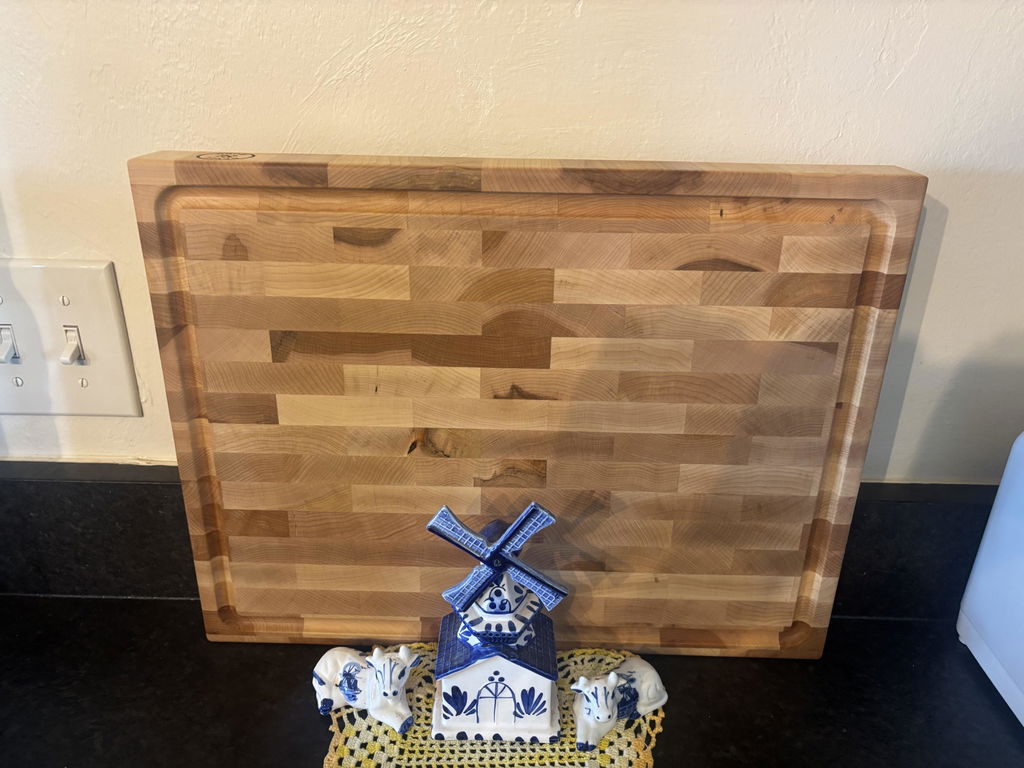
5. Bevel & Bond end-grain hard maple — the heavy-duty pick
- Price: $139.99
- Dimensions: 17" × 13" × 1.75", over 10 lb
- Material: end-grain US-grown hard maple, juice groove, non-slip feet, made in the USA
- Verdict: the board for people who prep and then serve on the same surface, and who don't mind hand-washing. Not the easiest board for batch prep, and we're not going to pretend otherwise.
Here's the honest case for it. At over 10 lb it doesn't move, which matters when you're an hour in and leaning into a butternut squash.
End grain means you cut into the ends of the fibers rather than across them, and the observable result is that it scars less and shows knife marks less than a thin board. Hard maple is 1,450 lbf on the Janka scale per The Wood Database — hard enough to resist gouging, not so hard it fights your edge.
And here's the case against it for this specific job. It's ten pounds to lift to a sink, it can't go in the dishwasher, and doing it anyway voids the 5-year warranty. If your prep routine is three fast wash cycles in two hours, the Epicurean is simply the better tool.
Buy ours if you want one board that handles the chopping, then holds the charcuterie when people come over. Buy it as the produce board in a two-board setup and let the Dexas take the raw chicken.
Comparison table
| Board | Price | Dimensions | Material | Weight | Dishwasher | Warranty |
|---|---|---|---|---|---|---|
| Epicurean Kitchen Series | $46.99 | 17.5×13×0.25 | Composite, NSF certified | 2.3 lb | Yes | Lifetime |
| Dexas NSF Polysafe | $17.99 | 14×17 | High-density poly, NSF | Not published | Yes | Not published |
| Material MK Free Board | $52 | 17.5×12×0.25 | Bioplastic | Not published | Yes | Lifetime |
| Joseph Joseph Chop2Pot Plus | $15.00 | 8.3×10.4 cutting area | Not published | Not published | Yes | 2 years |
| Bevel & Bond | $139.99 | 17×13×1.75 | End-grain hard maple | 10+ lb | No | 5 years |
| John Boos Chop-N-Slice | $41.95 | 12×8×1 | Edge-grain maple, NSF | 3 lb | No | 1 year |
| Sonder LA Alfred | $179 | 17×13×1.5 | End-grain walnut | 7.5 lb | No | 1 year |
Prices, dimensions and warranty terms were read from each brand's own website on 19 August 2026 and can change without notice.
The two-board setup
The single most useful thing in this article costs about eighteen dollars.
Run one board for produce and a separate one for raw meat, poultry and fish. When the chicken's cut, that board goes straight into the dishwasher and your produce surface never touched it. It's the one food-safety habit that genuinely matters at home, and it removes a decision you'd otherwise have to make while tired.
| Board | Job |
|---|---|
| Large light board or hardwood board | Produce and the bulk of prep |
| Dedicated second board | Raw chicken, beef and fish only |
| Folding board | Tipping scraps and diced veg into bowls |
Sizing and surface
Aim for at least 15" on the long side, and more if your counter allows. Below that you spend the session shovelling piles into bowls just to clear space.
For reference, a 17" × 13" board gives you 221 square inches. That's a comfortable everyday working surface, not a large board — if you batch-cook for five people, size up rather than buying thicker.
Cleaning and care
Scrape the surface clear with a bench scraper before you wash it. You'll be washing a mostly clean board instead of pushing scraps around the sink, which sounds trivial until you've done it four times in an evening.
Dishwasher-safe boards go in the machine. Wooden boards get hot water, dish soap, a rinse and then stand on edge to dry — never flat, never put away damp.
Oil a wooden board when it starts looking dry and pale, which under heavy weekly prep is every two to three weeks. Use a food-grade mineral oil and beeswax conditioner such as Board Balm rather than olive oil, which never fully dries and eventually goes rancid in the wood.
When to retire a board
FDA Food Code 4-501.12 puts the rule cleanly: surfaces "subject to scratching and scoring shall be resurfaced if they can no longer be effectively cleaned and SANITIZED, or discarded if they are not capable of being resurfaced."
That applies to every material. The practical difference is that a wooden board can be sanded flat and go back to work, and most plastic and composite boards can't. So budget for replacing your raw-protein board every year or two, and treat a good hardwood board as the one you keep.
Frequently asked
What's the best cutting board for meal prep? A light dishwasher-safe board with a big surface. We'd buy the Epicurean Kitchen Series 17.5" × 13" at $46.99, with a $17.99 Dexas alongside it for raw protein.
Why isn't the heavy wooden board the winner? Because batch prep involves washing the board several times in one session, and a 10 lb hardwood board can't go in a dishwasher. It's the better board for chopping and serving; it's the worse board for a fast Sunday cook.
Do I need two boards? It's the easiest way to meet the Food Code rule about switching between raw animal food and ready-to-eat food. It also costs less than most single premium boards.
Should the raw-meat board be wood or plastic? Plastic, in our view, purely because it goes in the dishwasher. Wood is permitted for raw meat and can be resurfaced, but the cleaning is on you every time.
How often should I oil a board used this hard? Every two to three weeks under heavy weekly prep, against monthly for a light-duty board. Dry, pale wood is the board asking.
Can I put a wooden board in the dishwasher? No. It waterlogs the wood, opens the glue lines, and voids our warranty along with most others.
The short version
For batch prep, buy light and dishwasher-safe. The Epicurean Kitchen Series is the best all-round choice at $46.99, with a $17.99 Dexas NSF Polysafe kept for raw protein — under $70 for a setup that handles a full Sunday session properly.
If you want one board that does the chopping and then goes to the table, the Bevel & Bond end-grain maple cutting board is 17" × 13" × 1.75" of US-grown hard maple, over 10 lb, with a juice groove, non-slip feet, a 5-year warranty and Board Balm in the box. It's a heavier, more permanent thing than meal prep strictly needs — which is exactly why some people want it.
More reading: what size cutting board you actually need, separate cutting boards for meat and vegetables, and cutting boards with a juice groove.
Last reviewed August 2026 by the Bevel & Bond workshop team. Competitor prices, specifications and warranty terms were checked at each brand's own website on 19 August 2026.