Walnut is the best partner for maple in a checkerboard cutting board, with cherry and sapele close behind. Contrast is the easy part of that decision. What actually decides whether the board survives a decade is how similarly the two species swell and shrink with humidity, and most buying guides skip it entirely.
Here is the part nobody mentions: hard maple moves more than any of the woods people pair it with. It is the restless one in the glue-up, and every partner you choose is a calmer wood being asked to keep up with it.
What woods pair best with maple in a checkerboard cutting board?
Black walnut, for four reasons at once: it is closed-grain, it is food-safe, its movement is the closest practical match to maple among woods you would actually want on a counter, and the light-to-dark contrast is about as clean as wood gets. Cherry is the next call, sapele after that.
The table below carries both numbers that matter. Janka hardness tells you how the two woods will wear against each other over years of knife work. Tangential shrinkage tells you how hard they will pull against each other through the seasons.
| Wood | Janka (lbf) | Shrinkage | Gap vs maple | Verdict |
|---|---|---|---|---|
| Hard maple | 1,450 | 9.9% | reference | The board itself |
| Black walnut | 1,010 | 7.8% | 2.1 pts | Best all-round partner |
| Sapele | 1,410 | 7.4% | 2.5 pts | Good, closest on hardness |
| Cherry | 950 | 7.1% | 2.8 pts | Very good, darkens with age |
| Purpleheart | 2,520 | 6.1% | 3.8 pts | Risky, far harder than maple |
| Padauk | 1,725 | 5.2% | 4.7 pts | Boldest colour, widest gap |
| Wenge | 1,930 | 8.1% | 1.8 pts | Close on movement, rough in use |
| Red oak | 1,220 | 8.6% | 1.3 pts | Avoid, open grain |
Read the last two rows and you can see why this is not a single-number decision. Red oak and wenge are the tightest movement matches on the list, and both are still the wrong answer. Compatibility is necessary. It is not sufficient.

If you want the wider species picture beyond pairing, our guide to the best wood for cutting boards covers the safe list in full.
Why does wood movement decide whether a checkerboard survives?
Because in a checkerboard the blocks are glued face to face with nothing to absorb the difference. Every wood swells in humid weather and shrinks in dry weather at its own rate, and when two species with different rates are bonded directly, each seasonal cycle loads every seam between them.

Those figures are the standard comparative index from the USDA Wood Handbook, measured green to oven-dry. Your kitchen will never do that to a board. The ranking is the useful part, not the absolute number.
Maple sits at the top at 9.9%, which reframes the whole question. You are not choosing a wood that moves; you are choosing how much calmer than maple you are willing to go. Walnut at 7.8% is a 2.1 point gap. Padauk at 5.2% is 4.7 points, more than double the strain for the same seam.
That stress does not distribute itself politely. Over a few years it finds the single weakest joint in the board, which is why a multi-wood board tends to open one hairline gap rather than age evenly. If yours does, a separated glue joint is repairable.
Why is maple and walnut the classic combination?
Because it is the only pairing that scores well on every axis instead of winning one and failing another. Walnut is closed-grain so it will not harbour moisture, it is unambiguously food-safe, its 2.1 point movement gap is the smallest among woods that pass the other tests, and at 1,010 lbf it is soft enough relative to maple's 1,450 that neither wears a step into the other.
Contrast is genuinely the least interesting reason it works, even though it is the reason most people pick it. It has stayed the default for decades because the engineering holds up, not because woodworkers ran out of ideas. More on the species in our walnut cutting board guide.
Which woods should you avoid pairing with maple in a checkerboard?
Open-grained species first: red oak and ash. Their pores are large enough to see, and large enough to hold food residue and moisture against the glue line no matter how good the pairing looks. Red oak having the tightest movement match on the entire chart changes nothing about that.
Skip anything dramatically harder, too. Purpleheart at 2,520 lbf against maple at 1,450 is a 1,070 point spread, and over years of chopping the softer squares wear down fractionally faster until the surface reads like a washboard under your palm.
Be careful with exotics you cannot verify. Some tropical hardwoods carry irritant oils and dust, and a surface you prepare food on is a poor place to run that experiment. Wenge is the honest example: it pairs beautifully on paper, splinters meanly in the shop, and its dust bothers a lot of people who work it.
Does padauk fade in a cutting board?
Yes, and faster than most buyers expect. That vivid orange-red oxidises toward a deep brownish red inside a year or two of normal light exposure, and no finish stops it. Mineral oil slows nothing; UV does the work.
The board still looks handsome afterwards. It just stops looking like the photograph that sold it to you, which matters if dramatic contrast was the entire reason you chose it. Padauk also carries the widest movement gap on the chart, so it asks the most of your seams while delivering the least permanent payoff.
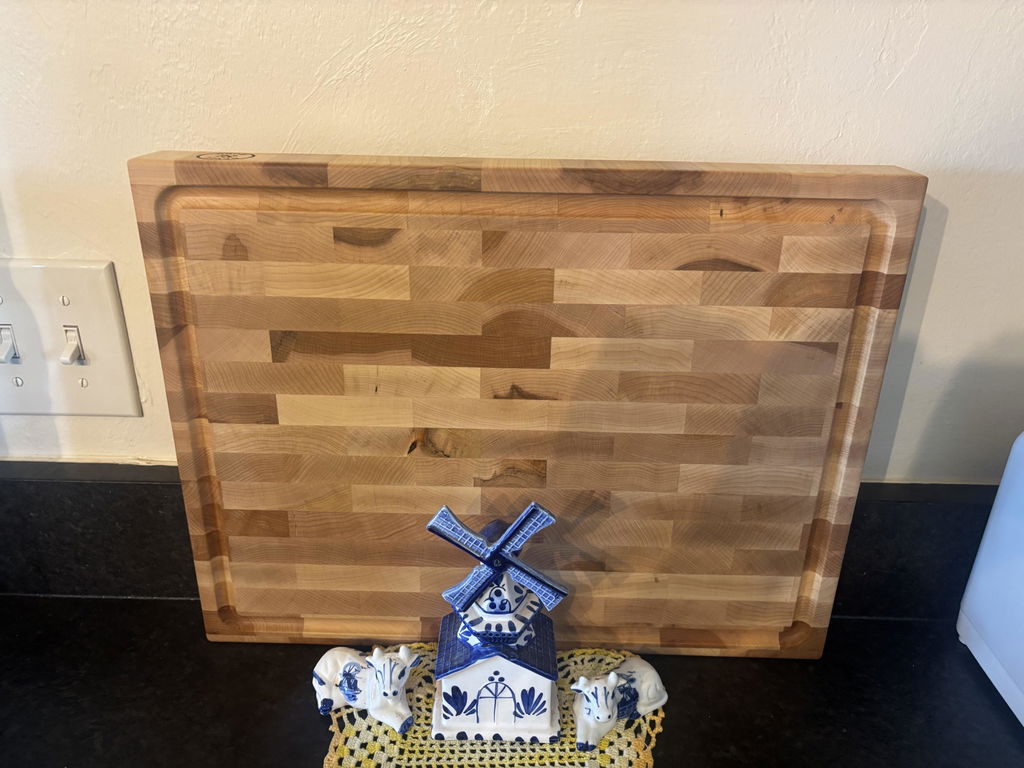
Our end-grain hard maple board is a single species throughout, so no seam in it carries mismatched stress. USA-made, 1.75 inches thick, backed by a 5-year warranty. See the full lineup in the complete collection.
Does a checkerboard cutting board have to be end grain?
No, but end grain is where the pattern comes from naturally. End-grain construction already means gluing up a slab, crosscutting it into blocks, rotating them, and gluing them again, so alternating two species during that sequence produces the checker almost as a byproduct.
Edge-grain checkerboards exist and look fine. They give up the hard-wearing surface that makes end grain worth the extra work, which is a real cost for a decorative gain. Our breakdown of how a board is actually built walks through the difference.
How many woods is too many in one board?
Three. Two is the classic for a reason, three can be done well by someone who knows what they are doing, and four is where the pattern starts fighting the food you put on it.
There is a structural cost as well as a visual one. Each additional species introduces another movement rate into a single glued panel, and the stress is set by the widest gap in the board rather than the average. A maple, walnut and padauk board is carrying the full 4.7 point spread whether or not those two squares touch.
Do multi-wood boards need different care than solid ones?
The routine is identical. The stakes are higher. Hand wash, dry standing on edge, never soak, never let it sit flat and wet, and never put it in a dishwasher.
The difference is what happens when you skip a month. On a solid board, drying out means a thirsty surface. On a checkerboard it means seams under mismatched tension with nothing keeping the wood dimensionally stable. Conditioning with a mineral oil and beeswax blend such as Board Balm every four to six weeks is what keeps that from becoming a gap.
What should you ask before buying a checkerboard cutting board?
Four questions, and any maker worth buying from will answer all four without hedging.
Which species are in it, named specifically? "Maple" alone can mean soft maple or birch, and "exotic hardwood" means the seller either does not know or would rather you did not.
Is it end grain or edge grain? What glue was used, and is it food-safe and formaldehyde-free? And what happens if a seam opens in year three?
That last one separates the field quickly. A maker who has thought seriously about mismatched movement has a warranty position on it. A maker who has not will change the subject to how good it looks.
Is a solid maple board a step down from a checkerboard?
The opposite, structurally. A single-species board has no dissimilar-movement stress anywhere in it, because every joint is maple meeting maple and expanding in step. You remove the failure mode entirely rather than managing it.
Checkerboards are chosen because they look striking, and that is a perfectly good reason to buy one. Just buy it knowing that the pattern is the benefit and the seams are the cost. We build ours in solid hard maple because we would rather sell a board that has one less way to fail, even though the two-tone version photographs better.
What is the verdict on pairing woods with maple?
Walnut if you want the safest good-looking answer, cherry if you want warmth, sapele if you want the closest hardness match. Avoid red oak and ash on grain, avoid purpleheart on hardness, and expect padauk to fade. Keep any multi-wood board conditioned on a schedule, because its seams are working harder than a solid board's ever will.
And if the movement question sounds like one more thing to manage, that is a reasonable conclusion to reach. Our end-grain hard maple board is one species throughout, 17 by 13 by 1.75 inches, and backed for five years.
When was this article last reviewed?
This article was last reviewed in August 2026 by the Bevel & Bond workshop team. Shrinkage figures are drawn from the USDA Forest Products Laboratory Wood Handbook, and Janka values from published species testing.