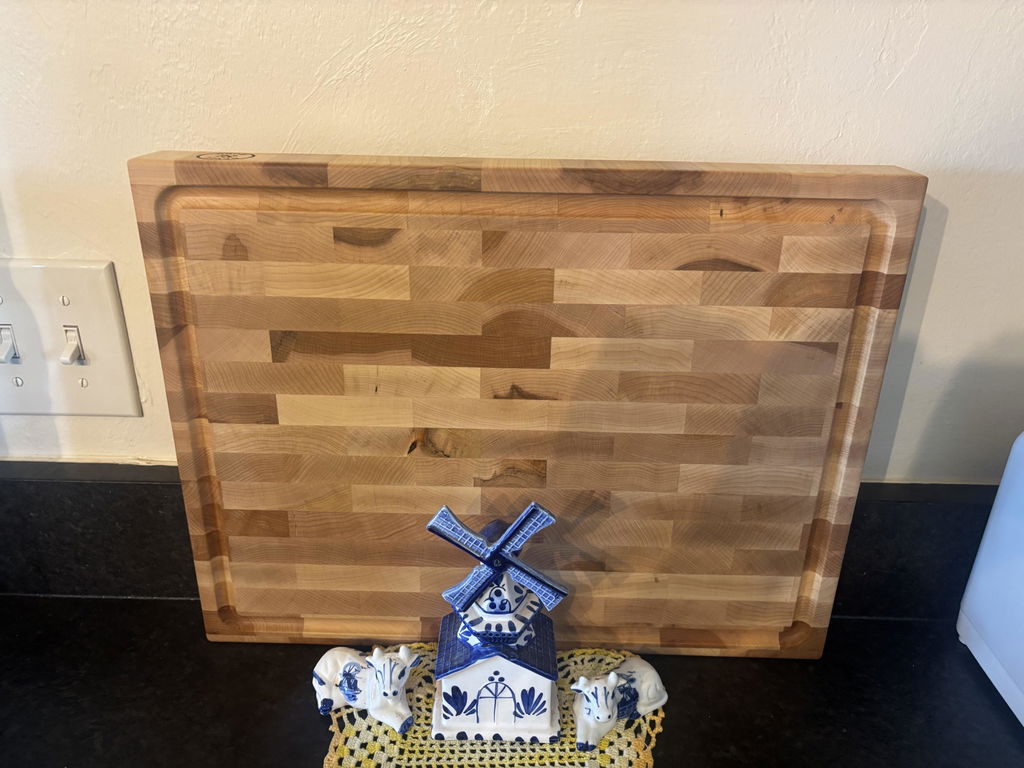
Your cutting board cracks in winter because the air in your house turns bone dry the day the furnace kicks on. Wood is a sponge that never fully stops breathing. When indoor humidity drops to 20 percent, the board gives up moisture faster than you replace it, the fibers shrink, and the end grain splits first.
This can happen to wooden boards, almost always in January, almost always to a customer who oiled diligently all summer and then forgot about it once the holidays hit. The board sat two feet from a heat vent for six weeks, lost a third of its surface moisture, and showed a fine check down the end grain. Good news: if you catch it early, most winter checking is preventable and some of it is repairable.
| What is happening | Why it cracks | What stops it |
|---|---|---|
| Furnace dries indoor air to 15 to 25 percent humidity | Wood loses moisture, fibers shrink, end grain splits | Run a humidifier, target 40 to 50 percent |
| Board stored near a vent or radiator | Localized drying, one side shrinks faster than the other | Move it to a cabinet or a counter away from heat |
| Oiling schedule slips over the holidays | Surface has no barrier, moisture leaves fast | Oil every 2 to 3 weeks in winter instead of the usual monthly |
| Board left wet or lying flat after washing | The down face dries slower than the up face, which sets up internal stress | Towel dry both faces, then stand it on edge with air reaching both sides |

What actually causes a cutting board to crack in winter?
Low indoor humidity, full stop. Your heating system pulls moisture out of the air, and the wood follows the air down. A maple board that was happy at 45 percent humidity all summer suddenly finds itself in a 20 percent room, and it releases water until it reaches a new equilibrium. Releasing water means shrinking, and wood does not shrink evenly. The stress has to go somewhere, so it opens a check, usually along the end grain where the fibers are most exposed.
Cold itself is not the villain. A cool, relatively humid environment may reduce rapid moisture loss, but it does not guarantee that a board will not crack. It is the dry, heated indoor air of a Midwest or Northeast winter that does the damage. If your wood furniture is developing gaps and your lips are chapped by Thanksgiving, your cutting board is drying out at the same rate.
Why does the crack always show up on the end grain?
Because end grain is the open end of thousands of tiny straws, and that is where moisture moves fastest. Our end-grain maple board is built with the wood fibers standing vertical, which is what gives you that hard-wearing, knife-friendly surface. The trade-off is that those open fiber ends drink and release moisture faster than a flat edge-grain face would.
When the board dries, the outer fibers shrink before the core catches up. That difference in movement is exactly the tension that starts a check. Winter cracks may follow grain or glue lines, but the pattern varies with construction, wood movement, moisture, and any defects. It starts at an end, works inward, and follows the grain. If you want the longer version of why grain orientation drives board movement, our guide on why cutting boards warp covers the same physics from the warping angle.
Can you fix a cracked cutting board, or is it done?
It depends on how deep the crack runs. A shallow surface check, the kind you can barely catch a fingernail on, can usually be stabilized: flood it with oil, let it drink for a few days, and the fibers will often swell back nearly closed. Sand lightly with 220 grit, re-oil, and keep it humid. That board has decades left.
A deep crack that runs through a glue joint is a different animal. Once a split opens all the way through the board and follows a glue line, you are looking at a structural failure, not a cosmetic one. You can slow it, but you cannot truly reverse it, and a board that flexes at the crack is done as a food-contact surface. Demote it to a bread board or a plant riser. We walk through the salvage decision in detail in our guide to fixing a cracked board.
How often should you oil a board in winter?
Every 2 to 3 weeks in winter, instead of the monthly schedule a broken-in board gets the rest of the year. Dry air pulls oil and moisture out of the wood faster, so the maintenance interval has to shrink to match. If the surface looks pale, chalky, or lighter than the sides, it was thirsty a week ago.
The test is simple. Flick a few drops of water on the face. If they bead and sit, your finish is intact. If they soak in and darken the wood within a minute, the board is dry and it is time to oil. In a heated house in February, I check my own boards weekly and oil roughly every 18 to 21 days. Our full oiling walkthrough covers the exact method, and the maintenance schedule lays out the whole calendar: weekly for a new board's first month, monthly once it is broken in, every 2 to 3 weeks when the air goes dry, and a deep wax conditioning a few times a year.
Fighting dry winter air is easier with a wax layer on top of the oil. Board Balm puts a beeswax barrier over the mineral oil, and that beeswax slows how fast the board loses moisture between oilings. Think of the oil as hydration and the wax as the raincoat that keeps it in. If your house drops below 30 percent humidity every winter, that wax layer is the simplest insurance you can buy for a board you want to maintain for long-term use.

Where should you never store a wood cutting board?
Never on top of a radiator, leaning against a heat vent, above the oven, or on a windowsill in direct winter sun. Any spot with a concentrated heat source dries one part of the board faster than the rest, and uneven drying is what cracks wood. I have seen a board warp into a taco shape because it lived on a shelf directly above a baseboard heater.
Store it standing on edge in a rack, somewhere with normal room air, so both faces breathe at the same rate. A kitchen cabinet is fine. The counter is fine, as long as it is not the eighteen inches directly above a heat register. If you can feel warm air moving where the board sits, move the board.
Does a humidifier really help?
Yes, more than any single thing you can do. A cutting board is just responding to the air around it, and a humidifier changes that air. Getting a dry winter room from 20 percent up to 40 percent humidity slows the board's moisture loss dramatically, and it happens to be better for your sinuses, your houseplants, and your wood floors too.
You do not need to aim the humidifier at the board. A single unit running in the kitchen or an open-plan living space is enough to lift the whole room. An inexpensive hygrometer costs about 12 dollars and takes the guesswork out. If it reads under 35 percent, your board is drying, visible or not.
How cold does it have to be for a board to crack?
Temperature is not the trigger, humidity is. A board can crack at a comfortable 70 degrees indoors if that air is bone dry from forced-air heat. What matters is the moisture content of the air around the wood, not the number on the thermostat. That is why cracking is a January and February problem in heated homes, not an outdoor-in-the-cold problem.
Will a hairline crack get worse if I ignore it?
Usually, yes. A hairline check is the wood telling you it is dry, and if you keep it dry it will keep opening. The fix is not complicated: oil it heavily, keep the room humid, and watch it. Caught in the first week, most hairline checks stabilize and some close up almost entirely. Ignored for a season, a hairline can become a structural split.
Can Board Balm help reduce the risk of winter cracking?
It helps, though it is not magic. Board Balm's beeswax layer slows moisture loss, which is exactly the mechanism behind winter checking, so a well-waxed board holds its moisture longer in dry air. It does not replace humidity control or regular oiling. Use all three together: oil for hydration, wax for the barrier, humidifier for the room. That combination is what keeps a maple board intact through a hard winter.
Is a cracked board still food safe?
A shallow surface check that you have cleaned, sanded, and re-oiled is fine to keep using. The concern with any crack is a deep crevice that traps food and water and will not dry out, which is a place bacteria can settle. If the crack is tight, shallow, and stays dry, keep cooking on it. If you can pack a crumb into it and it stays damp, retire that board from raw meat and produce prep.
Should I move my board somewhere more humid?
You do not need to relocate the board, you need to fix the air where it already lives. Moving a board from a dry kitchen to a damp basement just trades one problem for another and invites mold. Keep the board in the kitchen, run a humidifier to hold the room near 40 to 50 percent, oil on the winter schedule, and the board will be fine right where it is.
When was this article last reviewed?
This article was last reviewed in July 2026 by the Bevel & Bond workshop team. We revisit our care guides against what we see coming back through customer service and our own bench, and we update them when the advice changes.
A hard maple board is a 20-year tool if you treat the winter seriously. Keep it oiled, keep the room above 40 percent humidity, and keep it away from the heat vents. If you are ready for a board built to survive it, our end-grain maple cutting board arrives conditioned with Board Balm, and you can see the full lineup in our collection.