Buy maple for daily knife work. Hickory is harder and tougher, and if you want a board that survives a cleaver and a decade of abuse it is a real option, but at 1,820 lbf it is harsh on knife edges and heavy enough to earn a spot in the gym.
Hickory is the wood of axe handles, hammer shafts, and smokehouse chips. It is one of the toughest domestic hardwoods you can buy, and that reputation makes people assume the hardest wood must make the best board. Hardness helps a board resist gouging, but past a certain point it starts working against the thing you actually do on a board, which is cut with a sharp knife.
| Wood | Janka hardness | Grain type | Knife-friendliness | Stability | Typical price |
|---|---|---|---|---|---|
| Hard maple | 1,450 lbf | Closed, tight | Excellent | Very stable | $$ |
| Hickory | ~1,820 lbf | Closed but coarse | Harder on edges | More seasonal movement | $$ |

Is hickory too hard for a cutting board?
For daily knife work, yes, hickory is harder than it needs to be. At roughly 1,820 lbf it sits about 370 points above hard maple, and that extra hardness does not make it a better cutting surface. A board wants enough hardness to shrug off gouges and enough give to let the edge settle a hair instead of skidding. Maple's 1,450 hits that balance. Hickory pushes past it, so the wood pushes back on your knife instead of yielding to it. The Janka scale explainer covers why higher is not automatically better.
Does hickory dull knives faster than maple?
Yes. A harder surface gives the edge less to sink into, so each cut lands the blade against firmer wood and rolls or wears the edge a little sooner. Over a week of prep the difference is real: a hickory board sends you to the honing steel more often than a maple one. Maple at 1,450 is firm enough to last for years and soft enough to spare the edge. That is the whole reason it became the default for professional kitchens, not tradition for its own sake.
Is hickory tougher than maple?
Yes, and this is where hickory genuinely wins. Toughness is resistance to impact and splitting, which is a different property than hardness, and hickory is exceptional at it. That is why it goes into tool handles that get swung all day. If you are breaking down bone-in cuts with a cleaver or want a board that laughs off a dropped stockpot, hickory's impact resistance is a real advantage. For slicing tomatoes and mincing garlic, that toughness is capability you paid for and will not use.
Is hickory heavier than maple?
Noticeably, yes. Hickory is one of the denser domestic hardwoods, so a hickory board of the same size can outweigh a maple one by a meaningful margin. A heavy board stays put on the counter, which some cooks like. It is also the board you curse when it is time to lift it to the sink, dry both faces, and set it back. Maple gives you a board that is stable and stout without turning cleanup into a workout.
Does hickory move more than maple?
Yes, hickory is more prone to seasonal movement. It responds to humidity swings more than hard maple, which means more tendency to cup or check as the seasons turn if care slips. Maple is one of the more dimensionally stable domestic hardwoods, a big reason it became the standard for butcher blocks. A board that stays flat stays safe under the knife, and maple stays flatter with less coaxing.

Which should most cooks buy?
Most cooks should buy maple. Hickory earns its place if you are doing heavy, impact-driven work and want maximum toughness, and you accept a heavier board and quicker knife wear as the cost. For everyday slicing, dicing, and carving, maple's balance of hardness, stability, and edge-friendliness makes it the smarter daily driver.
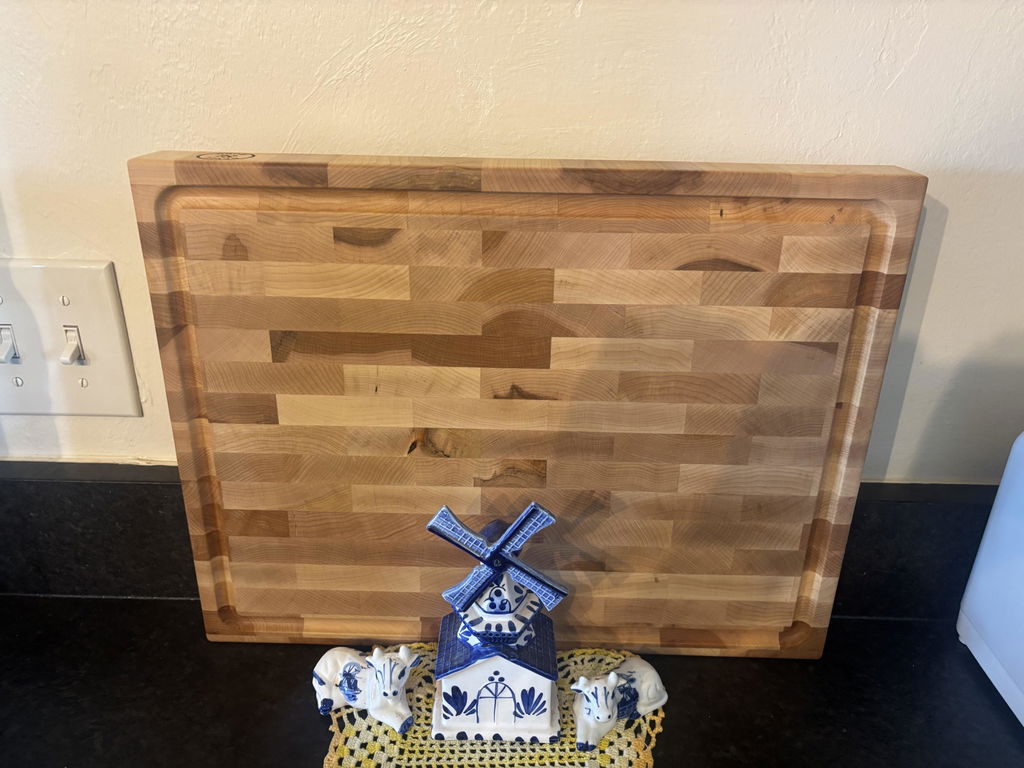
Our End-Grain Maple Cutting Board is hard maple chosen for that balance: 17 by 13 by 1.75 inches, food-safe PVA glue, made in the USA, a 5-year warranty, and a tin of Board Balm in a black gift box. The end-grain construction lets knife edges settle between the wood fibers instead of across them, which is gentler still on your blades. See the case for it in our end grain versus edge grain breakdown.
Is hickory a good wood for cutting boards?
It is a good wood for the right job. Hickory is food-safe, closed-grain enough for sanitary use, and extremely durable, so it makes a legitimate heavy-duty board. Its drawbacks are practical: it is hard on knife edges, heavy to handle, and moves more with the seasons. For a butcher-style board that takes cleaver work, hickory is a fair pick. For a general kitchen board you reach for every day, maple is the more forgiving choice.
Will hickory ruin my good knives?
Ruin is too strong, but hickory will dull them faster than a softer board. A harder surface returns more force to the edge with every cut, so a Japanese gyuto or a thin high-carbon blade you keep scary-sharp will lose that edge sooner on hickory than on maple. If you have invested in good knives, give them a surface that meets them halfway. Maple at 1,450 is that surface.
Does hickory need more maintenance than maple?
Somewhat, because of its greater seasonal movement. Any wood board wants regular oiling, but hickory's tendency to react to humidity means you want to stay ahead of it with a consistent schedule to keep it flat. A monthly coat of a food-grade mineral oil and beeswax conditioner like Board Balm, applied per our oiling guide, slows moisture exchange on either wood. Hickory is less forgiving if you let the routine lapse.
Is hickory more expensive than maple?
They run in a similar range, and price is not the deciding factor here. Depending on your supplier hickory can land close to hard maple, so you are not saving meaningfully by choosing it, and you are not paying a big premium either. Since cost is roughly a wash, the choice comes down to use: maple for daily knife work, hickory only if you specifically want the extra toughness for heavy jobs. Our best wood for cutting boards guide has the wider comparison.
When was this article last reviewed?
This article was last reviewed in July 2026 by the Bevel & Bond workshop team, who build and finish hard maple boards by hand and keep this guidance current with what they see on the bench.
If your board's main job is holding still while a sharp knife does the work, maple is the pick that respects your edges and your wrists. See the End-Grain Maple Cutting Board or browse the full collection.