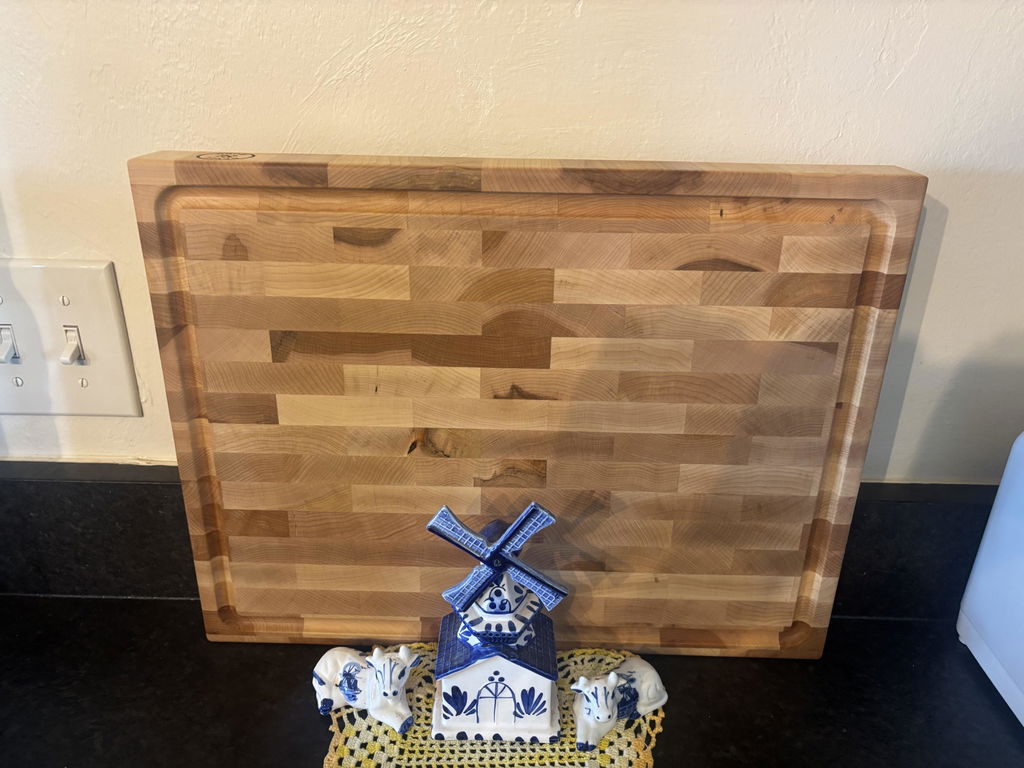
Buy the maple board. Beech is the less expensive, softer wood that historically filled kitchen drawers, but it swells and warps with humidity in a way hard maple does not, and that difference shows up after a year of real use.
Beech and hard maple look like cousins. Both are pale, closed-grain hardwoods that have been turned into spoons, bowls, and boards for centuries. The specs sit close on paper. The gap opens up in your kitchen, where a board lives near a sink, a dishwasher's exhaust, and a stove that swings the room from dry to humid twice a day.
| Wood | Janka hardness | Grain type | Knife-friendliness | Stability | Typical price |
|---|---|---|---|---|---|
| Hard maple | 1,450 lbf | Closed, tight | Excellent | Very stable | $$ |
| American beech | ~1,300 lbf | Closed | Good | Moves with humidity | $ |

If beech appealed on price, it's worth seeing how olive wood cutting boards compare — they behave very differently in a kitchen.
Which wood is harder, maple or beech?
Hard maple is harder, at 1,450 lbf on the Janka scale versus roughly 1,300 for American beech. That 150-point gap is small in the grand scheme, and both woods land in the sweet spot for a cutting surface: hard enough to resist gouging, soft enough that they do not chew up your knife edge. If hardness were the only question, this would be close to a coin toss. It is not the only question. For the full picture of what these numbers mean, see our Janka scale explainer.
Before choosing on price, check what a warranty actually covers — often the real difference.
Does beech warp more than maple?
Yes, and this is the real reason to skip it. American beech is notably reactive to humidity swings, meaning it takes on and gives off moisture faster than maple and moves as it does. A beech board left near a dishwasher vent or oiled on a schedule that slips can cup, and once a board cups it rocks under your knife. Hard maple is one of the more dimensionally stable domestic hardwoods, which is a large part of why it became the standard for butcher blocks and bowling lanes. Stable wood stays flat, and flat wood is safe wood.
Is beech grain open or closed?
Beech has closed grain, and that is a point in its favor. Closed grain means fewer open pores for moisture and food particles to settle into, which keeps the surface more sanitary and easier to clean than a ring-porous wood like oak or ash. Maple shares this closed-grain trait. So on grain structure the two are evenly matched, and both beat open-grain woods for kitchen duty. The tiebreaker goes back to stability, not pores.

Which is gentler on knife edges?
Maple and beech are both kind to knives, with maple holding a slight edge at 1,450 lbf against beech's 1,300. Hard maple's 1,450 rating is the widely cited target for a knife-friendly board: firm enough to last, giving enough to let the edge sink a hair instead of skating and dulling. Beech at 1,300 is a touch softer, which is fine, but softer wood also shows knife scarring and stains sooner. Maple's tighter, more uniform fibers tend to recover better from a season of chopping.
Is beech cheaper than maple?
Yes, and this is beech's one honest advantage. Beech usually costs less than hard maple because it is abundant and carries less figure, so if the only number you care about is the sticker, beech wins. The question is what you are buying with the savings: a board that needs more diligent oiling and a more controlled spot in the kitchen to stay flat. If you want a full rundown of the contenders, our guide to the best wood for cutting boards lays them out.
Which should most cooks buy?
Most cooks should buy hard maple. Beech makes sense if budget is the hard limit and you are diligent about care. For everyone else, the small premium for maple buys stability, stain resistance, and a surface that stays flat through years of humidity swings without a second thought.
Our End-Grain Maple Cutting Board is built from hard maple for exactly these reasons: 17 by 13 by 1.75 inches, food-safe PVA glue, made in the USA, backed by a 5-year warranty, and shipped with a tin of Board Balm in a black gift box. End grain adds hard-wearing to maple's stability, and you can read why in our breakdown of end grain versus edge grain.
Is beech wood safe for cutting boards?
Yes. Beech is food-safe and has a long history as kitchenware, spoons, and butcher surfaces across Europe. There is nothing toxic or unsanitary about it, and its closed grain cleans up well. The knock on beech is mechanical, not chemical: it moves more than maple. Kept oiled and away from heat and standing water, a beech board serves fine. It simply asks for more attention to stay flat.
How do I keep a beech or maple board from warping?
Oil it on a schedule, dry it standing on edge, and keep it away from heat and soaking water. Warping happens when one face gains or loses moisture faster than the other, so the goal is to keep moisture balanced across the board. A monthly coat of a food-grade mineral oil and beeswax conditioner like Board Balm slows moisture exchange, and never leaving a board flat in a puddle or in the dishwasher does the rest. Our oiling guide walks through it. Beech needs this routine more than maple does.
Does beech stain more easily than maple?
Yes, somewhat. Beech is a shade softer and slightly more absorbent than hard maple, so beet juice, turmeric, and red wine sink in a little faster and linger a little longer. Maple's tighter fibers and natural stain resistance shrug those off better. Neither wood is stainproof, and a well-oiled surface on either resists color far better than a dry one.
Will a beech board last as long as maple?
With equal care, maple will usually outlast beech. Both are durable hardwoods that can serve for years, but beech's greater seasonal movement means more chances to cup, crack, or open a glue joint over a long life. Maple's stability gives it a longer safe working life with less fuss. A neglected maple board still outlasts a neglected beech board.
When was this article last reviewed?
This article was last reviewed in July 2026 by the Bevel & Bond workshop team, who build and finish hard maple boards by hand and keep this guidance current with what they see on the bench.
If you want one board that stays flat, stays clean, and stays kind to your knives without a maintenance calendar taped to the cabinet, start with hard maple. See the End-Grain Maple Cutting Board or browse the full collection.