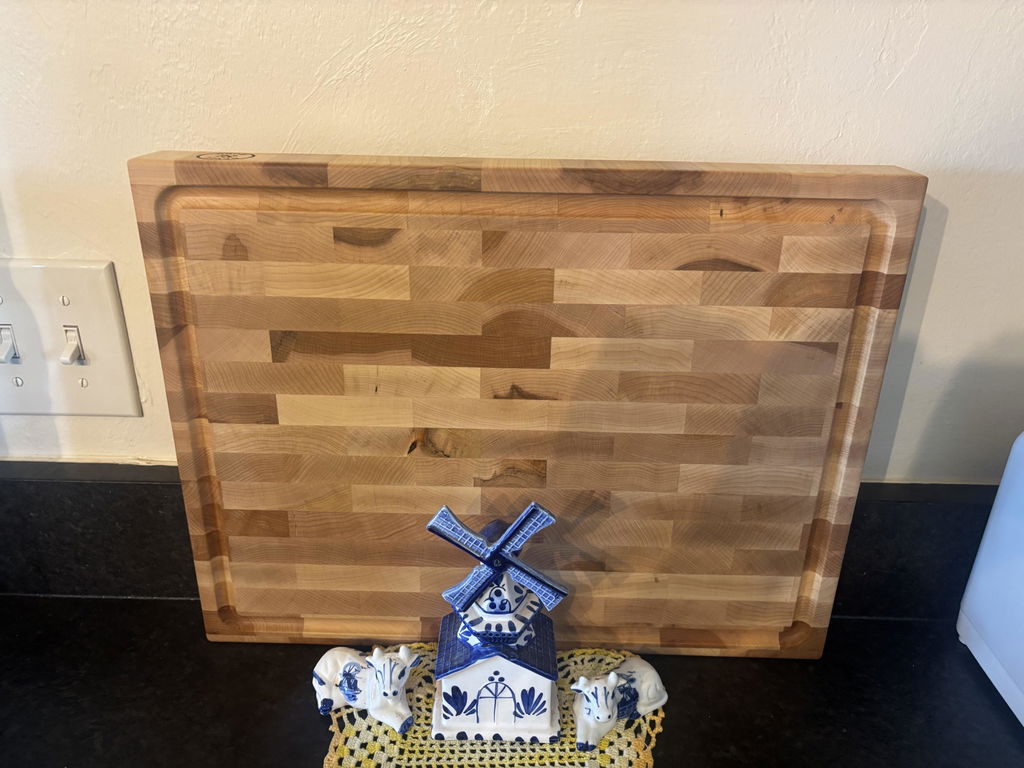
Buy maple. Ash is a handsome, springy, light-colored wood with a similar hardness, but its open, ring-porous grain traps moisture and food particles the way oak does, and that is exactly what you do not want in the surface you cut raw chicken on.
Ash and maple are close on the numbers that get quoted in product listings. Both are pale, both are hard enough, both are strong. The difference that matters is not on the spec sheet in bold. It is in the grain structure, and grain structure is what decides how a board cleans up after a messy dinner and how it holds up over years of washing.
| Wood | Janka hardness | Grain type | Knife-friendliness | Stability | Typical price |
|---|---|---|---|---|---|
| Hard maple | 1,450 lbf | Closed, tight | Excellent | Very stable | $$ |
| White ash | ~1,320 lbf | Open, ring-porous | Good | Stable but porous | $$ |

Ash and beech get confused constantly because both are pale and mid-priced. Beech vs maple covers the one actually worth buying.
Does open grain matter for a cutting board?
Yes, it matters more than hardness does. Open, ring-porous grain means the wood has visible pores running through it, and those pores are open channels for moisture, juice, and food particles to work into the surface. On a cutting board, where you are dragging raw meat juices and vegetable pulp across the wood daily, those channels are a place for liquid to sit and for cleaning to fall short. Maple's closed grain has no such channels, so it wipes cleaner and dries more completely. That is the whole argument in one paragraph.
Hickory is the other coarse-grained hardwood people ask about, and it fails for the opposite reason ash does — is hickory good for cutting boards?
What is ring-porous grain?
Ring-porous means the wood grows large pores in a ring each season, the way oak and ash do. When you slice into or across that grain you expose those pores at the surface, and they read as tiny open holes. It is the same structure that makes oak beautiful for furniture and a poor choice for a raw-food surface. White ash shares this trait with red oak. Hard maple is diffuse-porous with pores so small and evenly scattered that the surface reads as closed and smooth, which is what you want under a knife and a sponge.
Is ash harder than maple?
No, ash is slightly softer, at roughly 1,320 lbf against maple's 1,450. That gap is small and neither wood is too soft for kitchen duty, so hardness is close to a tie. If ash and maple were both closed-grain, this would be a genuinely tough call. They are not, and the grain difference decides it. Read more on what these ratings actually predict in our Janka scale explainer.
Is ash harder to keep clean than maple?
Yes, its open pores ask for more diligent cleaning and sealing. Ring-porous grain can be more difficult to clean and maintain than a tight, closed-grain surface, so an ash board wants more careful scrubbing and a more consistent oiling and sealing routine to keep those pores filled and protected. Skip a few oilings on maple and you have a dry board. Skip them on ash and you have open pores drinking in whatever you last cut. Our oiling guide applies to both, but ash is less forgiving of a lapse.
Which is gentler on knives?
Maple and ash both treat knives well, though maple is the more consistent of the two. Ash is springy and a touch softer, which is easy on a blade, but its alternating bands of hard and soft grain wear unevenly and can feel less uniform under the knife over time. Maple's even, diffuse pores give a consistent surface that stays smooth and predictable cut after cut. Neither wood will wreck an edge. Maple simply offers a more uniform cutting feel.

Which should most cooks buy?
Most cooks should buy maple. Ash is a fine-looking wood and reasonable for a decorative or low-contact board, but for a working surface that meets raw food every day, its open grain is a liability that no amount of good looks offsets. Maple's closed grain, stain resistance, and stability make it the surface you do not have to think about.
Our End-Grain Maple Cutting Board is hard maple, chosen for that tight closed grain: 17 by 13 by 1.75 inches, food-safe PVA glue, made in the USA, a 5-year warranty, and a tin of Board Balm in a black gift box. End grain gives you a hard-wearing surface on top of maple's tight grain, and our end grain versus edge grain piece explains why that matters.
Is white ash safe for cutting boards?
White ash is food-safe as a material, but its open grain is a hygiene compromise. Ash itself contains nothing toxic and has been used for tool handles and furniture for generations. The concern is the ring-porous structure, which gives moisture and food particles somewhere to hide and makes thorough cleaning harder than on a closed-grain board. Kept meticulously sealed and reserved for lighter tasks, an ash board can serve. For raw meat and heavy daily prep, closed-grain maple is the safer surface.
Can you seal ash to close the grain?
Oiling and conditioning fill the pores and help, but they do not turn open grain into closed grain. A good food-safe oil and a wax conditioner like Board Balm penetrate and sit in ash's pores, which reduces how much moisture the surface takes on and makes cleaning easier. That finish wears with use and washing, though, so it needs faithful reapplication to keep working. You are managing the open grain, not eliminating it. With maple there is far less to manage.
Does ash stain more than maple?
Yes, because its open pores hold pigment. Colored juices like beet, turmeric, and red wine settle into ring-porous grain and are harder to scrub back out than they are on maple's smooth closed surface. Maple's natural stain resistance and tight fibers keep color on top where a wipe can catch it. A well-oiled ash board resists staining better than a dry one, but it still gives color more places to lodge.
Is ash a good choice for any board?
Ash is a reasonable choice for a decorative or low-contact board, where looks lead and raw food rarely touches it. Ash's pale color, bold grain, and springy strength make it attractive for serving boards, trivets, or a board used mostly for bread and cheese. The moment the board's real job is daily knife work on raw ingredients, the open grain becomes a drawback and maple is the better tool. Match the wood to the work, and see our best wood for cutting boards guide for the full field.
When was this article last reviewed?
This article was last reviewed in July 2026 by the Bevel & Bond workshop team, who build and finish hard maple boards by hand and keep this guidance current with what they see on the bench.
If the board is going to meet raw food every day, closed grain isn't a nice-to-have, it's the point. Start with hard maple: see the End-Grain Maple Cutting Board or browse the full collection.