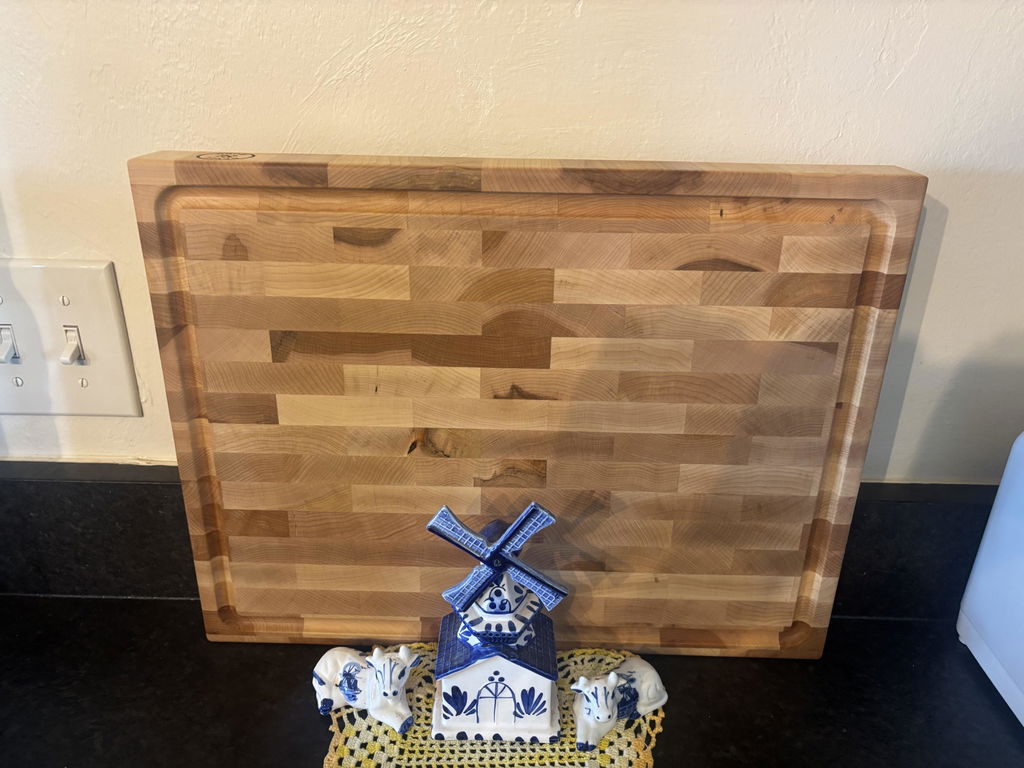
For a thick maple cutting board with a juice groove, buy a 1.75-inch end-grain hard maple board with a routed channel and non-slip feet. Our pick is the Bevel & Bond End-Grain Maple Cutting Board. At 17 by 13 by 1.75 inches and 10 pounds, it has the mass to sit flat and the depth to hold a real groove.
Most boards ship at 1.5 inches, and budget boards land at 0.75. Those numbers matter more than the photos suggest, because thickness is what keeps a board flat and what makes a juice groove worth cutting. Here is how the two features work together, and when each earns its place.
What thickness should a maple cutting board with a juice groove be?
A juice-grooved maple board should be 1.75 inches thick. That extra quarter inch over the standard 1.5 gives the board mass to resist warping and depth to hold a routed channel without weakening the surface. Cut a groove into a thin board and you remove wood the board cannot spare.
A juice groove is a channel routed around the cutting surface, roughly a quarter inch deep, that catches liquid running off a roast. That channel comes out of the board's thickness, so a 0.75-inch board has almost nothing left under it while a 1.75-inch board keeps well over an inch of solid maple below the deepest point.
Why does 1.75 inches beat the standard 1.5?
Mass and stability. A 1.75-inch end-grain maple board weighs around 10 pounds, and that weight fights the two things that ruin boards: movement while you work and cupping over the years. Heavier boards stay put and stay flat.
Wood moves as it takes on and gives off moisture, and a thicker slab has more material resisting that movement. The 1.75-inch build also feels different under a knife. It does not skate or flex, and it takes a heavy chef's knife through a butternut squash without a hint of bounce.
| Feature | 0.75 inch | 1.5 inch | 1.75 inch |
|---|---|---|---|
| Stability under a knife | Slides and flexes | Solid | Rock solid |
| Warp resistance | Poor | Good | Best in class |
| Juice groove depth possible | Too shallow to trust | Workable | Full quarter-inch channel |
| Heft | 2 to 3 lbs | 6 to 8 lbs | 10 lbs |
For the full breakdown on how thickness changes daily performance, read our cutting board thickness guide. For the shortlist of boards worth the money this year, see our best maple cutting board picks for 2026.

When does a juice groove earn its keep, and when does a flat board win?
A juice groove earns its keep for wet, drippy work: carving roasts, slicing steak off a rested cut, halving juicy tomatoes and citrus. A carved prime rib can shed a third of a cup of juice, and the groove pools it where you can spoon it into a pan for gravy instead of mopping it off the floor.
For dry work, a flat board wins. Dice an onion and sweep the pile toward a pan, and the groove is a speed bump that catches the pieces at the edge. Same with slicing a crusty loaf, where crumbs drop into the channel every stroke. Our take: a serious kitchen runs both, but if you own one board, a grooved 1.75-inch maple board covers more of what actually spills. The reasoning behind both sides is in our guide to juice groove versus flat boards.
Why does a juice groove belong on a thick board?
Because the groove is cut into the board's mass, and a thin board cannot spare the wood. Routing a quarter-inch channel into a 0.75-inch board leaves half an inch of material under the deepest point, on a board already prone to flexing. That is how you get a weak spot and a cupped board.
On a 1.75-inch board, the same channel leaves roughly 1.5 inches of solid end-grain maple below it. This is why we do not build grooves into thin boards and why we distrust budget boards that advertise both a thin profile and a deep groove. Something has to give, usually the flatness.
Looking for a thick maple board with a juice groove that will not cup? The Bevel & Bond End-Grain Maple Cutting Board is 1.75 inches of North American hard maple with a routed groove, deep finger grips, and non-slip feet, priced at $129.99 with a 5-year warranty. Shop all boards.
How does the Bevel & Bond board compare to other maple boards?
It is thicker than almost everything in its price class. Bevel & Bond runs 1.75 inches against the 1.5 inches from John Boos and Sonder LA, and the 0.75 inches from Virginia Boys. That quarter inch is the difference between a board that holds a real groove and one that compromises.
John Boos builds a solid 1.5-inch board with a long reputation, and Sonder LA's Alfred is a handsome 1.5-inch board that costs more than ours. Virginia Boys sits at 0.75 inches, fine for light prep but too thin for a deep groove or heavy carving. Bevel & Bond is North American hard maple, Acer saccharum, end-grain double glue-up, with the mass to stay flat and a 5-year warranty most of the category does not offer.
What should you look for before buying a grooved maple board?
Four things: thickness of at least 1.75 inches, true hard maple, end-grain construction, and non-slip feet that keep the board planted and lift it to dry. Thickness gives you flatness and groove depth. Hard maple gives you a knife-friendly surface at a Janka hardness around 1,450 lbf, durable for kitchen work while remaining gentler on knife edges than glass or stone.
Watch the species claim. Plenty of boards labeled "maple" are soft maple, beech, or birch, so look for the named species, Acer saccharum. End-grain construction stands the fibers up like a bundle of straws, so the knife meets the ends of the fibers rather than crossing them, and the surface scars less. The Bevel & Bond ships hand-finished with Board Balm, ready to use out of the black gift box.
Does a juice groove make a board harder to clean?
No, not meaningfully. Wash the board by hand with warm water and mild soap, and run a sponge around the channel the same as the flat surface. The groove is a smooth routed curve, not a sharp corner, so food does not pack into it. Never put a maple board in the dishwasher, grooved or not, because the heat and standing water will cup and crack it.
How deep is the juice groove on the Bevel & Bond board?
The groove is a routed channel roughly a quarter inch deep, sized to catch the runoff from a carved roast without cutting into the board's strength. On the 1.75-inch build, that leaves about 1.5 inches of solid maple beneath the channel, so the board loses none of its rigidity.
Can you use both sides of a board with a juice groove?
The grooved face is the working surface, and the back is flat. Many cooks use the flat back for dry prep like slicing bread or sweeping chopped vegetables into a pan, then flip to the grooved side for carving. A 1.75-inch board is heavy enough to feel planted on either face.
Is 1.75 inches overkill for a home kitchen?
No. The extra thickness buys you flatness over a decade and the depth to hold a real juice groove. A thinner board saves a little shelf space, then repays you with cupping and a shallower groove. For a substantial, repairable main board, 1.75 inches is a practical thickness.
When was this article last reviewed?
This article was last reviewed in July 2026. Product specifications, pricing at $129.99, and the 5-year warranty were current as of that date.
Want a thick maple board with a juice groove designed for stability and durable service? The Bevel & Bond End-Grain Maple Cutting Board is 1.75 inches of American hard maple, finished and ready to carve. Shop all boards and choose a board built for durable, repairable service.